
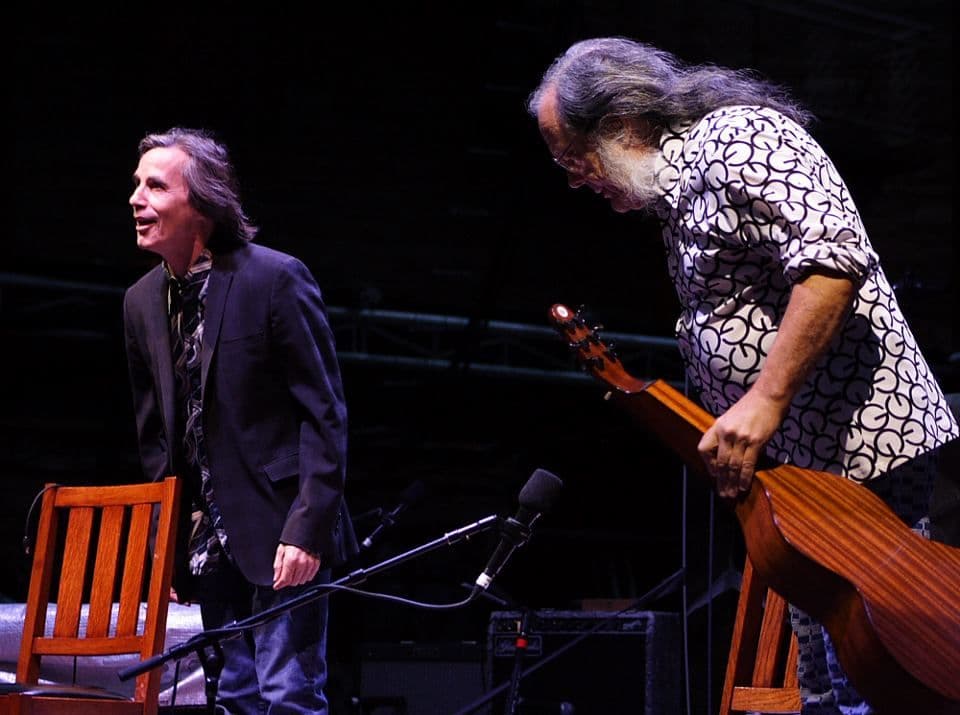
Mercury Blues — a road-worn celebration of freedom, machines, and the restless American soul
There is a special kind of joy that lives inside “Mercury Blues” when performed by Jackson Browne & David Lindley — not polished, not carefully contained, but loose, laughing, and alive with the sound of the open road. This is not a song that seeks chart positions or radio dominance. Instead, it taps into something older and deeper: the romance of motion, the bond between man and machine, and the quiet defiance of choosing freedom over comfort.
Important context first: “Mercury Blues” is a classic American blues song written and first recorded by K.C. Douglas in 1948. Over the decades, it became a traveling tune, passed hand to hand, voice to voice, reshaped by each generation that picked it up. The version most closely associated with Jackson Browne & David Lindley emerged through live performances in the mid-1970s, particularly during the era surrounding Browne’s landmark album Running on Empty (1977). Their rendition was never released as a charting single and did not appear on Billboard rankings — but its cultural footprint far outweighs any numerical success.
What makes their performance unforgettable is not reinvention, but understanding. Browne and Lindley didn’t polish the song into something new; they leaned into its bones. Lindley’s slide guitar — playful, snarling, and joyously unrestrained — becomes the engine of the track. It growls and laughs in equal measure, while Browne steps back, letting the groove breathe. This was a rare moment where ego disappeared and pure musical camaraderie took over.
The song itself is deceptively simple. On the surface, “Mercury Blues” is about a car — a Mercury automobile — and the desire to leave town, leave troubles behind, and drive until the horizon runs out. But beneath that simplicity lies a powerful metaphor. The Mercury is not just a vehicle; it is independence. It is speed as escape. It is the promise that no matter how heavy life feels, there is always a road waiting.
When Browne and Lindley played the song together, it carried the spirit of musicians who had spent countless nights traveling — not just physically, but emotionally. By the mid-1970s, Jackson Browne was already known for his introspective songwriting, his ability to turn personal reflection into shared experience. David Lindley, on the other hand, was a musical shape-shifter — fluent in blues, folk, world music, and rock — a player who understood instinctively when to push and when to let go.
That contrast is what gives their “Mercury Blues” such electricity. Browne provides the grounding presence, while Lindley lights the match. There’s laughter in the music, an almost mischievous joy, as if they both knew they were stepping outside the seriousness that often defined Browne’s catalog — and relishing it.
For listeners who have lived long enough to remember when cars meant possibility rather than congestion, this song hits a special nerve. It recalls a time when turning the key felt like opening a door to another life. When the road ahead wasn’t measured in miles, but in hope. The blues here aren’t sorrowful — they are liberating. They say: I’ve been weighed down, yes, but I can still move.
Later versions of “Mercury Blues” — most notably the hit by the Steve Miller Band decades afterward — would climb charts and reach mainstream success. But Browne and Lindley’s take remains something purer, more intimate. It belongs to smoky stages, late-night drives, and memories that surface without warning.
In the end, “Mercury Blues” as performed by Jackson Browne & David Lindley is less a song than a moment caught in motion. A reminder that sometimes music doesn’t need to explain itself. It just needs to roll forward, windows down, guitar singing, heart light — trusting the road to do the rest.