
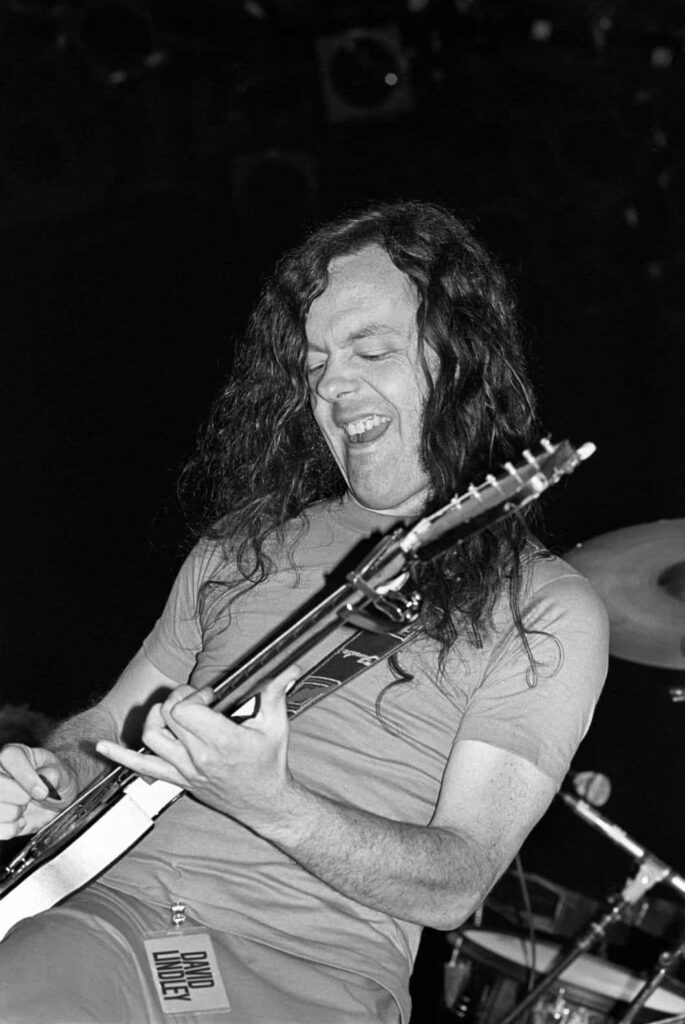
Mercury Blues — the roar of an engine, the wild freedom of youth, and the unmistakable joy of David Lindley’s touch
There’s a spark of electricity the moment David Lindley launches into “Mercury Blues.” It’s the kind of spark that wakes old memories — dusty highways at sunset, radios humming warm and bright, the world wide open in front of you. Though the song itself was first written back in 1949 by K.C. Douglas and Robert Geddins, Lindley’s 1981 version on his album El Rayo-X gave it a new life, a fiery new color. His rendition didn’t chase the charts; it didn’t need to. Instead, it carved out a space of its own — a cult favorite, beloved by musicians, cherished by fans who understood just how rare Lindley’s musical magic was.
In the early ’80s, when genres were beginning to blur and the California sound was shifting, Lindley stepped forward with something beautifully raw. His slide guitar playing on “Mercury Blues” didn’t just decorate the track — it defined it. With every bend, every shimmering streak of steel against string, he turned the song into a fast-driving, heart-liberating anthem. His vocal delivery carried a relaxed humor, the kind of knowing grin someone wears when recalling wild nights and younger days. And oh, that groove — loose, gritty, joyful — the kind that makes even an old soul tap their foot.
For listeners who lived through that era, or for those who simply remember when cars weren’t just machines but symbols of independence, the song carries a special resonance. A Mercury wasn’t merely a car — it was a badge of pride, a promise of speed, a soft seat where dreams took shape. Lindley understood that feeling. You can hear it in the way he drags a note just long enough to remind you of the wind through the window, the hum of tires on warm pavement.
Behind the scenes, Lindley approached El Rayo-X with a sense of playful rebellion. He never sought the spotlight the way other guitar heroes did. Instead, he built a world where music came first — joyful, quirky, unpretentious. “Mercury Blues” became the shining centerpiece of that world, one that showcased not only his technical brilliance but also his rare ability to let music breathe, dance, and smile. It’s no wonder the song became a calling card for new fans discovering him — and a treasure for those who already knew.
The years have only strengthened the track’s charm. For older listeners especially, the song is a gentle rewind to a time when life felt a bit wilder, a bit freer. It reminds us of the thrill of driving with no destination, of nights when laughter spilled out of open car doors, of friendships forged under neon lights and wide, forgiving skies. Lindley’s version preserves that freedom — not loud or boastful, but full of good-natured swagger.
What gives the song its lasting meaning isn’t the horsepower or the humor. It’s the spirit behind it: a celebration of movement, joy, and the simple pleasure of being alive behind a wheel. Lindley, with his unmistakable tone and playful soul, turns “Mercury Blues” into a tribute not only to a car but to the feeling of possibility that once lived in all of us.
So when the opening riff rings out, let it take you back — to the long road, the open air, and the laughter of days that still glow warmly in memory. David Lindley’s “Mercury Blues” is more than a cover; it’s a reminder that some joys never fade. They just keep rolling on.