
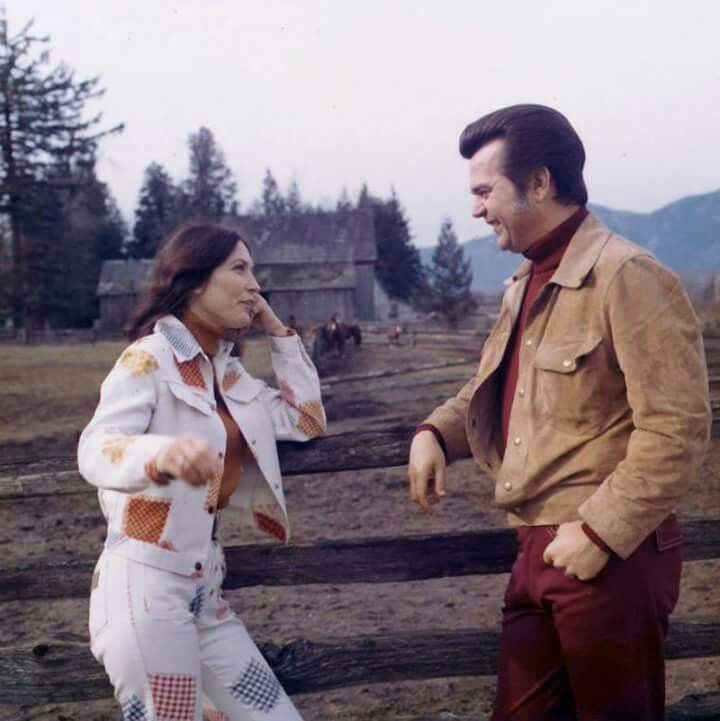
A love that runs faster than the river—“Louisiana Woman, Mississippi Man” captures the urgency of passion divided by distance yet bound by destiny.
When Conway Twitty and Loretta Lynn released “Louisiana Woman, Mississippi Man” in 1973, they weren’t just adding another duet to their already remarkable catalog—they were distilling the very essence of country music’s storytelling tradition into under three minutes of irresistible rhythm and chemistry. The song quickly climbed to No. 1 on the Billboard Hot Country Singles chart, reinforcing the duo’s status as one of the most beloved partnerships in the genre’s history. At a time when country music thrived on authenticity and emotional clarity, this record felt both immediate and timeless.
Written by Becky Bluefield and Jim Owen, the song draws its power from a simple but evocative premise: two lovers separated by the mighty Mississippi River, each rooted on opposite banks—one in Louisiana, the other in Mississippi. Yet what could have been a quiet lament becomes, in the hands of Twitty and Lynn, something far more spirited. The tempo is brisk, almost urgent, mirroring the impatience of two hearts unwilling to accept geography as fate. The river, often romanticized in American songwriting, becomes here a barrier to be challenged rather than admired.
What makes “Louisiana Woman, Mississippi Man” endure is not just its narrative, but the unmistakable interplay between its performers. Conway Twitty, with his smooth, commanding baritone, brings a grounded confidence to the male perspective, while Loretta Lynn counters with a voice that is both playful and resolute. Together, they create a dialogue that feels lived-in—less like a performance and more like an overheard conversation between two people who know each other all too well. Their chemistry had already been proven in earlier hits like “After the Fire Is Gone”, but here it feels sharpened, more spontaneous, almost electric.
Behind the scenes, the success of the song also reflects the broader arc of their partnership. By 1973, Twitty and Lynn had become a reliable force in country music, regularly delivering chart-topping duets that balanced traditional themes with contemporary appeal. Yet their collaboration was never merely commercial. There was a natural ease between them—an understanding of phrasing, timing, and emotional nuance—that elevated even the simplest material. This track, with its vivid imagery and conversational structure, provided the perfect canvas.
Lyrically, the song speaks to a universal tension: the push and pull between obligation and desire, between where one belongs and where one longs to be. The Mississippi River is not just a physical divide—it symbolizes all the distances people must navigate in love, whether imposed by circumstance, family, or life itself. And still, the refrain insists on movement, on crossing, on refusing to remain apart. It’s a message that resonates quietly but deeply: love, when true, is rarely convenient—but it is always persistent.
There’s also something unmistakably American in its setting. The South, with its rivers, its state lines, and its cultural textures, becomes more than a backdrop—it becomes a character in the story. You can almost hear the humidity in the air, feel the pull of the current, sense the long roads stretching toward reunion. For listeners who came of age in that era, the song carries not just a melody, but a memory—a time when radio waves brought voices like Twitty and Lynn into living rooms, cars, and quiet evenings.
Over the decades, “Louisiana Woman, Mississippi Man” has remained a staple of classic country playlists, a testament to the enduring appeal of well-crafted duets. It doesn’t rely on grand production or elaborate arrangements. Instead, it thrives on clarity, sincerity, and the undeniable connection between two artists at the height of their powers.
In the end, the song leaves behind a feeling more than a conclusion. It reminds us that distance can sharpen longing, that love often speaks in simple words, and that sometimes, the most powerful stories are the ones told in a voice that feels familiar—like it’s been waiting for you all along.