
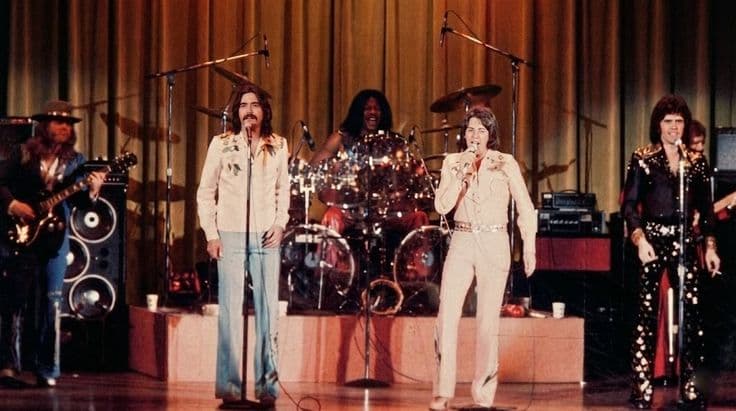
A jubilant call to embrace life’s fleeting moments, “Celebrate” reminds us that even in uncertain times, joy is an act of faith.
Released in 1970, “Celebrate” by Three Dog Night arrived at a moment when American music—and American life—was restless, divided, searching for something steady to hold on to. Issued as a single from the album It Ain’t Easy, the song climbed to No. 15 on the Billboard Hot 100 in the United States and reached No. 9 in Canada, becoming one of the group’s most recognizable anthems of uplift during a turbulent era. The parent album, It Ain’t Easy, went on to peak at No. 8 on the Billboard 200, confirming once again that Three Dog Night had an uncanny instinct for choosing songs that spoke directly to the emotional pulse of the time.
Written by Gary Bonner and Alan Gordon, the songwriting duo formerly associated with The Magicians, “Celebrate” was brought to life under the steady production of Richard Podolor, the architect behind much of Three Dog Night’s polished yet soulful sound. Lead vocals were delivered by Chuck Negron, whose elastic tenor carried both urgency and warmth—two qualities essential to the song’s enduring appeal.
What makes “Celebrate” remarkable is not complexity but conviction. The arrangement opens with a bright, almost gospel-tinged exuberance. Horns punch through the rhythm section, and the backing vocals—so crucial to the Three Dog Night identity—create a communal spirit. This was a band that thrived on vocal interplay. Unlike many groups of their era, they did not rely on a single frontman. Instead, they rotated leads among Chuck Negron, Danny Hutton, and Cory Wells, giving their catalog a textured emotional range. In this case, Negron’s lead performance feels like a hand extended outward, inviting everyone into the circle.
Yet beneath the buoyant exterior, there is something more reflective. The lyrics speak of celebration not as excess, but as gratitude. “Celebrate, celebrate, dance to the music…” It sounds simple, but in 1970—amid political unrest, generational conflict, and the lingering shadows of Vietnam—such a message carried weight. Joy was not naïve; it was necessary. Celebration became a quiet defiance against despair.
Three Dog Night had already established themselves with hits like “One,” “Easy to Be Hard,” and “Mama Told Me (Not to Come)”, songs that balanced social commentary with pop accessibility. “Celebrate” fit neatly into that lineage. It did not lecture. It did not moralize. Instead, it reminded listeners that music itself could be a sanctuary. For three minutes, the burdens of the world softened under layered harmonies and an irresistible groove.
Commercially, while it did not reach the Top 10 in the U.S., its cultural footprint far exceeded its chart position. Radio embraced it. Concert audiences responded with visible enthusiasm. Over time, it became one of those songs that seemed to belong to everyone—played at gatherings, woven into personal milestones, echoing from car radios during long summer drives. It carried the sound of brass and optimism into living rooms across America.
There is also something quintessentially Three Dog Night about “Celebrate.” The band was known for interpreting outside material rather than writing most of their own hits. But what they offered—what few could replicate—was interpretation elevated to transformation. They did not merely perform songs; they inhabited them. Their vocal blend, disciplined yet passionate, gave borrowed compositions a new emotional signature.
Looking back, “Celebrate” feels like a time capsule from an era when radio united neighborhoods and when the Top 40 charts were a shared cultural heartbeat. The song stands as a reminder that pop music, at its best, is not trivial. It carries memory. It carries hope. It carries the echo of who we were when we first heard it.
And perhaps that is why “Celebrate” endures. Not because it demands attention, but because it offers reassurance. It tells us that no matter how complicated the world becomes, there remains a rhythm worth dancing to, a chorus worth singing together. In the hands of Three Dog Night, celebration was not just an event—it was a way of surviving, and even thriving, through history’s shifting seasons.