
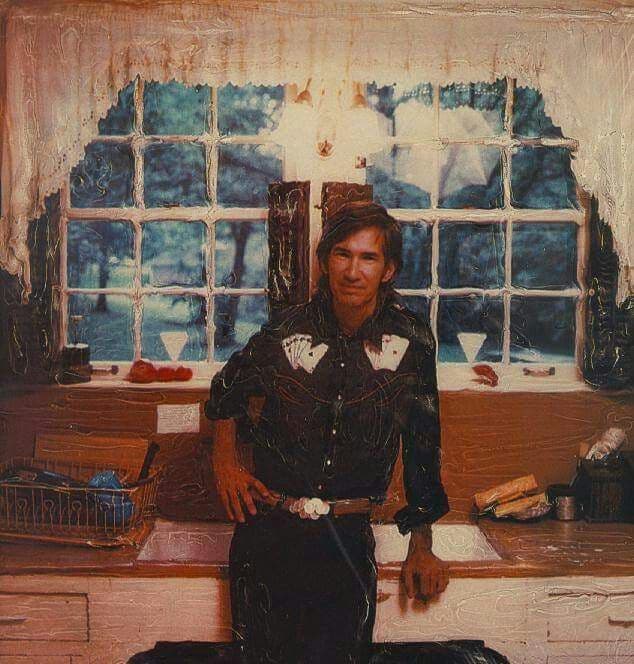
When a Voice Refuses to Comfort, and Forces Us to Face Ourselves
There are moments when we accidentally encounter a voice that sends a chill down our spine—not out of fear, but from a sense of painful familiarity. As if someone has finally spoken the things we never dared to name ourselves. For me, the story of Townes Van Zandt carries exactly that feeling. He was not the kind of artist who overwhelms you at first encounter, but one who lingers quietly, embedding himself in thought, in the darkest corners of human emotion.
The central figure of this story appears as someone standing outside every familiar mold. Born into wealth, carrying a name tied to history and prestige, he should have lived a safe, predetermined life. But that life never truly belonged to him. Mental illness, the crude treatments of his era, and a deep sense of dislocation—even within his own memories—turned him early on into a wanderer, not only across American roads but within his own inner world.
Music came to him as a refuge. The guitar became the only companion capable of withstanding the chaos in his mind. What unsettles me most is the way he wrote songs: he did not avoid pain, soften it, or try to offer an escape. He stared despair straight in the face, called it by its true name, and allowed it to exist intact in every line. His songs feel like whispered confessions at midnight, when people no longer have the strength to pretend they are strong.
Although many of his songs later became famous through the voices of others, he himself remained on the edge of the spotlight. There is something bitter, yet strangely fitting, in that paradox: the man who wrote songs that touched millions of hearts never truly stepped into the center of recognition. He seemed to belong to small spaces—old bars, cramped rooms—where listeners sat close enough to hear every breath in his voice.
His private life was a constant collision with himself: alcohol, broken relationships, prolonged instability. Yet what prevents me from seeing him solely as a tragedy is the light he gave to others. Some people found in his music a profound sense of empathy, even a reason to keep living. Ironically, the man who gave them that feeling of being understood never truly found redemption for himself.
When the story reaches its end, I do not feel shocked—only quietly sad. His passing mirrors the way he lived: understated, unassuming, yet leaving behind a void that is hard to name. His legacy does not lie in charts or awards, but in the way his songs continue to be passed from hand to hand like precious secrets.
To me, Townes Van Zandt is not a role model to emulate, but a reminder: that honesty in art can be brutally beautiful; that some people are born not to shine brightly, but to illuminate the darkness we usually try to avoid. And sometimes, it is precisely those voices on the margins that speak the most truthful things about being human.