
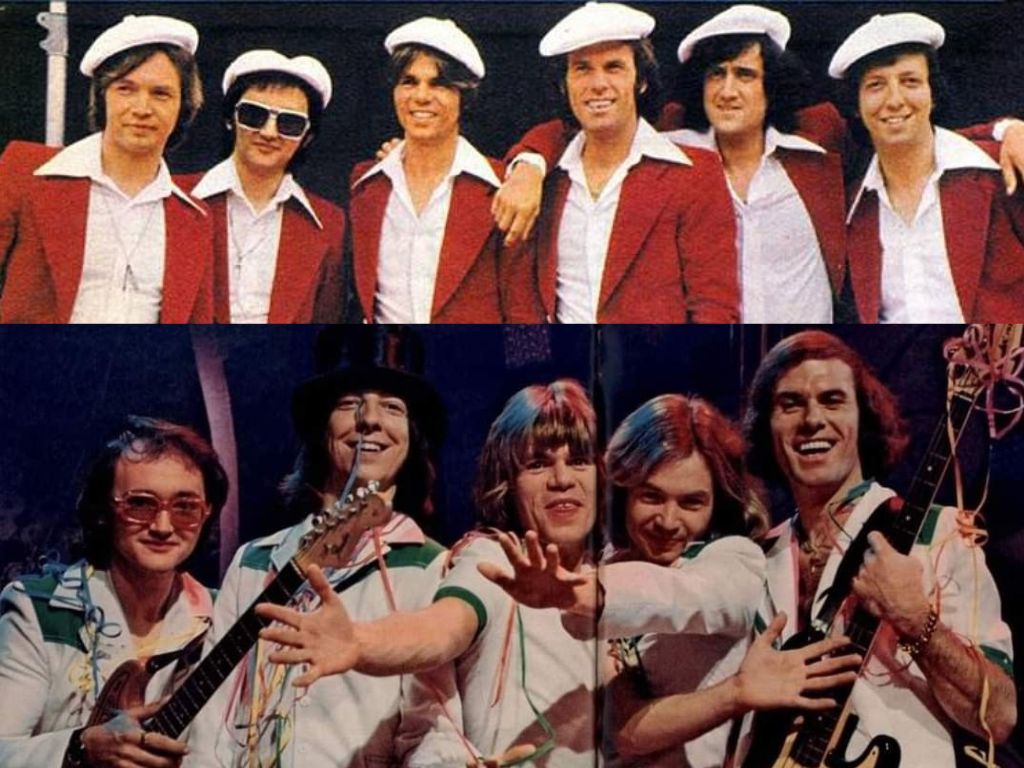
“Tonight”: A Timeless Echo of Fleeting Romance and Persistent Hope
Ah, The Rubettes. Just the name itself conjures up images of simpler times, doesn’t it? Of bell-bottoms and platform shoes, of a vibrant, uninhibited pop landscape that danced to its own joyful beat. And among their infectious, sing-along anthems, there’s one that truly stands out for its blend of effervescent charm and underlying yearning: “Tonight”.
Released in July 1974, “Tonight” followed hot on the heels of their monstrous debut hit, “Sugar Baby Love”, which had sent shivers of nostalgic glee down spines across the globe and topped the UK charts. While it didn’t quite reach the dizzying heights of its predecessor, “Tonight” still proved to be a formidable success, climbing to a respectable number 12 on the UK charts. It was a testament to the songwriting prowess of Wayne Bickerton and Tony Waddington, the duo behind much of The Rubettes‘ early material, and their knack for crafting irresistible pop confections.
The story behind “Tonight”, much like many of The Rubettes‘ early tracks, is rooted in the shrewd, almost industrial approach to hit-making that characterized a segment of the 1970s music scene. Bickerton and Waddington had originally written a clutch of songs, including “Sugar Baby Love”, “Juke Box Jive”, and indeed, “Tonight”, as demonstration recordings. These were initially intended for a rock and roll jukebox musical that, alas, never saw the light of day. When “Sugar Baby Love” exploded, a band was quickly assembled around the sound, with session musicians often laying down the initial tracks. The signature falsetto that graced “Sugar Baby Love” (and subtly influenced “Tonight”‘s vocal styling) was provided by session singer Paul Da Vinci, who, despite his pivotal contribution, never officially joined the band. This behind-the-scenes creation process speaks volumes about the era, where the song itself was often king, and the “band” could sometimes be a beautifully crafted vehicle for its delivery.
But beyond the mechanics of its creation, what is the essence of “Tonight”? At its heart, it’s a tender, hopeful ode to a blossoming romance, a yearning for an evening where all the cares of the world fade away, leaving only two people bathed in the glow of affection. The lyrics, with their simple yet evocative imagery, paint a picture of quiet intimacy: “Tonight won’t be like any night / Tonight the stars up in the sky will be shining for me and my baby / Tonight, we’ll climb the highest high / Just talking ’til the morning light me and my baby tonight.” It’s a sentiment that resonates deeply, particularly with those of us who remember the pure, unadulterated excitement of those early days of love, when just being together felt like scaling the heavens.
There’s a beautiful simplicity to its message, a timeless appeal that transcends the glam-rock trappings of its era. While The Rubettes were known for their retro 1950s-inspired image and sound, often associated with the burgeoning “rock and roll revival” that swept through the ’70s, “Tonight” manages to feel both of its time and utterly enduring. It’s not about grand gestures or dramatic declarations, but about the profound joy found in shared moments, in quiet conversation, and in the unspoken promise of a future together. It’s a song that speaks to the universal human desire for connection and comfort, for that one person with whom you can truly be yourself, and with whom even the simplest evening becomes an extraordinary event.
For those of us who grew up with “Tonight” spinning on our record players, it carries a heavy weight of nostalgia. It takes us back to school dances, to first crushes, to the innocent dreams of youth. The melody, with its gentle sway and the distinctive harmonies that were a trademark of The Rubettes, evokes a sense of warmth and familiarity. It reminds us of a time when pop music, even in its most commercially crafted forms, could still possess an honest emotional core, a genuine sweetness that wasn’t afraid to be vulnerable. It’s a song that proves that sometimes, the most profound feelings are expressed in the simplest of words, and the most lasting memories are forged in the quiet magic of “tonight.”