
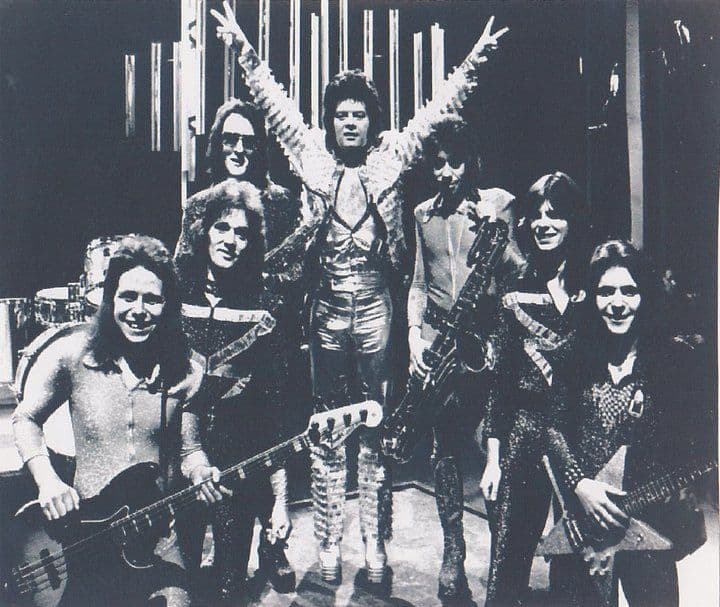
Let’s Get Together Again — a bright, stomping invitation to remember when joy was simple and music brought us closer
When “Let’s Get Together Again” burst onto the airwaves in 1974, it carried with it something more than glitter, rhythm, and irresistible hooks. Performed by The Glitter Band, the song arrived like an open door — cheerful, confident, and full of warmth — inviting listeners back to a time when music was communal, hopeful, and gloriously uncomplicated. From its first pounding beat, it felt like a promise: that togetherness, once lost, could still be found again.
Right at the moment of its release, “Let’s Get Together Again” made its mark in a very real, measurable way. The single climbed to No. 2 on the UK Singles Chart, becoming one of the group’s biggest hits and securing its place in the golden era of British glam rock. It later appeared on their 1974 album Rock’n’Roll Dudes, an album that captured The Glitter Band at their commercial and creative peak. These were not modest achievements — they reflected a band that understood the pulse of its time and spoke directly to the hearts of its audience.
Yet numbers alone cannot explain the song’s lasting charm.
The Glitter Band emerged in the early 1970s from the vibrant, theatrical world of glam rock — a scene driven by pounding drums, handclaps, bold melodies, and a sense of playful defiance. Unlike many bands fronted by a single star, The Glitter Band thrived on collective energy. Their sound was built around rhythm, unity, and a sense of shared celebration. “Let’s Get Together Again” perfectly embodies that spirit.
Lyrically, the song is disarmingly simple. There is no grand metaphor, no heavy drama. Instead, it speaks plainly about separation and reunion — about the desire to reconnect after distance, misunderstanding, or time apart. That simplicity is its strength. The words feel universal, almost timeless, because they echo a truth everyone understands: no matter how far we drift, there is always a longing to return to familiar faces and shared moments.
What truly gives the song its emotional weight is its tone. It is joyful, yes, but there is also a quiet undertone of nostalgia. The invitation to “get together again” implies that something precious has already been lived — and perhaps lost. The rhythm urges you forward, while the sentiment gently pulls you backward. This tension between movement and memory is what makes the song linger long after it ends.
Musically, the track is unmistakably glam rock — bold drums, chanting vocals, and a chorus designed to be sung together rather than alone. It feels made for crowded rooms, dance floors, and shared laughter. Yet beneath the shine and stomp lies a deeper comfort: the reassurance that togetherness still matters, that connection is worth celebrating even after time has changed us.
For listeners who first heard the song in the 1970s, “Let’s Get Together Again” often becomes a musical time capsule. It recalls evenings when the radio was enough, when music didn’t demand analysis but offered pure release. For those discovering it later, the song still works its magic — not as a novelty, but as a reminder of how powerful simplicity can be.
In the broader story of The Glitter Band, this song stands as a defining moment. It captures who they were and what they offered: rhythm over ego, joy over complexity, unity over isolation. It doesn’t ask for introspection; it asks for participation. Clap your hands. Sing along. Remember who you were — and who you shared those moments with.
In the end, “Let’s Get Together Again” is more than a glam rock hit. It is a gentle celebration of reunion, memory, and human closeness. A song that smiles at the past without sadness, and invites us — once more — to gather around the music and feel, if only for a few minutes, wonderfully together again.