
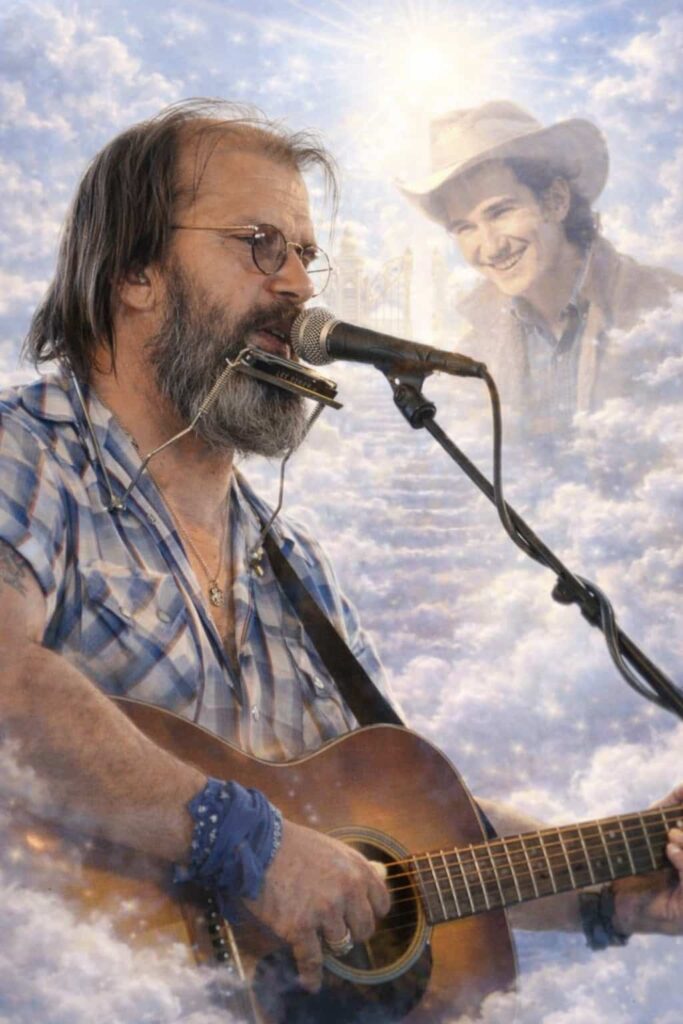
“Pancho and Lefty” — a song of wandering spirits, betrayal, and the silent ache of a life lived too fast, sung through the dust and heartache of country‑folk tradition.
There are few songs in the vast tapestry of 20th‑century music that carry such haunting resonance as “Pancho and Lefty,” first penned by the legendary American songwriter Townes Van Zandt in 1972 and later given new life by so many other voices — including Steve Earle in his tribute Townes, and the unforgettable duet version by Willie Nelson and Merle Haggard that climbed to No. 1 on the Billboard Hot Country Songs chart in 1983.
When you speak of “Pancho and Lefty,” you are speaking of storytelling at its most elemental: two men, bound by fate and friendship, stepping out into a world that has little mercy for restless souls. Van Zandt’s original release on The Late Great Townes Van Zandt did not chart at the time, but it became nothing short of a quiet legend — honoured decades later by Rolling Stone on its list of the 500 Greatest Songs of All Time.
The song unfolds with a voice that seems to come from another era — like a troubadour sitting by a dying fire, recounting the rise and fall of those who took one too many chances. There is Pancho, a figure who wears his gun like others wear their hearts, and Lefty, the friend who walked away — perhaps to save himself — yet carries the burden of regret. Townes himself said the song came out of the blue, as if whispered into his mind rather than consciously created.
It’s easy to imagine what this song meant to those who first heard it in the early 1970s: a generation that had seen dreams fade into desert dust, and felt the stinging echo of love and loss in every verse. Pancho and Lefty isn’t just a ballad about outlaws — it’s a reflection on the roads we choose and the price we pay. The Federales might let Pancho slip away “out of kindness, I suppose,” — but the regret lingers long afterward in Lefty’s twilight years.
In the years that followed, the song was adopted and reshaped by other voices who understood its depth. Willie Nelson and Merle Haggard’s duet gave it a mainstream life it never had in Van Zandt’s own catalog, pushing it to the top of the country charts and bringing this bittersweet tale to millions of listeners. That version, rich with harmonies and the heft of two iconic voices, became almost a generational anthem for those who’d danced with chance and lost.
But somewhere, in quieter rooms and among those who cherish songwriting above showmanship, the original continues to speak. When Steve Earle chose to record Pancho and Lefty for his 2009 tribute album Townes, it wasn’t because the Tin Pan Alley of Nashville needed another hit — it was because Earle, a lifelong friend and admirer of Van Zandt, recognized in those lines a truth about longing and the wanderer’s heart.
Listening to Earle’s rendition — especially live in Sydney or any stage where his voice trembles with memory — one feels the weight of years in every syllable. It’s the kind of performance that doesn’t just play a song, but invites the audience into it, makes them feel the dust on their boots and the wind at their backs. An older listener, sitting back with that quiet half‑smile, might hear not just a story of two bandits but the echoes of their own crossroads — the paths taken, the chances missed, the friends left behind on roads that stretched too far. This is the power of Pancho and Lefty — a song that becomes not just music, but memory.
And for anyone who’s ever wondered why this song has endured — why it doesn’t feel dated even after half a century — it’s because its heart is timeless. It speaks of freedom and consequence, love and betrayal, life and the slow headlong drift toward an uncertain dusk. In every note and every lyric, it invites us to remember what it feels like to be alive, to take risks, and to understand that even the strongest hearts can be worn down by regret.
That is why “Pancho and Lefty” will always be much more than a song — it is a companion through years and miles, a ballad for the wanderers of every generation, and a testament to the enduring soul of honest music.