
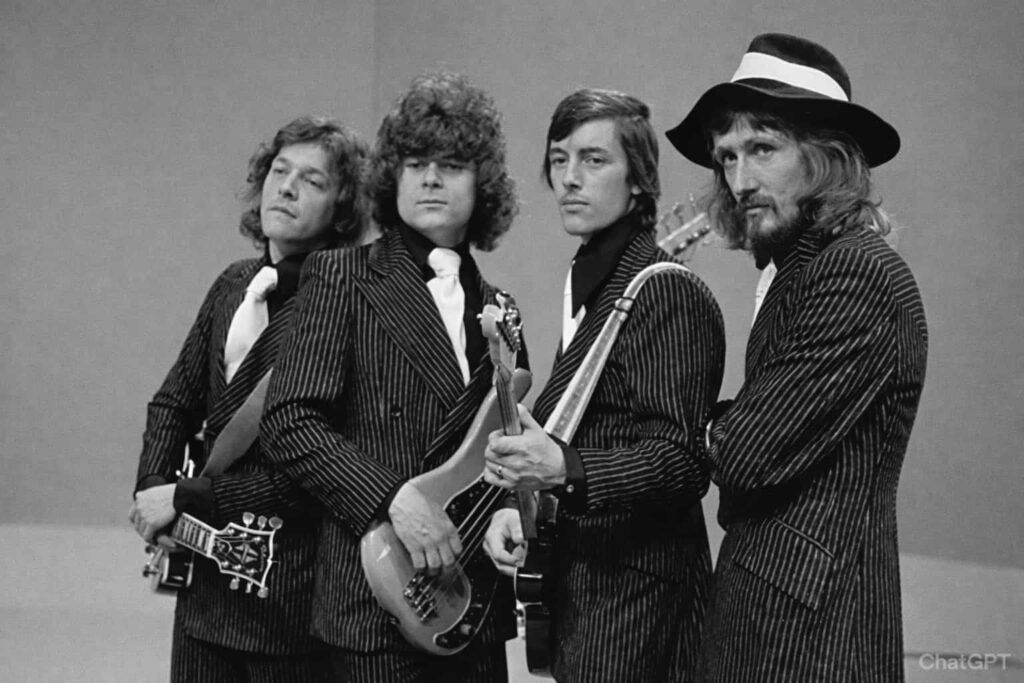
A Ballad of Gangland Myth and Radio Glory — When “The Night Chicago Died” Turned Fiction into a Worldwide Hit
In the summer of 1974, a British pop group few Americans had heard of suddenly found themselves at the very top of the charts across the Atlantic. Paper Lace, a Nottingham band formed in 1968, released “The Night Chicago Died”, and against all odds, it soared to No. 1 on the Billboard Hot 100 in the United States (September 1974). It also reached No. 3 in Canada and climbed into the Top 10 in Australia, though in their native UK it stalled at No. 11. The single was included on their album Paper Lace (1974), and for a brief, shining moment, the group captured the imagination of a generation that still believed radio could deliver a story as vividly as cinema.
Written by the songwriting team of Peter Callander and Mitch Murray, the song was not based on an actual historical event, despite its cinematic storytelling. There was no single, definitive “night Chicago died.” Instead, it drew loosely on America’s fascination with the Prohibition era, gangsters, and the mythic shadow of Al Capone. To American listeners, however, the British accents and slightly romanticized view of Chicago’s underworld added an almost surreal charm. Ironically, the song’s geographical inaccuracies—such as references to “the east side of Chicago,” which locals know is largely industrial and sparsely residential—did nothing to hinder its popularity.
From the very first line, “Daddy was a cop on the east side of Chicago,” the narrative unfolds like a radio drama. The lyrics are delivered from the perspective of a young woman waiting anxiously as gunfire erupts in the night. The father, a policeman, is caught in a violent confrontation with gangsters. The tension builds with each verse, culminating in the haunting refrain: “And the night Chicago died, they talked about it all over town.” It is melodrama in its purest pop form—unabashedly emotional, slightly theatrical, yet irresistibly catchy.
Musically, the track blends soft rock with orchestral pop flourishes. The piano-driven melody, steady percussion, and layered harmonies give it a sing-along quality, while subtle production touches evoke a sense of urgency. There is something distinctly early-1970s about its sound—polished yet warm, dramatic yet radio-friendly. It belongs to that era when storytelling songs dominated the airwaves, standing comfortably alongside narrative hits like “Billy, Don’t Be a Hero”—another Callander and Murray composition, which Paper Lace also recorded.
What makes “The Night Chicago Died” endure is not historical accuracy, but emotional resonance. It taps into universal fears: the dread of waiting for a loved one to come home, the anxiety carried in silence, the fragile line between order and chaos. For many listeners, the song evokes a time when families gathered around the radio or the television variety shows of the 1970s, when pop songs told stories that felt almost epic in scale. There is an innocence to its drama—a reminder of an era before irony dominated popular culture.
Interestingly, while Paper Lace never replicated that level of success in America, the song secured their place in pop history. They became part of the rich tapestry of British acts who briefly conquered the U.S. charts during the post-Beatles wave. Though sometimes labeled a “one-hit wonder,” that description hardly captures the craftsmanship behind the recording or the cultural moment it represents.
Listening today, one can’t help but feel a pang of nostalgia. The orchestration swells, the chorus rises, and for three minutes and twenty seconds, we are transported to a fictional Chicago night filled with sirens and uncertainty. Yet beneath the gunfire and gangland imagery lies something more intimate: the timeless image of a child waiting for a parent’s safe return.
And perhaps that is why, decades later, “The Night Chicago Died” still lingers on oldies stations and memory-filled playlists. It is not just a pop song about gangsters—it is a reminder of how music once painted entire worlds within the grooves of a 45 rpm single.