
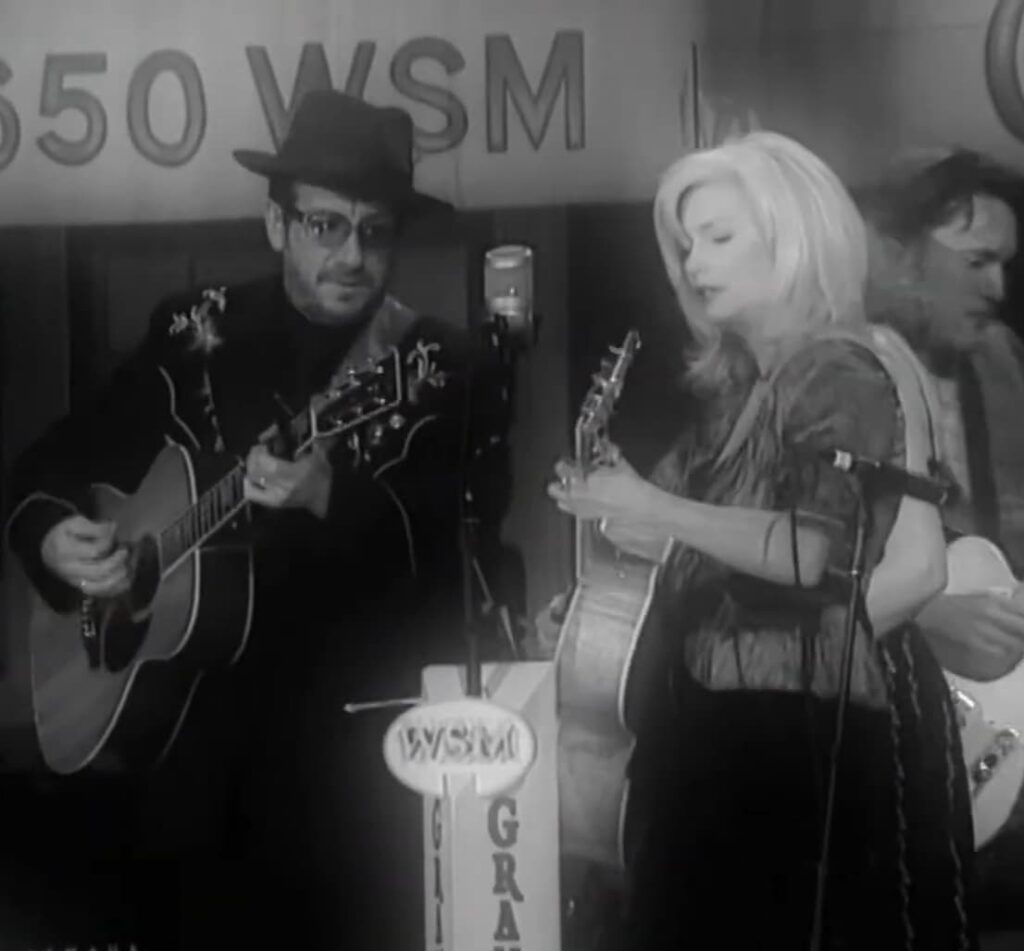
A fragile confession wrapped in melody—Love Hurts reminds us that even the deepest feelings often carry the sharpest edges.
Few songs in popular music have traveled a journey as long and as emotionally layered as “Love Hurts.” Originally written by Boudleaux Bryant in 1960 and first recorded by The Everly Brothers, the song found its most famous early success through Nazareth in 1975, whose aching, hard-rock interpretation pushed it to No. 8 on the Billboard Hot 100 and No. 1 in several countries, including Norway and the Netherlands. Yet, by the time Emmylou Harris and Elvis Costello revisited it in their 2006 live performance, the song had shed any fixed identity—it had become something timeless, almost like a standard of emotional truth, reshaped by each voice brave enough to carry it.
For Emmylou Harris, a figure deeply rooted in country and Americana traditions, “Love Hurts” was never just a cover—it was a continuation of a conversation she had been having with classic songwriting her entire career. Known for her crystalline voice and emotional restraint, Harris approached the song not with dramatic excess, but with a quiet understanding of its wounds. On the other side stood Elvis Costello, whose career had been defined by sharp lyrical intelligence and genre fluidity. When these two artists came together on stage in 2006, the result was not a reinvention—but a revelation.
Their live rendition strips the song down to its emotional skeleton. There is no need for grand arrangements or overpowering instrumentation. Instead, the performance breathes through subtle phrasing, shared glances, and the delicate tension between two seasoned voices. Harris sings with a sense of lived experience—each word sounds remembered rather than performed. Costello, meanwhile, adds a slightly rougher texture, as if his voice carries the scars the lyrics describe. Together, they transform “Love Hurts” into something less like a lament and more like a quiet acceptance.
The story behind the song itself is deceptively simple. Boudleaux Bryant reportedly wrote it inspired by the bittersweet reality of love—not the idealized version often portrayed in early pop music, but the kind that leaves marks. Lines like “Love is like a cloud, holds a lot of rain” may seem almost understated, yet they contain a universal truth that listeners across generations have recognized instantly. It is precisely this simplicity that has allowed the song to endure, to be reshaped across genres—from the close harmonies of The Everly Brothers to the rock edge of Nazareth, and finally into the intimate, almost conversational delivery of Emmylou Harris and Elvis Costello.
What makes the 2006 performance particularly meaningful is the stage of life both artists had reached. This was not young heartbreak being dramatized—it was reflection. The kind that comes after years of love, loss, compromise, and understanding. When Harris sings “Some fools think of happiness, blissfulness, togetherness,” it doesn’t sound cynical—it sounds knowing. And when Costello joins her, there’s a quiet agreement in the air, as though both are acknowledging something unspoken but deeply shared.
There were no chart ambitions tied to this live performance, no commercial push to climb rankings. And yet, in many ways, it stands taller than chart positions ever could. Because by 2006, “Love Hurts” had already secured its place in musical history—not as a hit alone, but as a vessel for truth.
Listening to this duet today feels less like revisiting a song and more like opening an old letter—one that has been read many times, its edges softened, but its message still intact. In the hands of Emmylou Harris and Elvis Costello, the song becomes a gentle reminder: love does hurt—but perhaps it is precisely that pain that gives it meaning.