
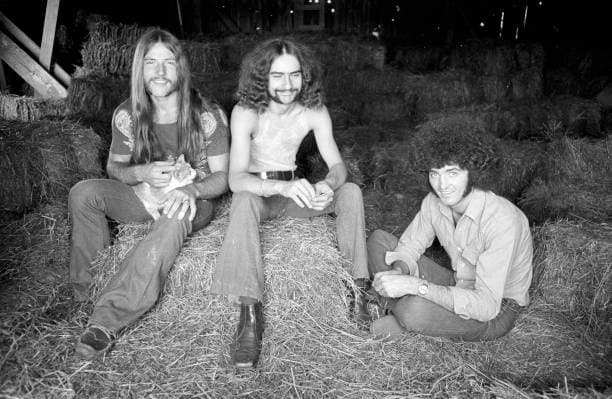
“Bad Time”: A Melancholy Melody of Fading Love and Unspoken Regrets
Ah, the mid-seventies. A time when bell-bottoms were wide, hair was long, and rock and roll, in its purest, most unadulterated form, still reigned supreme. It was an era that gifted us so many indelible tunes, and among them, a track that, while perhaps not always front and center in the collective memory, holds a special place for those of us who remember it ringing out from car radios and turntable speakers. I’m talking, of course, about Grand Funk Railroad‘s surprisingly poignant hit, “Bad Time.” Released in 1975, this song found its way onto the Billboard Hot 100, peaking at a respectable number 4. Coming from their ninth studio album, ***All the Girls in the World Beware!!!***, it was a somewhat unexpected departure for a band often known for their hard-driving, no-nonsense rock anthems. But then again, that’s what made it all the more memorable, didn’t it?
For many, Grand Funk Railroad was synonymous with raw power and electrifying live performances. Tracks like “We’re an American Band” and “I’m Your Captain (Closer to Home)” solidified their reputation as a force to be reckoned with. So, when “Bad Time” emerged, with its more melodic structure and introspective lyrics, it caught some by surprise. It wasn’t the typical foot-stomping, fist-pumping anthem we’d come to expect. Instead, it offered a glimpse into a more vulnerable side of the band, particularly the songwriting prowess of frontman Mark Farner.
The story behind “Bad Time” is, in many ways, the universal story of love’s slow, agonizing fade. It speaks to that unsettling realization when you know, deep down, that a relationship is coming to an end, even if neither party has quite articulated it yet. It’s about the unspoken tensions, the widening chasms, and the inevitable, creeping sense of dread that accompanies the twilight of a shared journey. Farner’s lyrics, delivered with a yearning in his voice that felt palpable, painted a vivid picture of a relationship that had reached its breaking point. He sings of “sitting alone and counting the time,” a poignant image that immediately resonates with anyone who has experienced the lonely introspection that often precedes a breakup. The song isn’t angry or accusatory; rather, it’s tinged with a profound sadness, a lament for what was and what can no longer be. It’s the sound of a heart acknowledging the inevitable, even as it aches.
What made “Bad Time” so effective, and what allows it to endure for those of us who remember its debut, is its ability to tap into that shared human experience of loss and regret. It wasn’t a bitter breakup song; it was a wistful reflection on a love that, despite its best efforts, was simply no longer working. The gentle, almost melancholic guitar melody, coupled with the understated rhythm section, created an atmosphere that perfectly complemented the lyrical content. It felt like a deep sigh, a quiet acceptance of a difficult truth.
Listening to it now, decades later, it evokes a cascade of memories, doesn’t it? Perhaps it takes you back to a specific moment, a particular heartbreak, or even just the general feeling of growing pains that came with navigating relationships in those formative years. It’s a reminder that even the most bombastic rock bands could, at times, strip away the bravado and deliver something truly tender and reflective. “Bad Time” stands as a testament to the versatility of Grand Funk Railroad and, more importantly, to the enduring power of a song that captures the quiet ache of a love lost, resonating with a timeless truth that transcends generations. It reminds us that even when things are going “bad,” there’s a certain beauty in acknowledging the fragility of human connection.