
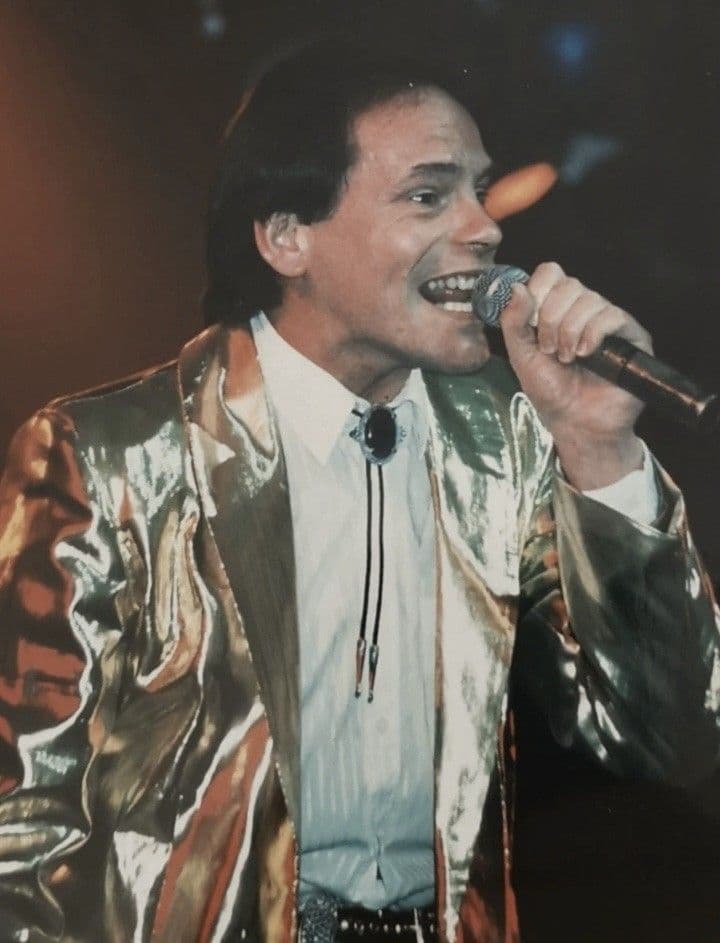
A quietly haunting portrait of longing and emotional disarray—“Delirious” lingers like a late-night memory you cannot quite let go of
There are songs that arrive with great fanfare, climbing the charts with noise and spectacle—and then there are those that slip gently into the listener’s consciousness, leaving a more intimate, enduring imprint. “Delirious” by Dave Bartram, released in 1983 as part of the album The Game’s Up by Showaddywaddy, belongs firmly to the latter category. While it did not storm the upper reaches of the charts—peaking modestly outside the UK Top 40—it nevertheless holds a special place among those who followed the later evolution of the band beyond their rock & roll revival hits of the 1970s.
To understand “Delirious,” one must first understand Dave Bartram himself—not merely as a vocalist, but as a custodian of a musical era that was slowly fading by the early 1980s. As a founding member of Showaddywaddy, Bartram had already experienced the dizzying heights of success with hits like “Under the Moon of Love” and “Three Steps to Heaven.” By the time The Game’s Up was released, however, the musical landscape had shifted dramatically. Synth-pop, new wave, and electronic experimentation were dominating the airwaves. In this context, “Delirious” feels almost like a personal confession—a man standing at the crossroads of changing times, grappling with both artistic identity and emotional vulnerability.
The song itself unfolds with a restrained, almost melancholic arrangement. Gone is the exuberant, retro flair that once defined the band’s sound. Instead, “Delirious” leans into a softer, more introspective style, allowing Bartram’s voice to carry the emotional weight. His delivery is tender, tinged with a weariness that suggests lived experience rather than youthful heartbreak. It is this authenticity that gives the song its quiet power.
Lyrically, “Delirious” explores the fragile boundary between love and obsession. The narrator finds himself consumed by thoughts of someone who may no longer be present—caught in a mental loop that blurs reality and memory. The word “delirious” itself becomes a metaphor for emotional disorientation, a state where longing distorts perception. There is no dramatic climax, no resolution—only a lingering sense of yearning that feels deeply human. It is a theme that resonates more profoundly with time, as one begins to recognize the subtle ways in which memory shapes emotion.
Behind the scenes, the recording of The Game’s Up marked a transitional period for Showaddywaddy. Internal changes within the band, combined with shifting audience tastes, meant that the album did not achieve the commercial success of their earlier work. Yet, this very context lends “Delirious” an added layer of poignancy. It is, in many ways, a reflection of artists confronting the passage of time—not with bitterness, but with a quiet acceptance.
Though “Delirious” was never a chart-topping hit, it found its audience in more subtle ways. Live performances during the early 1980s often revealed a different dimension of the song. One particularly memorable rendition at regional UK venues showcased Bartram’s ability to connect intimately with his audience, stripping away any sense of performance and replacing it with genuine emotional exchange. These moments, though not widely documented, remain etched in the memories of those who witnessed them.
In retrospect, “Delirious” stands as a testament to the enduring value of sincerity in music. It reminds us that not all songs need to dominate the charts to matter. Some exist simply to accompany us through quieter moments—to sit with us in reflection, to echo feelings we may not easily express. For listeners who return to it years later, the song offers something rare: not just nostalgia, but understanding.
And perhaps that is its greatest achievement. In a world that often celebrates the loudest voices, Dave Bartram chose, in “Delirious,” to speak softly—and in doing so, he was heard more deeply than ever.