
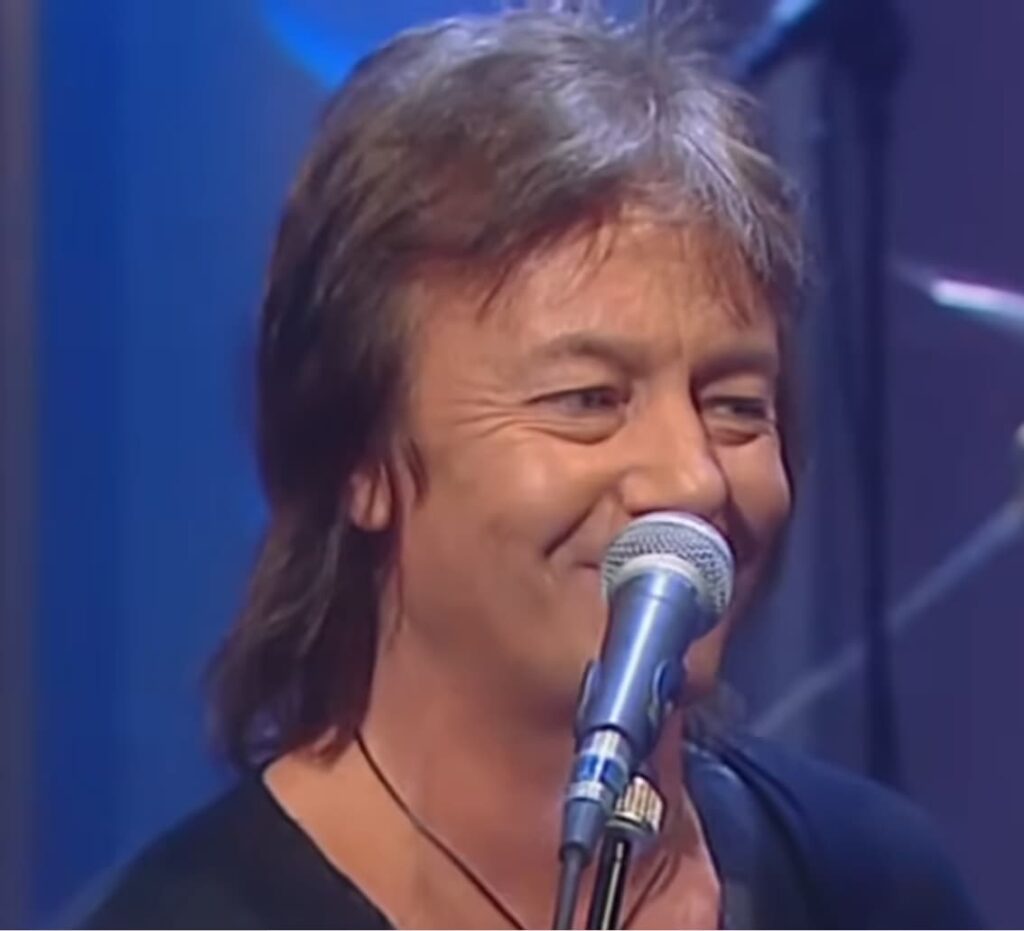
A quiet return to the soul—“Drift Away” becomes a late-life confession of music as refuge, memory, and gentle healing
When Chris Norman sat down to reinterpret “Drift Away” during his One Acoustic Evening, he wasn’t chasing charts or reinvention—he was revisiting a truth that had followed him for decades: that music, at its purest, is a place we go when words fail us. The song itself, originally written by Mentor Williams and first brought to prominence by Dobie Gray in 1973, reached No. 5 on the Billboard Hot 100 and became a defining anthem of quiet resilience in the early ’70s. It also climbed to No. 1 on the US Easy Listening chart, a telling detail—this was not a song of rebellion, but of surrender, of leaning into melody when life grew too heavy.
By the time Chris Norman approached the song in his acoustic setting decades later, its meaning had deepened. Known worldwide as the unmistakable voice of Smokie, Norman had long carried a certain warmth in his tone—slightly weathered, undeniably human. In this stripped-back rendition, that voice does something remarkable: it doesn’t perform the song so much as inhabit it. The familiar lines—“Give me the beat, boys, and free my soul…”—arrive not as a singalong refrain, but as a quiet admission, almost like a letter written late at night.
The story behind “Drift Away” is rooted in something disarmingly simple. Mentor Williams, brother of actor Paul Williams, wrote the song while reflecting on the healing power of music during uncertain times. America in the early 1970s was still processing the aftermath of social upheaval, and yet this song didn’t protest—it comforted. Dobie Gray’s version carried a gospel-like reassurance, blending soul and soft rock into something timeless. It wasn’t about escaping reality, but about finding a way to endure it.
What makes Chris Norman’s One Acoustic Evening interpretation so affecting is its sense of distance—distance from youth, from fame, from the urgency that once defined popular music. Here, the arrangement is minimal: a guitar, a voice, and silence in between. And in that silence, the song breathes. The listener is invited not just to hear, but to remember—where they were when they first encountered the song, what it meant then, and how it feels now.
Unlike many reinterpretations that aim to modernize, Norman does the opposite. He leans into the passage of time. His phrasing lingers, his voice occasionally cracks—not out of weakness, but out of honesty. It is the sound of someone who understands that music is not merely entertainment; it is companionship. The kind that stays with you through long nights and quiet mornings.
There is also something quietly profound in the choice of this song for an acoustic setting. “Drift Away” has always been about surrender—not giving up, but letting go just enough to be carried by something larger than oneself. In Norman’s hands, that idea feels almost spiritual. The performance doesn’t demand attention; it earns it gently, the way old songs often do when revisited with care.
In the end, this version of “Drift Away” is less about nostalgia and more about continuity. It reminds us that while voices may age and arrangements may change, the emotional core of a song—its ability to hold us, even briefly—remains untouched. And perhaps that is why, after all these years, the song still resonates: because it speaks not to a moment in time, but to a feeling we never quite outgrow.