
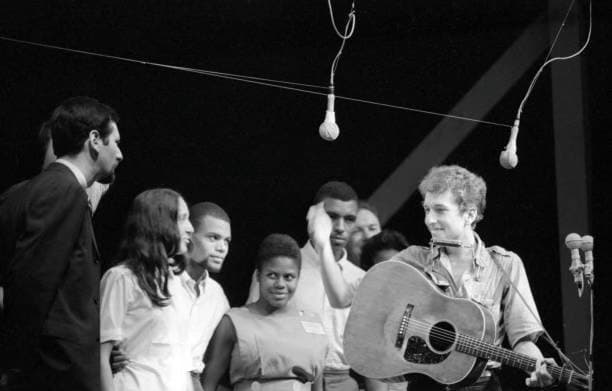
A timeless folk protest that drifted through the 1960s and became the quiet voice of conscience
A reflection on “Blowin’ in the Wind” as it moved from Bob Dylan’s pen into the hands of voices that defined an era of change.
When Bob Dylan first wrote Blowin’ in the Wind in 1962, and released it in 1963 on the album The Freewheelin’ Bob Dylan, few could have predicted how far its quiet questions would travel. It was never written as a song of answers, but rather as a meditation—almost like a series of soft, unanswered sighs drifting through a restless decade. The song does not shout; it asks. And in those questions—about peace, freedom, and human dignity—it found its permanence.
At the time of its original release, Dylan’s version of “Blowin’ in the Wind” was not issued as a major charting single. Instead, it lived primarily within the folk album itself, which reached a modest position on the US Billboard 200 (peaking around No. 22). Its impact, however, was never measured in numbers alone. It was already beginning to circulate through coffeehouses, protest gatherings, and student meetings, becoming something larger than a recording—becoming a shared language of conscience.
The turning point came when Peter, Paul and Mary released their rendition as a single in 1963. Their version brought the song into the mainstream in a way Dylan’s original had not. It climbed to No. 2 on the Billboard Hot 100, holding its place near the top of American popular music and introducing its message to an audience far beyond the folk revival circles. In that moment, “Blowin’ in the Wind” ceased to belong to a single writer and became a collective anthem. It was sung in churches, rallies, classrooms, and living rooms, its melody both gentle and unshakable.
Around the same time, Joan Baez helped carry the song deeper into the emotional landscape of the early 1960s. Her crystalline voice gave it a sense of purity—almost sacred in tone—transforming the song into something that felt less like protest and more like reflection. And in the broader folk movement, figures like Pete Seeger and the Freedom Singers embraced it within the spirit of the Civil Rights era, where music was not entertainment but necessity.
What makes “Blowin’ in the Wind” endure is not its melody alone, but its structure of unanswered questions: How many roads must a man walk down? How many seas must a white dove sail? These are not rhetorical devices meant to be solved; they are reflections meant to be carried. The song understands something deeply human—that certain truths are not declared, but slowly recognized over time.
For listeners of that era, especially those witnessing social upheaval, the song felt like a mirror held up to a changing world. It did not instruct; it listened. It allowed silence between its lines, as if silence itself held meaning. In that space, people found their own interpretations—hope, frustration, longing, or determination.
Even today, decades later, “Blowin’ in the Wind” remains less a relic and more a living question. It belongs to no single voice, despite being born from one. It was shaped by Bob Dylan, carried to prominence by Peter, Paul and Mary, deepened by Joan Baez, and echoed through the collective spirit of Pete Seeger and the Freedom Singers. Each interpretation added another layer of meaning, like wind passing through different landscapes yet remaining the same invisible force.
Perhaps that is why the song still resonates so deeply with those who remember its earliest days. It does not try to resolve history—it simply asks us to keep listening as it passes by.