
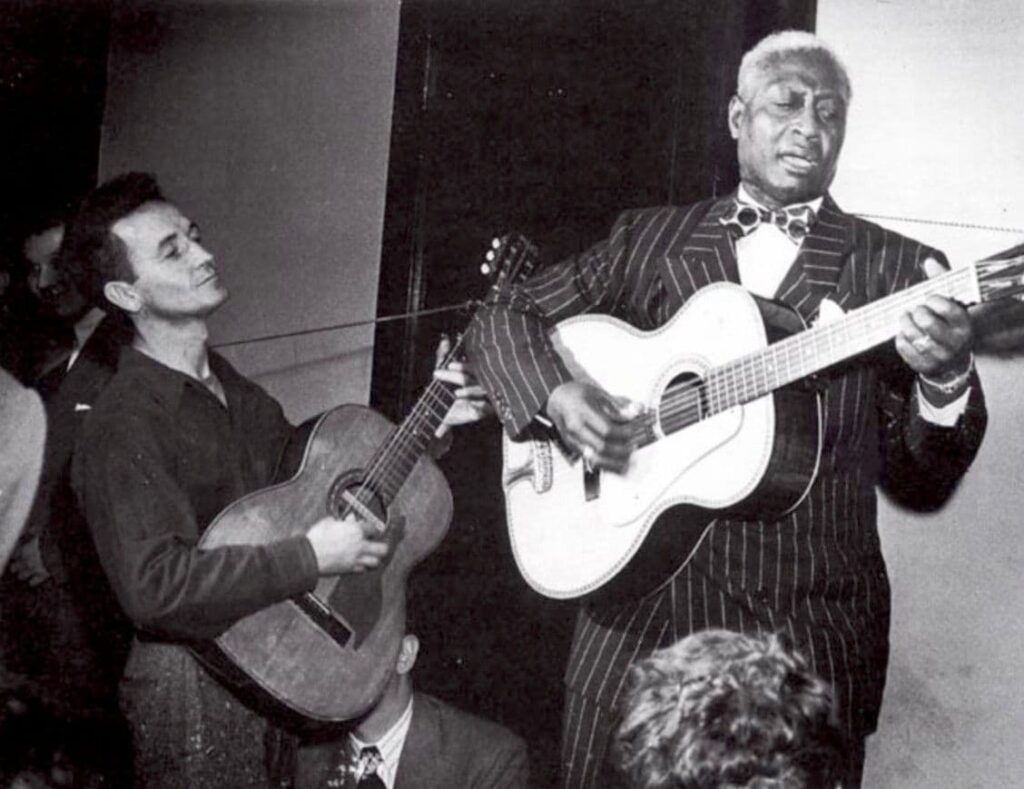
A lullaby of loss and longing—“Goodnight, Irene” drifts between sorrow and comfort, carrying the weary voice of a troubled heart into the quiet of night.
Few songs in the American folk tradition carry the weight, the history, and the emotional gravity of “Goodnight, Irene” as performed and popularized by Lead Belly (Huddie Ledbetter)**. Though often associated with later revivals and interpretations, the song’s roots stretch back to Lead Belly’s own life in the early 20th century, long before it reached mainstream success. Recorded in 1933 while he was incarcerated at Angola Prison, this haunting melody would eventually transcend its humble beginnings to become one of the most enduring standards in American music.
The version that brought “Goodnight, Irene” to the top of the charts came in 1950, when The Weavers, featuring Pete Seeger, released their interpretation. That recording reached No. 1 on the Billboard charts and remained there for an astonishing 13 weeks, introducing the song to a broad audience at a time when folk music was beginning to find its place in the popular consciousness. It was a posthumous triumph for Lead Belly, who had passed away in 1949, never witnessing the full magnitude of his influence.
At its core, “Goodnight, Irene” is not a simple lullaby, despite its gentle melody. The lyrics reveal a far more complex and troubled emotional landscape. There are verses filled with longing, regret, and even despair—lines that speak of love lost and the quiet desperation of a man wrestling with his own thoughts. Some versions include darker stanzas referencing suicidal ideation, which were often softened or omitted in commercial recordings. This duality—between soothing tune and unsettling message—is precisely what gives the song its enduring power.
The story behind the song is deeply personal. Lead Belly himself claimed that Irene was inspired by a woman he loved, though the details remain elusive, blurred by time and retelling. What remains undeniable is that the song carries an authenticity that cannot be manufactured. It feels lived-in, shaped by hardship, loneliness, and the kind of emotional honesty that defined much of Lead Belly’s work.
When artists like Woody Guthrie and Pete Seeger embraced and performed “Goodnight, Irene,” they were not merely covering a song—they were preserving a piece of American musical heritage. Their interpretations helped bridge generations, bringing the raw, unfiltered voice of Lead Belly into living rooms and concert halls across the country. In doing so, they ensured that the song would not fade into obscurity but instead become a cornerstone of the folk revival.
There is something quietly devastating about how “Goodnight, Irene” lingers after it ends. It does not demand attention with grand gestures or dramatic crescendos. Instead, it settles into the listener’s memory like a fading photograph—soft at the edges, yet impossible to forget. It speaks to a time when songs were passed from voice to voice, shaped by each singer who carried them forward.
For those who return to it years later, the song often feels different. What once sounded like a simple farewell may now echo with deeper meaning—of love that could not be held onto, of nights that felt longer than they should, and of the quiet hope that morning might bring some kind of peace.
In the end, “Goodnight, Irene” is more than a song. It is a companion for the solitary hours, a reminder of the fragile line between comfort and sorrow. And in the voice of Lead Belly, carried forward by Woody Guthrie and Pete Seeger, it remains one of the most human recordings ever left behind—a gentle goodnight that never quite says goodbye.