
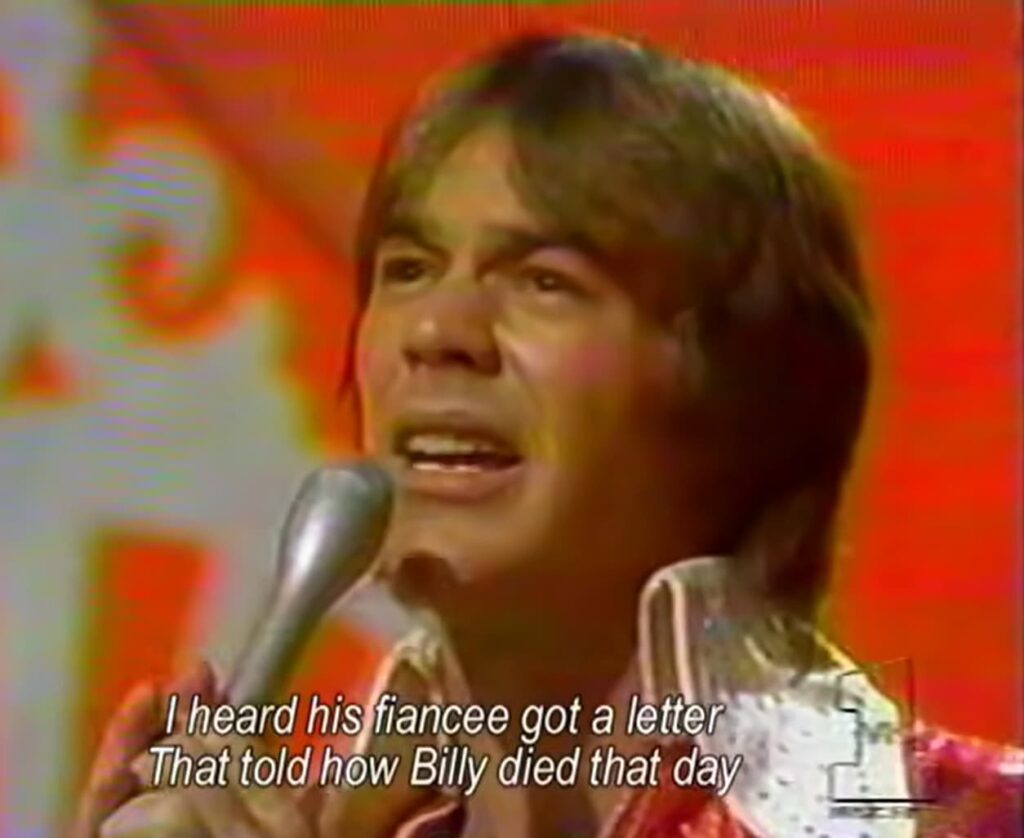
A Song About Glory, Fear, and the Boys Who Never Returned
In the spring of 1974, “Billy Don’t Be a Hero” became far more than a catchy pop hit. Beneath its marching rhythm and radio-friendly chorus lived a quiet heartbreak about war, innocence, and the terrible cost of becoming someone’s “hero.”
When Bo Donaldson and The Heywoods released “Billy Don’t Be a Hero” in 1974, few could have predicted how deeply the song would settle into the memories of an entire generation. The single climbed all the way to No. 1 on the Billboard Hot 100 in the United States in June of that year, remaining there for two weeks. Before the American version conquered the charts, the song had already become a massive success in Britain through the group Paper Lace, whose original recording reached No. 1 on the UK Singles Chart earlier that same year. It was one of those rare moments in popular music when two versions of the same song could coexist in public memory, each carrying its own emotional weight.
Billy Don’t Be a Hero by Bo Donaldson and The Heywoods may have sounded bright and almost cheerful on the surface, but its story was anything but lighthearted. The lyrics tell of a young woman pleading with Billy not to rush off into battle seeking glory. She begs him to stay alive, to come home, to ignore the desperate temptation of proving himself brave. But Billy, like so many young men throughout history, cannot resist the call. He charges forward into danger hoping to become a hero — only to die before ever returning home.
That emotional contradiction is perhaps why the song still lingers in people’s hearts decades later. The melody is upbeat, almost deceptively innocent, while the story underneath carries sorrow that only becomes deeper with age. As children, many listeners heard the marching drums and catchy chorus. Later in life, they heard the tragedy.
The timing of the song’s release mattered enormously. America in 1974 was still emotionally exhausted from the shadow of the Vietnam War. Although the lyrics never explicitly mention Vietnam, audiences immediately connected the song to the painful reality unfolding across television screens and family dinner tables during those years. Young soldiers were leaving home, many never returning, while families waited helplessly for letters, phone calls, or devastating news. The song quietly captured that emotional atmosphere without turning into a protest anthem. Instead, it focused on something far more intimate: the human cost of youthful idealism.
Interestingly, the songwriters — Mitch Murray and Peter Callander — originally imagined the story against the backdrop of the American Civil War rather than Vietnam. Yet listeners naturally attached it to the conflict closest to their own lives. That is often the mark of timeless songwriting: a song begins in one historical setting but eventually belongs to everyone.
Paper Lace recorded the first successful version, and their rendition carried a distinctly British pop flavor of the early 1970s. But it was the American interpretation by Bo Donaldson and The Heywoods that truly embedded itself into U.S. culture. Their version felt warmer, softer, and somehow more personal. It played endlessly on AM radio stations during long summer afternoons, from car speakers, diners, small-town jukeboxes, and living rooms where families gathered after dinner.
For many people, the song became tied to memory itself. Some remember hearing it while riding in the back seat of a family car. Others remember older brothers leaving for military service. Some remember first loves, high school dances, or quiet evenings when music still came through crackling transistor radios. And for veterans and military families, the song often carries a heavier meaning altogether.
Lines like “Billy, keep your head low” feel painfully real to those who knew young men who never came home from war. The simplicity of the lyrics is exactly what gives them power. There is no complicated poetry, no grand political statement — only fear, love, and helplessness. The girl in the song cannot stop Billy from chasing an idea larger than himself, and that helplessness echoes through every generation touched by war.
What makes “Billy Don’t Be a Hero” endure is not merely nostalgia. It is the way the song preserves a particular emotional innocence that defined much of popular music in the early 1970s. Songs then often carried sadness gently, without cynicism. Even tragedy could be wrapped inside beautiful harmonies and melodies that invited people to sing along together.
Today, listening to “Billy Don’t Be a Hero” feels almost like opening an old photograph album. The faces may fade slightly with time, but the emotions remain untouched. The song reminds listeners of a world where heroism was still romanticized, where radio songs carried entire memories inside them, and where millions of young people tried to understand courage, loss, and growing up all at once.
And perhaps that is why the song still matters. Behind every “Billy” was a family waiting at home, a sweetheart praying for one more letter, and a future that might never arrive. Few pop songs from the 1970s captured that bittersweet truth with such simplicity — or such lasting emotional power.