
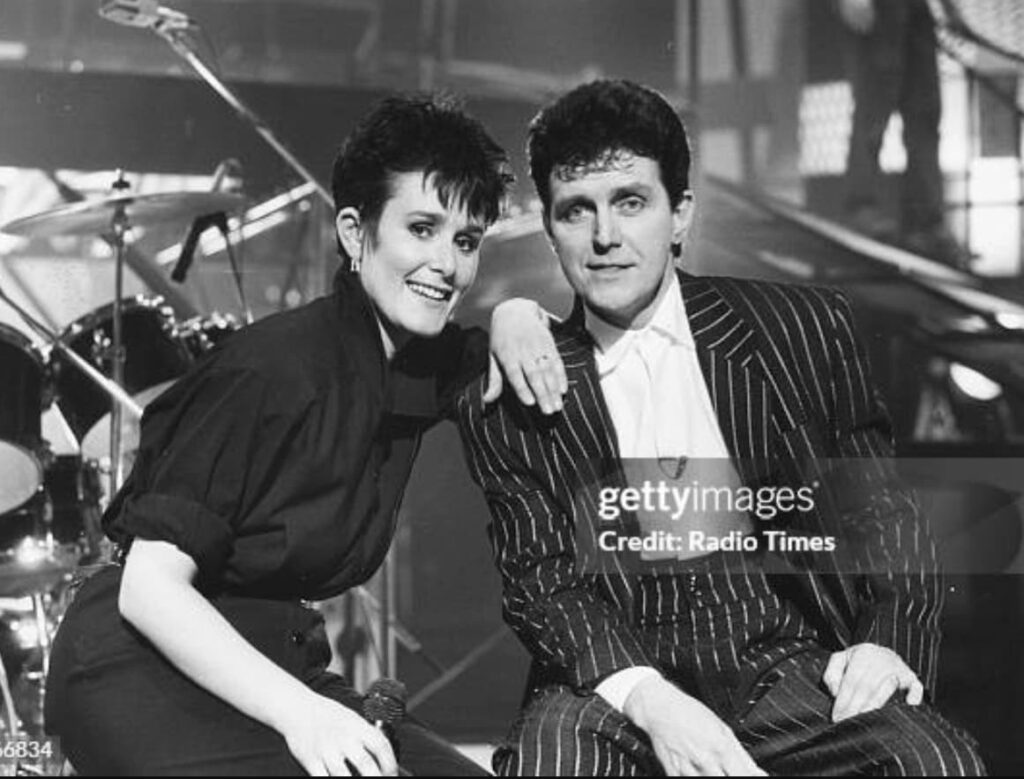
A duet wrapped in tenderness and quiet longing, “Speak Of Love” captured a moment when romance in pop music still sounded sincere, gentle, and beautifully human — a reminder that sometimes the softest songs leave the deepest echoes.
By the early 1980s, the musical landscape had changed dramatically. Synth-pop was rising, MTV was reshaping image and sound, and many artists from the glam and soft-rock era were struggling to find their place in a younger, faster-moving industry. Yet in the middle of that transition came a song like “Speak Of Love” by Alvin Stardust and Sheila Walsh — a duet that never tried to compete with trends, but instead leaned into warmth, melody, and emotional honesty.
Released in 1984, the single became a modest but memorable success in the UK, reaching the Top 20 of the UK Singles Chart, peaking at No. 19. For many listeners at the time, the song felt comforting in a decade increasingly dominated by electronic production and sharp-edged pop aesthetics. It carried echoes of an earlier tradition — the kind of duet built not on spectacle, but on chemistry, restraint, and heartfelt delivery.
What made “Speak Of Love” especially touching was the contrast between the two voices. Alvin Stardust, already well known for hits like “My Coo Ca Choo”, had always possessed a voice filled with smoky confidence and theatrical charm. He came from the glam-rock era, but beneath the leather image and dark sunglasses was a singer deeply influenced by classic rock ’n’ roll and old-fashioned romantic balladry. Sheila Walsh, meanwhile, brought a softer and more delicate emotional texture to the recording. Her voice did not overpower the song — it humanized it.
Together, they sounded less like two performers trying to impress an audience and more like two people quietly reaching for understanding.
That is perhaps the true emotional strength of “Speak Of Love.” The song is not dramatic in the way many love duets are. There are no explosive declarations, no heartbreak theatrics, no overwhelming orchestral crescendos. Instead, it speaks in gentle tones about connection, vulnerability, and the simple human need to be reassured through words and affection. The title itself almost feels like advice from another generation — a reminder that love should not remain hidden or assumed, but spoken aloud while there is still time.
Listening to the song today, one can hear how carefully it was arranged. The production reflects the mid-1980s, certainly, with its polished instrumentation and smooth studio sheen, yet the emotional core remains timeless. The melody moves patiently. Nothing feels rushed. The pauses between lines matter just as much as the lyrics themselves. Songs like this trusted silence. They allowed emotion to breathe.
For longtime admirers of Alvin Stardust, the duet also revealed another side of him. Much of his public image had been built around swagger and style, but “Speak Of Love” showed maturity and gentleness beneath the persona. By the 1980s, he was no longer simply the rebellious glam figure from the previous decade. He had become an artist capable of subtle emotional storytelling. In many ways, the song aged alongside its audience.
There is also something deeply nostalgic about the era in which the song appeared. The mid-1980s still belonged to radio in a very intimate way. People heard songs like this while driving home at night, sitting quietly in living rooms, or recording favorite tracks onto cassette tapes from late-night broadcasts. A duet such as “Speak Of Love” was not designed for viral moments or instant consumption. It was meant to linger. And for many listeners, it did.
Though it may not be remembered as loudly as some of the decade’s blockbuster hits, the song has endured precisely because of its sincerity. Time has a curious way of rewarding songs that speak softly but honestly. Decades later, “Speak Of Love” feels less like a commercial single and more like a memory preserved in melody — the kind of song that quietly returns when life becomes reflective and the noise of the world grows tiring.
And perhaps that is why it still resonates. Not because it chased greatness, but because it understood something simple and eternal: love is often remembered not through grand gestures, but through the gentle words people wished they had said more often.