
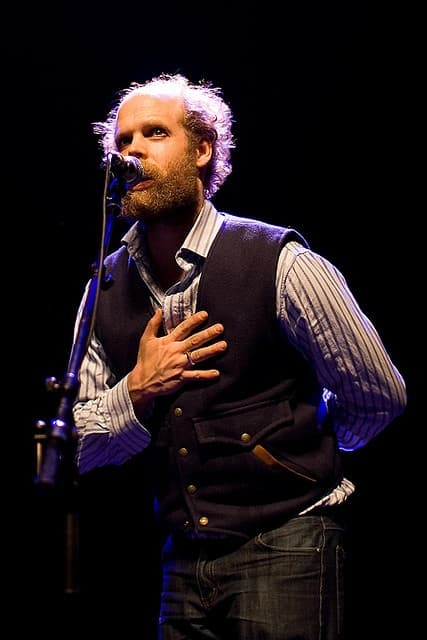
A song that sounded less like a confession… and more like a man quietly standing in the ruins of his own soul, asking whether love can survive the shadows inside us.
When Bonnie ‘Prince’ Billy released “I See a Darkness” in 1999, the song did not arrive with the noise of a radio hit or the glitter of commercial ambition. It entered the world softly—almost cautiously—through the album I See a Darkness, and over time it became something far more enduring than a chart success. Though the song did not become a major Billboard single, the album itself was widely acclaimed and is now regarded as one of the defining works of late-1990s alternative folk and Americana. In many circles of critics and devoted listeners, it is considered a modern classic.
And perhaps that is fitting.
Because “I See a Darkness” was never designed for crowded dance floors or passing trends. It was written for the quiet hours—for the moments when the room is dark, the house is still, and a person begins speaking honestly to themselves for the first time all day.
At the center of the song is Will Oldham, the enigmatic songwriter behind the name Bonnie ‘Prince’ Billy. By the late 1990s, Oldham had already built a reputation as one of the most emotionally fearless voices in independent music. But with “I See a Darkness,” he reached somewhere deeper than melancholy. The song explored depression, spiritual exhaustion, friendship, guilt, and the terrifying fear of becoming emotionally unreachable.
What made the song so startling was its tenderness.
The narrator does not simply admit to darkness within himself—he worries about how that darkness affects the people he loves. There is no dramatic breakdown, no theatrical misery. Instead, the song unfolds like a private conversation between old friends sitting at a kitchen table long after midnight. The famous opening lines immediately establish that intimacy, speaking not with anger, but with concern and quiet vulnerability.
Musically, the arrangement is almost painfully restrained. A slow acoustic guitar, sparse percussion, and Oldham’s fragile, weathered voice create an atmosphere that feels suspended somewhere between prayer and confession. There is space in the recording—space for silence, for reflection, for memory. In another era, producers might have tried to make the song bigger. But its greatness comes precisely from what it refuses to do.
It refuses to hide.
One of the most fascinating chapters in the song’s history came when Johnny Cash recorded his own version in 2000 for the album American III: Solitary Man. Cash’s interpretation introduced the song to an entirely different generation of listeners and gave it an almost haunting new dimension. By that time, Cash’s voice carried the weight of age, illness, regret, and survival. When he sang the words “I see a darkness,” they sounded less metaphorical and more like a lifetime of hard-earned truth.
The duet version featuring both Johnny Cash and Will Oldham remains one of the most emotionally devastating collaborations ever recorded in modern folk music. Two voices from different worlds—one a legendary American icon nearing the end of his life, the other an independent songwriter still wandering through emotional uncertainty—meeting in the same fragile space. It felt less like a performance and more like recognition.
And that may explain why the song has endured so powerfully over the decades.
Many songs about sadness try to dramatize pain. “I See a Darkness” does something rarer: it humanizes it. The song does not ask for pity. It asks for understanding. Beneath all its sorrow lies an extraordinary emotional generosity—the hope that another person might still remain beside us, even after seeing our worst fears and hidden shadows.
That emotional honesty became deeply influential across alternative folk, Americana, and indie music in the years that followed. Artists searching for authenticity often pointed back to Will Oldham’s work as proof that vulnerability itself could be artistic strength.
Listening to the song today, more than twenty-five years after its release, it still feels untouched by time. The production has not aged because it was never tied to fashionable sounds. The emotions remain painfully recognizable because loneliness, doubt, and the search for connection never truly disappear from human life.
Some songs entertain us.
Some songs accompany moments in our lives.
But “I See a Darkness” belongs to a smaller, rarer category of music—the kind that quietly waits for us to become old enough, wounded enough, or honest enough to finally understand it.
And once that understanding arrives, the song never entirely leaves you.