
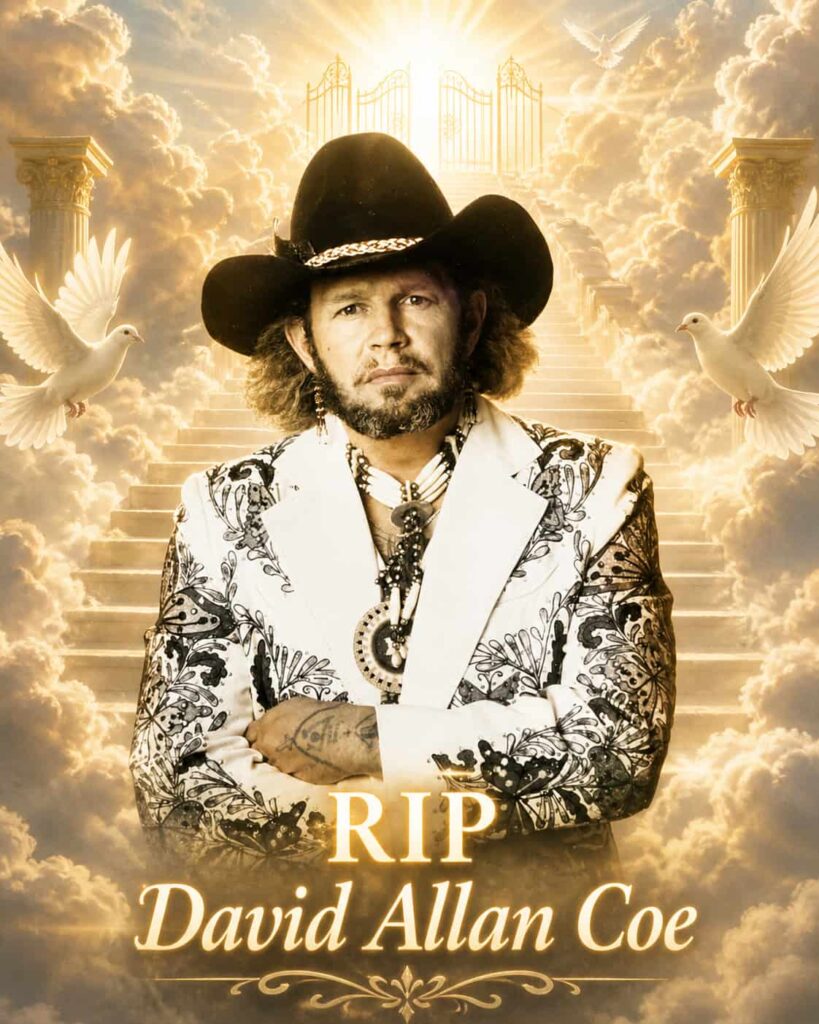
A Final Ride for an Outlaw: Remembering David Allan Coe
The video opens with breaking news that marks the end of an era: David Allan Coe, one of country music’s most rebellious and enigmatic figures, has passed away at the age of 86. Confirmed by his widow Kimberly, his death closes the chapter on a life that was as controversial as it was influential. Though the cause of death remains undisclosed, the emotional weight of the announcement is undeniable—country music has lost one of its true outlaws.
David Allan Coe’s legacy is deeply woven into the fabric of American country music. Long before he became a household name, his songwriting had already begun shaping the genre. In 1973, Tanya Tucker brought his composition “Would You Lay with Me (In a Field of Stone)” to the top of the charts, marking his breakthrough in Nashville. Just a few years later, Johnny Paycheck turned Coe’s “Take This Job and Shove It” into a working-class anthem, further solidifying his reputation as a powerful storyteller. His own recording of “You Never Even Called Me by My Name” became a defining piece of country humor and authenticity, celebrated for its tongue-in-cheek take on the “perfect” country song.
Yet Coe’s journey to fame was anything but conventional. Born in Akron, Ohio, in 1939, he spent much of his early life entangled in the criminal justice system. Reformatories and prisons became a recurring backdrop to his youth, shaping the rough-edged persona he would later embrace. When he arrived in Nashville in 1967, he brought with him not only talent but also a larger-than-life mythos. Stories of his past—some likely exaggerated—became part of his identity, blurring the line between truth and performance.
By the mid-1970s, Coe had signed with Columbia Records and released albums that would secure his place in country history. His image was just as memorable as his music: from wearing a Lone Ranger mask to crafting songs that placed himself alongside legends like Willie Nelson and Waylon Jennings. He wasn’t just part of the outlaw country movement—he embodied it.
Coe’s creativity didn’t stop at traditional country. In later years, he explored unexpected collaborations, including a project with members of the metal band Pantera, resulting in the album Rebel Meets Rebel. He also connected with artists like Kid Rock, proving his influence extended far beyond one genre. Even as he aged, Coe remained a road warrior, performing at motorcycle rallies and continuing to record music well into the 2000s.
However, his later life was not without hardship. Financial struggles and legal issues, including a tax evasion case in 2015, added complexity to his already turbulent story. Still, through it all, Coe never lost the sense of identity he had fought so hard to build. As he once said in an interview, he found his place in society not behind bars, but in the recognition of his name and his music.
David Allan Coe’s life was a blend of myth, music, and defiance. He leaves behind not just songs, but a legacy that challenges, entertains, and endures.