
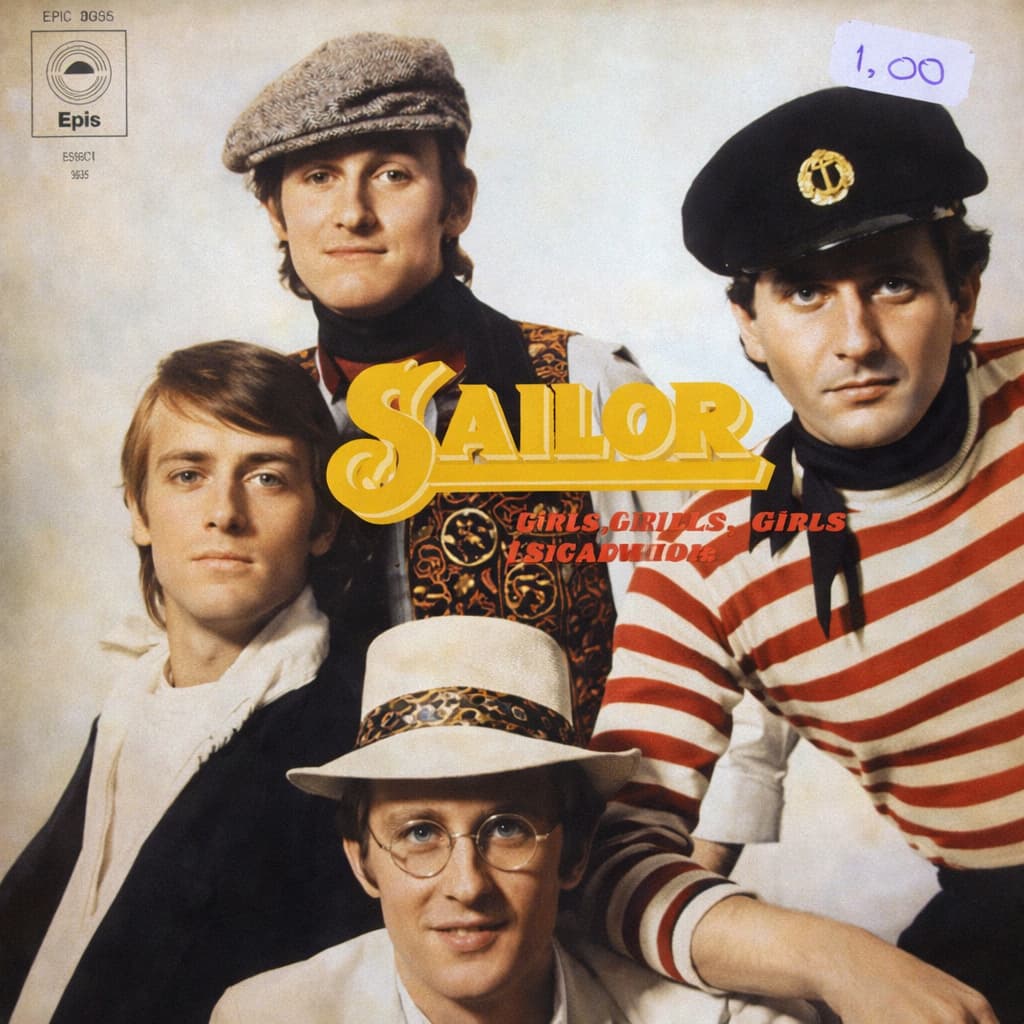
A Gentle Voyage Through Youthful Dreams and Fleeting Freedom
When we revisit “Sailor” by Sailor, we are taken back to a softer, more whimsical corner of the early 1970s—a time when pop music still carried the scent of music halls, seaside postcards, and youthful imagination. Released in 1974 as part of their self-titled debut album Sailor, the song did not storm the charts in the way some contemporaries did, yet it quietly established the band’s identity and paved the way for their later successes, particularly in Europe. While it did not achieve a high position on major charts like the UK Singles Chart, its charm lay elsewhere—in its storytelling, its nostalgic tone, and its unmistakable character.
Formed by Georg Kajanus, the band Sailor stood apart from many of their glam and rock-driven peers. Their music leaned into a theatrical, almost vaudevillian style, enriched by unusual instrumentation such as the “nickelodeon”—a custom-built instrument that gave their sound its distinctive, old-world flavor. “Sailor”, as a song, embodies this aesthetic perfectly. From its opening notes, one senses a gentle sway, like a ship rocking on calm waters, carrying with it stories of longing and quiet adventure.
At its core, “Sailor” is less about the literal life at sea and more about the emotional voyage of youth—the restless desire to escape, to discover, and perhaps to leave behind something undefined but deeply felt. The lyrics paint a picture of a young man drawn to the horizon, chasing dreams that are as vast and uncertain as the ocean itself. There is a tenderness in the way the story unfolds, a sense that the journey is as much inward as it is outward.
What makes the song particularly resonant is its bittersweet undertone. Beneath the gentle melody and playful arrangement lies a subtle awareness of time passing. The sailor’s journey becomes a metaphor for life’s transience—the way we all set out with hope, only to find that the world is both larger and lonelier than we imagined. This duality—hope intertwined with quiet melancholy—is what gives the song its lasting emotional weight.
The mid-1970s were a period of transition in popular music. While bands like ABBA were beginning to dominate the charts with polished pop perfection, and others leaned into rock’s growing intensity, Sailor carved out a niche that felt almost deliberately out of time. Their music, including “Sailor”, seemed to look backward even as it moved forward, drawing on older traditions to tell contemporary stories. This gave their work a timeless quality—one that continues to resonate with listeners who appreciate music that values mood and narrative over sheer commercial impact.
There is also something deeply visual about “Sailor.” One can almost picture a quiet harbor at dusk, the fading light reflecting off the water, as a young man prepares to leave everything familiar behind. It is this imagery that lingers long after the song ends. Unlike many hits of its era, which were built for immediate impact, “Sailor” reveals itself slowly, inviting the listener to return again and again, each time discovering a new shade of meaning.
Though it may not have been a chart-topping sensation, “Sailor” remains an essential piece of the band’s legacy. It captures a moment when pop music still allowed room for storytelling, for subtlety, and for a kind of emotional honesty that does not demand attention but quietly earns it. For those who remember—or long for—that era, the song feels like a letter from the past, carried gently across the years, still intact, still meaningful.
In the end, “Sailor” is not just a song—it is a memory, a mood, and a quiet reminder of the journeys we all take, whether across oceans or simply through the passage of time.