
A playful yet bittersweet celebration of youthful fascination, wrapped in bright harmonies and seaside nostalgia, capturing a fleeting moment of 1970s pop innocence before time quietly moved on.
When Sailor released “Girls, Girls, Girls” in 1975, it arrived like a gust of fresh sea air on British radio—buoyant, cheeky, and instantly memorable. Right from its release, the song made its commercial impact clear, climbing rapidly to No. 2 on the UK Singles Chart, where it became one of the defining pop singles of the mid-1970s. It was later included on the band’s debut album, Trouble (1975), a record that captured Sailor’s unique blend of glam-era polish, melodic pop craftsmanship, and slightly eccentric charm.
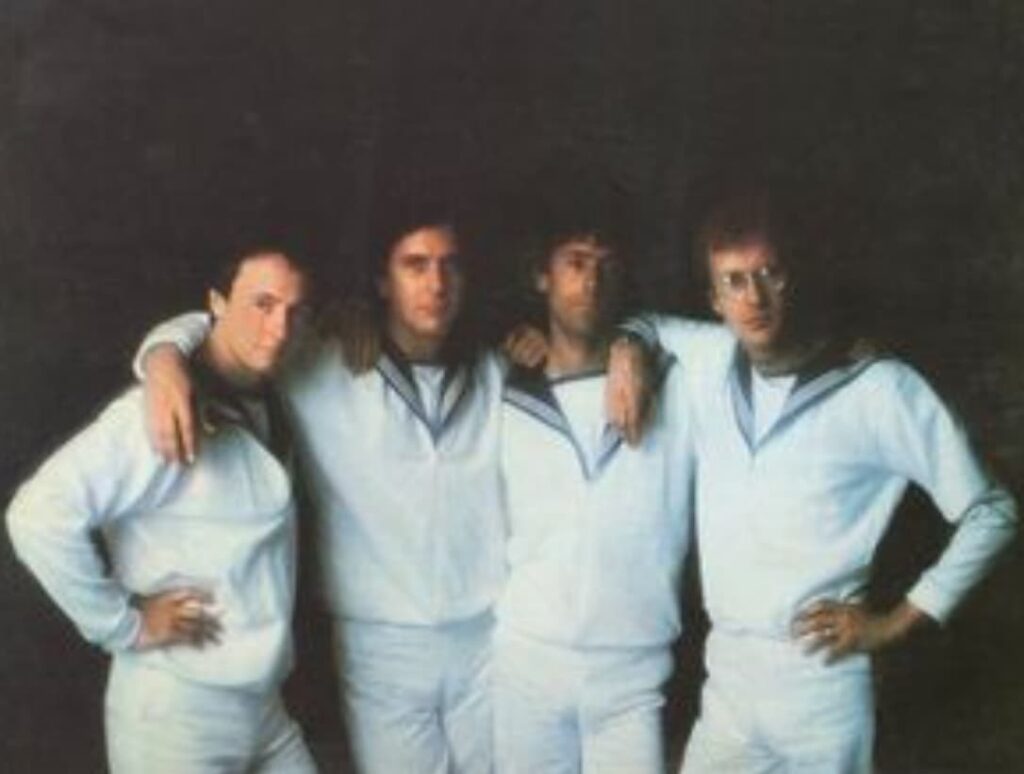
What made “Girls, Girls, Girls” stand out at the time was not raw power or emotional heaviness, but rather its sense of playful storytelling. Sailor—fronted by the charismatic Georg Kajanus, with Grant Serpell, Henry Marsh, and Phil Pickett—were never a conventional rock band. Their sound leaned toward theatrical pop, enriched by unusual instrumentation such as synthesizers and the nickelodeon, giving their music a fairground-like brightness that felt both modern and oddly nostalgic even in its own era.
Behind the lighthearted surface of “Girls, Girls, Girls” lies a clever observation of male fantasy and youthful distraction. The lyrics revolve around a narrator overwhelmed—almost comically so—by the endless parade of feminine allure around him. Rather than presenting romance as deep or tragic, the song treats attraction as a dizzying spectacle, something overwhelming and slightly absurd. This sense of irony is key: the song smiles at its own exaggeration, never taking itself too seriously. In that way, it reflects a very specific moment in pop history, when humor and melody could coexist without apology.
Musically, “Girls, Girls, Girls” is built on a tight, bouncy rhythm and layered vocal harmonies that recall the craftsmanship of earlier British pop traditions, from The Beatles’ lighter moments to the melodic clarity of late-1960s sunshine pop. Yet it is firmly rooted in the 1970s, polished by studio precision and carried by a buoyant, almost nautical momentum—perhaps a subtle nod to the band’s name itself. The production is clean, radio-friendly, and designed to charm rather than confront.
The story behind the song is less about a dramatic personal confession and more about capturing a universal, fleeting feeling: that stage of life when the world feels full of possibility, distraction, and bright faces passing by like scenes through a train window. There is no resolution in the song, no great love won or lost—only the ongoing swirl of impressions. That lack of closure is precisely what gives the song its quiet poignancy when heard decades later.
With time, “Girls, Girls, Girls” has taken on a softer, more reflective glow. What once sounded like carefree pop now carries the gentle weight of memory. For listeners who first encountered it in the 1970s, the song often evokes images of transistor radios, summer holidays, seaside towns, and a world that felt lighter, slower, and less complicated. It reminds us of how pop music once specialized in capturing moments rather than messages—snapshots of feeling, preserved in three perfect minutes.
Within Sailor’s catalog, “Girls, Girls, Girls” remains their signature song, the one most closely associated with their name and legacy. While the band would enjoy other successes, including “A Glass of Champagne,” it is this track that most clearly defines their place in pop history. It stands as a reminder that not all enduring music is heavy or profound on the surface. Sometimes, longevity comes from charm, melody, and an honest reflection of youthful wonder.
Today, listening to “Girls, Girls, Girls” feels like opening an old photo album: the colors slightly faded, the smiles frozen in time, but the emotions still unmistakably alive. It is a song that does not demand attention—it gently invites remembrance.