
“One More Cup of Coffee (Valley Below)” — A Haunting Song of Love, Farewell, and the Call of the Road
When Steve Earle and Lucia Micarelli lent their voices to “One More Cup of Coffee (Valley Below)”, they were not simply performing a song — they were channeling a powerful lineage of storytelling that traces back to one of the most evocative songwriters of the 20th century, Bob Dylan. This recording is a cover of Dylan’s original from his 1976 album Desire, re-envisioned for the 2012 compilation Chimes of Freedom: The Songs of Bob Dylan Honoring 50 Years of Amnesty International, a noble project that brought together artists from many generations to pay tribute to Dylan’s enduring legacy.
Though this version by Earle and Micarelli did not dominate the charts in the way pop singles often do, it did find modest resonance in digital outlets — notably reaching around #50 on the iTunes chart — an achievement that speaks not to explosive mainstream fame but to a quiet appreciation among listeners attuned to the deeper currents of songwriting and performance.
At its heart, One More Cup of Coffee is a song that marries yearning with resignation. The narrator, perched on the edge of departure, reflects on a love that is beautiful yet elusive. In Dylan’s original, recorded in July 1975 and released in January 1976, the tale was inspired by his own experiences at a Romani festival in the south of France — an encounter that seeped into the song’s imagery of wandering, destiny, and the ethereal pull of landscapes both emotional and physical.
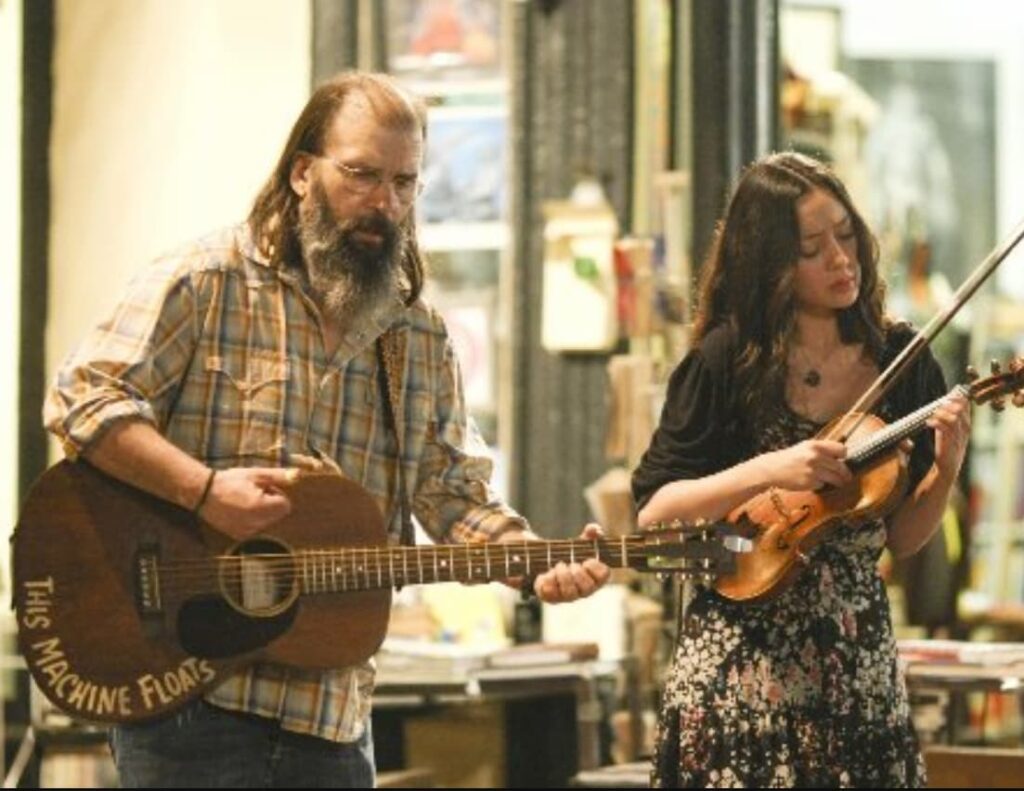
When Steve Earle, a veteran troubadour of American roots music, joins with Lucia Micarelli, a violinist and vocalist of remarkable expressiveness, they bring new texture to this timeless narrative. Earle’s voice — deepened by years on the road and the hard-earned wisdom of a life in music — carries the weary determination of someone who knows all too well the cost of leaving. Micarelli’s contribution adds a luminous thread, weaving a sense of fragility and introspection into the emotional fabric of the song.
For older listeners especially, this duet feels like a conversation across time: between lovers, between past and present, and between the spirit of the original song and its reincarnation in a new era. The repeated line — “One more cup of coffee for the road / One more cup of coffee ’fore I go / To the valley below” — becomes more than a refrain; it becomes an invocation of memory and parting, a final solace before the inevitable journey.
The song’s imagery is rich with metaphors that speak to anyone who has ever stood between attachment and departure. The woman in the narrative is described in vivid terms — her breath “sweet”, her eyes “like two jewels in the sky”, yet her heart remains mysterious and distant. Her family’s mythic roles — a wandering father who teaches blade-throwing, a sister with eyes on the future — add layers of folklore and mystique, emphasizing how love can feel not just unattainable but inexplicably tied to forces beyond our understanding.
For many who grew up with the music of the 1960s and 1970s, Dylan’s original recording was already a companion through winding roads and quiet mornings. To hear Earle and Micarelli’s version — recorded long after the cultural upheavals of that earlier era — is to feel the song’s shadows lengthen further, as if seen through the lens of accumulated years. It becomes not just a song about leaving, but about the bittersweet beauty of reflection itself.
This is music that does not simply entertain; it resonates. It calls to mind the long evenings when a single melody could hold an entire lifetime’s worth of emotion, when every chord carried a memory. In One More Cup of Coffee, Steve Earle and Lucia Micarelli remind us that some songs never fade — they only deepen with time.