
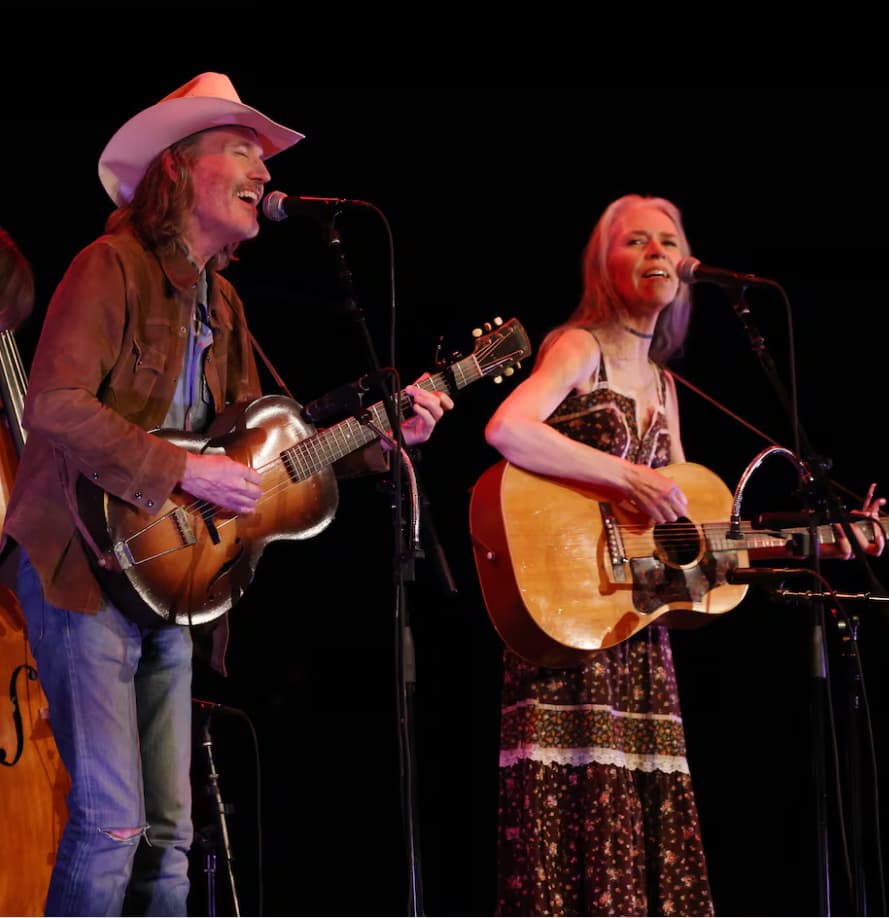
A timeless hymn of farewell and hope — “I’ll Fly Away” as carried into the modern age by Gillian Welch
When Gillian Welch sings “I’ll Fly Away,” she is not merely reviving an old gospel hymn — she is gently reopening a door to one of the most enduring spiritual songs in American music. The hymn itself was written in 1929 by Albert E. Brumley, during a time when the American South was struggling through economic hardship and uncertainty. Its message was simple yet profound: beyond the burdens of earthly life, there is the promise of peace, freedom, and rest.
The version recorded by Gillian Welch and her longtime musical partner David Rawlings appeared in 2000 on the soundtrack album O Brother, Where Art Thou?, a project produced by T Bone Burnett. The soundtrack became one of the most remarkable revival stories in modern folk and roots music. It reached No. 1 on the Billboard Top Country Albums chart, No. 1 on the Billboard Bluegrass Albums chart, and climbed to No. 5 on the Billboard 200, an extraordinary achievement for a record built largely from traditional American songs. The album would later win the Grammy Award for Album of the Year in 2002, an honor rarely granted to a roots or folk-oriented project.
Welch’s rendition of “I’ll Fly Away” is brief and unadorned — barely over a minute long — yet it carries a weight of feeling that far exceeds its length. Her voice, accompanied only by Rawlings’ understated guitar, feels like a quiet conversation rather than a performance. There is no grand arrangement, no attempt to modernize the melody. Instead, Welch leans into the fragile beauty of the hymn, allowing the words to breathe in a way that feels both ancient and immediate.
The story behind the song itself has always been part of its charm. Albert E. Brumley, who worked as a cotton picker in Oklahoma before becoming a prolific gospel songwriter, reportedly wrote “I’ll Fly Away” while imagining the monotony of long hours in the fields. He later said the song was inspired by the feeling of longing for freedom — the same longing expressed in the spirituals sung by generations before him. In that sense, the song’s promise of “flying away” was never only about heaven; it was also about release from hardship and the hope of a better place.
Over the decades, “I’ll Fly Away” became one of the most recorded gospel songs in American history. It has been performed by artists across many traditions — from Johnny Cash and Alison Krauss to bluegrass pioneer Bill Monroe. But the moment when the song returned to widespread public attention came with the film O Brother, Where Art Thou? (2000), directed by Joel and Ethan Coen. In the film, the music functions almost like a narrative voice, and Welch’s version of the hymn appears as a fleeting but unforgettable moment.
What makes Gillian Welch’s interpretation so powerful is its emotional restraint. She sings the lines not with the certainty of a preacher but with the quiet reflection of someone who has spent time contemplating life’s long journey. The lyric — “Some bright morning when this life is over, I’ll fly away” — feels less like a declaration and more like a gentle reassurance whispered across generations.
For listeners who grew up with gospel quartets on the radio or Sunday morning hymns echoing through small churches, the melody carries a familiarity that can stir deep memories. Yet Welch’s voice also gives the song a sense of fragile intimacy, as though it has traveled through time and arrived in the present unchanged.
In the broader landscape of American folk music, Gillian Welch has always acted as a kind of careful historian — someone who understands that the old songs still speak, if they are allowed to remain honest and unpolished. Her work on O Brother, Where Art Thou? helped reintroduce traditional Appalachian and gospel music to a new generation, and “I’ll Fly Away” became one of the emotional cornerstones of that revival.
More than ninety years after it was written, the hymn still carries the same quiet promise that Albert E. Brumley first imagined. In Welch’s voice, it feels less like a relic of the past and more like a gentle reminder that music — especially the old songs — has a way of holding our memories, our hopes, and our faith in something beyond the horizon.