
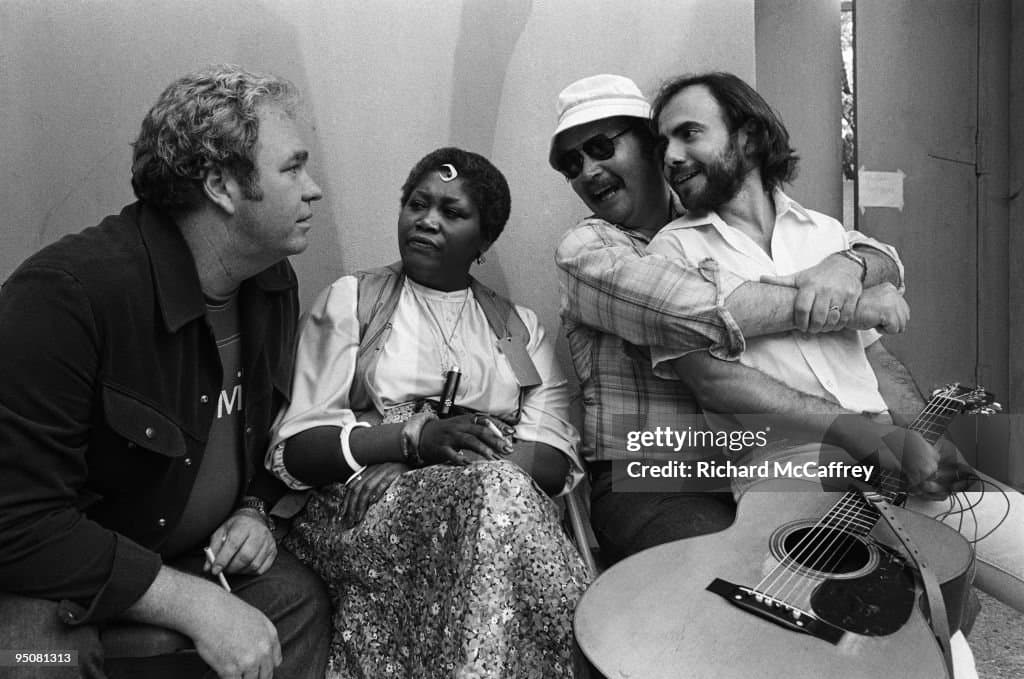
A Joyful Anthem of Hope and Devotion That Turned a Ballpark Into a Living Choir
Few songs capture the spirit of a city and its long-suffering faith quite like “Go Cubs Go” by Steve Goodman. Released in 1984 and later immortalized as the victory anthem of the Chicago Cubs, this buoyant, brass-laced singalong was far more than a novelty tune. It was the last gift of a devoted fan, written in the shadow of illness, and it would eventually echo through one of the most historic championship moments in American sports.
“Go Cubs Go” was recorded for the album Affordable Art (1984), the final studio album released during Goodman’s lifetime. Although the song did not chart on the Billboard Hot 100—a reminder that not every cultural treasure is born in the hit parade—it gained a second life in 2007 when the Chicago Cubs adopted it as their official victory song at Wrigley Field. Since then, it has been sung after every home win, transforming the ballpark into a sea of swaying arms and smiling faces.
To understand the song’s emotional weight, one must understand Steve Goodman himself. A beloved Chicago-born folk singer-songwriter, Goodman was already widely respected for penning “City of New Orleans,” famously recorded by Arlo Guthrie in 1972. But by the early 1980s, Goodman was battling leukemia—a fight he had waged on and off since his youth. In 1984, as his health declined, he was commissioned to write a song for the Cubs. The team, at the time, had not won a World Series since 1908. Generations had grown up believing, half in jest and half in resignation, that the Cubs were destined to fall short.
Goodman approached the assignment not with irony, but with joy.
Instead of writing a lament, he composed a bright, brassy, Dixieland-style celebration. “Go Cubs Go” bursts with optimism: “Go Cubs Go! Go Cubs Go! Hey Chicago, what do you say? The Cubs are gonna win today!” It is simple, direct, and unpretentious. There is no poetic abstraction here—only faith, camaraderie, and a childlike certainty that today might finally be the day.
The story carries a poignant twist. Goodman passed away in September 1984, just days before the Cubs clinched the National League East division title—their first postseason appearance since 1945. He never saw the team reach that milestone. And he certainly never saw what would happen more than three decades later, when the Cubs won the 2016 World Series, defeating the Cleveland Indians in a dramatic seven-game series. That autumn, “Go Cubs Go” rang out with a different resonance. It was no longer hopeful—it was triumphant. The long wait was over, and Goodman’s voice, recorded decades earlier, became part of baseball history.
Musically, the song is rooted in Goodman’s folk sensibility but dressed in festive, almost vaudevillian instrumentation. Its structure is uncomplicated, almost deliberately so, making it accessible to everyone in the stands. That simplicity is its genius. Like the best communal songs, it invites participation rather than admiration. It does not ask to be analyzed; it asks to be sung.
And yet, beneath its cheer lies something deeply moving. When one listens closely, knowing Goodman’s circumstances, the song becomes an act of defiance against despair. It is the sound of a man refusing to let illness define his final chapter. It is laughter in the face of mortality. It is belief in tomorrow.
Unlike many anthems engineered by marketing departments, “Go Cubs Go” feels handmade. It carries the warmth of a songwriter who loved his city, loved his team, and understood the emotional ritual of sports fandom. For many, the song recalls radio broadcasts drifting through summer evenings, the crack of a bat on a sunlit afternoon, the shared hope that this season would be different.
Today, whenever it plays at Wrigley Field, the crowd does not merely celebrate a win. They celebrate endurance—of a team, of a fan base, and of a songwriter whose melody outlived him. Steve Goodman may not have seen the championship he dreamed of, but his song became part of it.
And perhaps that is the deeper meaning of “Go Cubs Go.” It reminds us that faith, even when it seems naïve, has power. That loyalty matters. That joy, when shared, multiplies. In the end, it is not just about baseball. It is about believing—season after season—that hope is worth singing about.