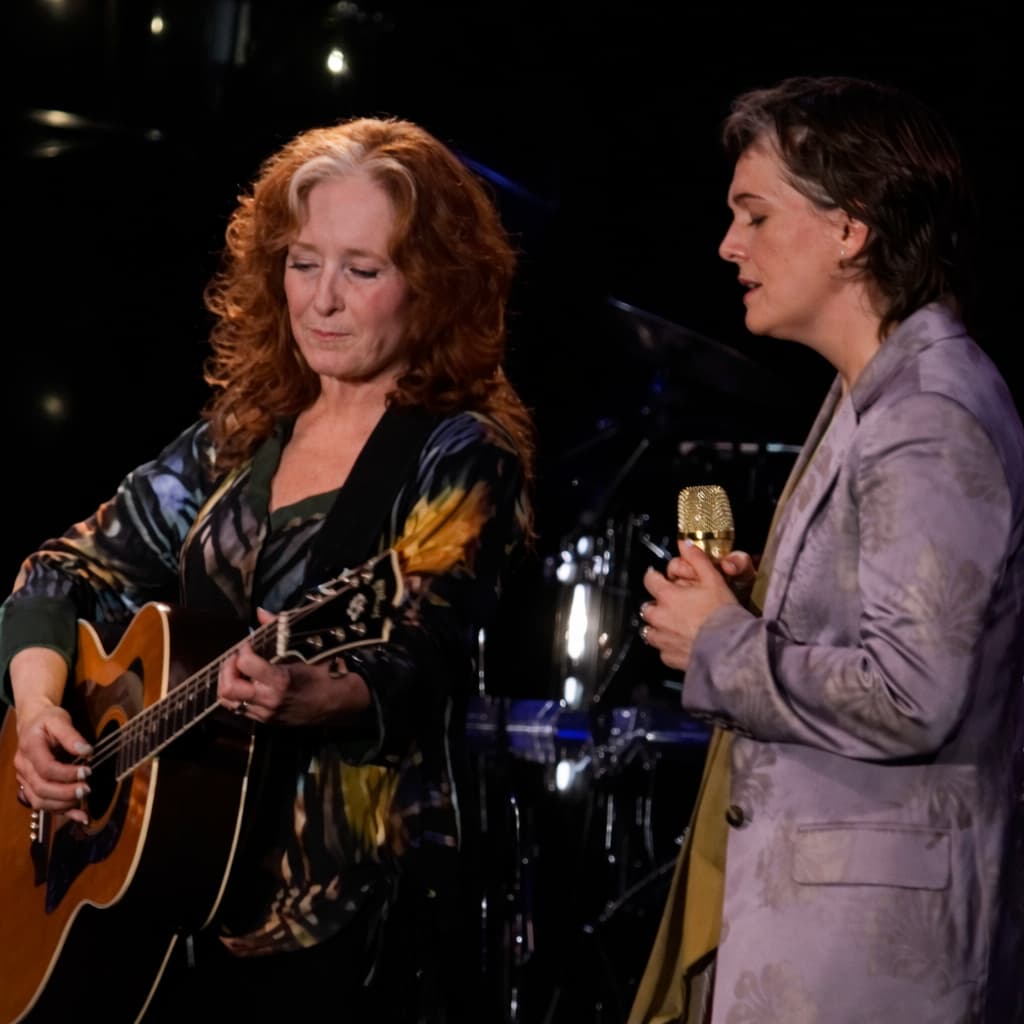
A Tender Conversation Across Generations About Loneliness, Longing, and Quiet Resilience
When “Angel From Montgomery” is mentioned, it is impossible not to think first of its author, John Prine, who wrote the song in 1971 and included it on his self-titled debut album, John Prine. That record, produced by Arif Mardin and released on Atlantic Records, did not dominate the charts in a commercial sense, but it quietly became one of the most revered debut albums in American songwriting. Over the decades, the song grew into a standard—passed from voice to voice like a cherished letter.
One of the most poignant modern interpretations comes from Bonnie Raitt & Brandi Carlile, two artists who approach the song not as a performance piece, but as a shared act of reverence. Though their duet has most often appeared in live settings—particularly at tribute concerts honoring John Prine—its emotional impact has been profound. When performed at events such as the 2020 tribute special celebrating Prine’s life and legacy, their rendition felt less like a cover and more like a continuation of his spirit.
Originally, “Angel From Montgomery” was not a chart-topping single. In fact, it was never released as a major hit single upon its initial recording. Yet paradoxically, it became one of the most covered and beloved songs in American folk and country music. When Bonnie Raitt recorded her now-classic version for her 1974 album Streetlights, the song found a wider audience. Although her rendition did not storm the Billboard Hot 100, it became a signature piece in her live performances and helped solidify her reputation as one of the most expressive interpreters of contemporary songwriting.
The story behind the song is deceptively simple. John Prine, in his early twenties, imagined the inner life of a middle-aged woman trapped in a quiet, loveless marriage in Montgomery, Alabama. It is astonishing that such emotional maturity came from someone so young. Prine once remarked that he wrote the song quickly, inspired by the idea of giving a voice to someone rarely heard in popular music—a woman reflecting on the compromises of her life.
“Make me an angel that flies from Montgomery,” the narrator pleads. The line is not about religious salvation. It is about escape—about the longing to feel alive again. The “angel” becomes a metaphor for renewal, dignity, perhaps even remembrance of who one once was. The song’s power lies in its restraint. There are no dramatic crescendos, no elaborate storytelling devices. Instead, there is honesty—plainspoken and devastating.
When Bonnie Raitt & Brandi Carlile perform the song together, something remarkable happens. Raitt, who has carried the song in her repertoire for decades, brings seasoned empathy—her voice textured by time, experience, and survival. Brandi Carlile, herself deeply influenced by Prine and Raitt, enters not as a replacement voice but as a bridge between eras. Their harmonies do not compete; they console.
Carlile has often spoken publicly about how much John Prine meant to her artistic development. At tribute performances, her emotional connection is unmistakable. The duet version typically strips the song down to acoustic guitar and minimal accompaniment, honoring the folk tradition from which it emerged. The absence of studio polish becomes part of the statement: this is a song that survives because it is true.
It is worth noting that while “Angel From Montgomery” did not achieve high chart positions upon release, its cultural placement far exceeds any numerical ranking. It has appeared on numerous “greatest songs” lists and has been recorded by artists across genres, from country to Americana. Its endurance speaks to something deeper than popularity—it speaks to recognition. Listeners see themselves in its verses.
The meaning of the song shifts subtly with time. In youth, one may hear it as a story of regret. Later, it becomes something more layered—a meditation on endurance, on the quiet bravery of waking up each day even when dreams have faded. The line “Just give me one thing that I can hold on to” resonates differently as years pass. It becomes less about escape and more about connection.
In the hands of Bonnie Raitt & Brandi Carlile, the song becomes a dialogue between gratitude and grief. It carries the weight of John Prine’s absence while celebrating the gift he left behind. There is a tenderness in their phrasing, a patience in the pacing, that feels almost conversational. They do not rush the story. They let it breathe.
And perhaps that is why “Angel From Montgomery” continues to endure. It does not shout. It does not demand attention. It simply waits—like an old friend—ready to sit beside you and speak the truths that are hardest to say aloud.
Some songs belong to a year. Others belong to a generation. This one belongs to a lifetime.