
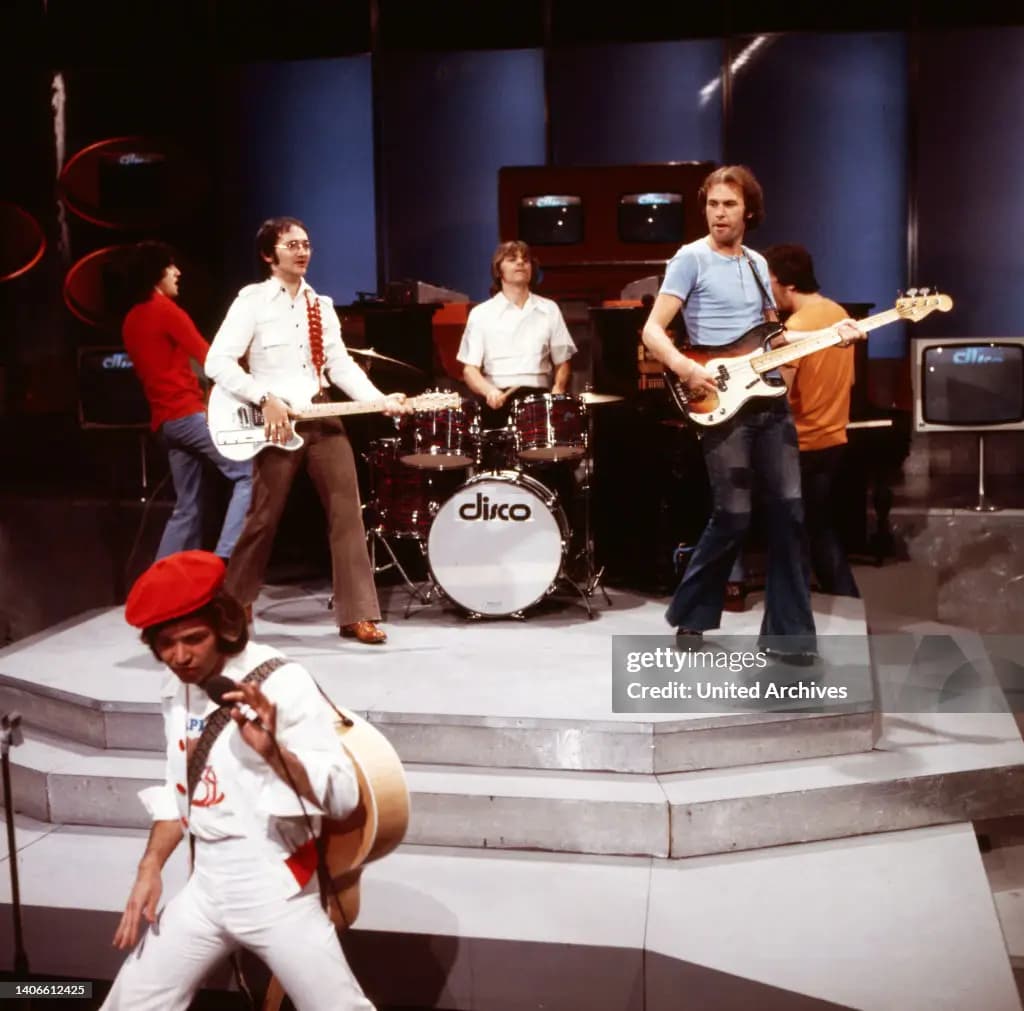
A joyful burst of youthful harmony and nostalgic innocence, capturing the carefree spirit of mid-1970s pop in its purest form
When speaking of the golden age of British pop revivalism in the mid-1970s, one cannot overlook the cheerful charm of “Foe-Dee-Oh-Dee” by The Rubettes—a song that, while not reaching the towering heights of their debut smash, still holds a treasured place among listeners who remember that era with warmth and affection.
Released in 1975, “Foe-Dee-Oh-Dee” followed the monumental success of their breakthrough hit “Sugar Baby Love” (1974), which had soared to No. 1 on the UK Singles Chart and introduced the group’s distinctive blend of doo-wop harmonies and polished pop production. By contrast, “Foe-Dee-Oh-Dee” achieved a more modest but respectable chart performance, peaking at around No. 17 on the UK Singles Chart. Though it did not replicate the explosive success of its predecessor, it reinforced The Rubettes’ identity as torchbearers of a nostalgic sound that bridged generations.
Included on their 1975 album “We Can Do It”, the song exemplifies the band’s dedication to reviving the spirit of 1950s American doo-wop, filtered through a distinctly British pop sensibility. The production, guided by the songwriting team of Wayne Bickerton and Tony Waddington, is clean, buoyant, and unmistakably crafted for radio—a hallmark of the era when melody and harmony reigned supreme.
At its heart, “Foe-Dee-Oh-Dee” is deceptively simple. The lyrics revolve around youthful affection, playful courtship, and the kind of innocent romance that feels almost untouched by time. The titular phrase itself—“foe-dee-oh-dee”—functions less as literal language and more as an emotional refrain, echoing the nonsense syllables that defined classic doo-wop. In this sense, the song is less about storytelling and more about feeling—a lighthearted celebration of joy, rhythm, and connection.
Behind the scenes, the success of The Rubettes was not without its complexities. The band was originally assembled by producers rather than formed organically, a common practice in the 1970s pop industry. Yet, despite this manufactured beginning, the group developed a genuine musical chemistry that resonated with audiences. Their signature white suits and caps, combined with tight vocal arrangements, created a visual and sonic identity that was instantly recognizable.
Listening to “Foe-Dee-Oh-Dee” today is like opening a well-preserved photograph album. There is a certain glow to it—an unhurried optimism that reflects a time when pop music often served as a gentle escape from the weight of the world. The harmonies are rich yet unpretentious, the rhythm inviting without demanding, and the overall mood unmistakably uplifting.
What makes the song particularly meaningful is how it captures a fleeting cultural moment. In the mid-1970s, there was a renewed fascination with the past—especially the romanticized innocence of the 1950s. The Rubettes, alongside acts like Showaddywaddy and Mud, helped bring that sound back into the mainstream, offering listeners both nostalgia and novelty in equal measure.
Perhaps the enduring appeal of “Foe-Dee-Oh-Dee” lies in its sincerity. It does not strive for grandeur or depth in the conventional sense; instead, it embraces simplicity with confidence. And in doing so, it reminds us that sometimes the most lasting musical memories are those built on melody, harmony, and a feeling that lingers long after the final note fades.
For those who revisit it now, the song may evoke not just a particular time in music history, but also personal moments—dances, radio afternoons, or quiet evenings when a tune like this could brighten the room without asking for much in return. In that way, “Foe-Dee-Oh-Dee” remains more than just a pop song; it is a gentle echo of a world that once felt a little lighter, a little simpler, and undeniably full of song.