
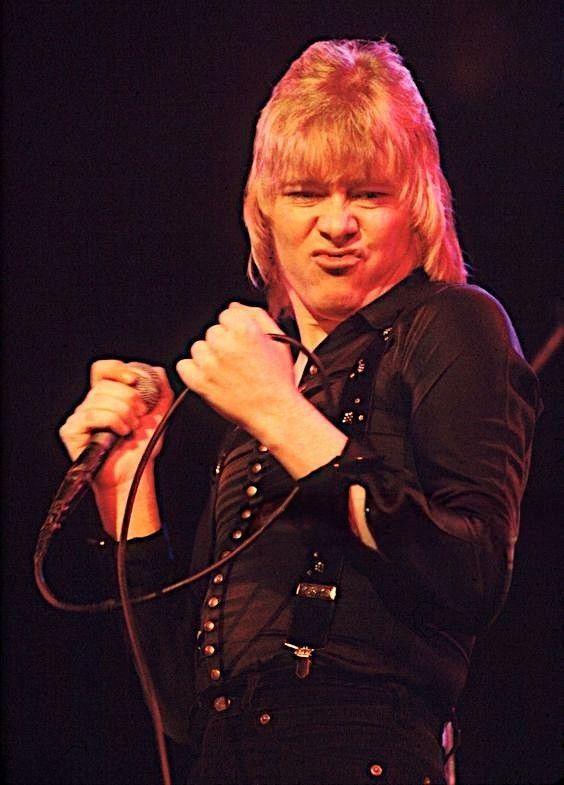
A Fading Glitter Reignited: Sweet and Brian Connolly in Hanau, 1986 — a voice of glory, fragility, and memory intertwined
In 1986, when Brian Connolly, the unmistakable voice of Sweet, stepped onto the stage in Hanau, Germany, it was not merely another concert—it was a deeply symbolic return of a man whose voice had once defined the glittering heights of 1970s glam rock. Though no longer riding the commercial peaks of earlier years, Connolly carried with him a legacy that had once dominated the charts. During their prime, Sweet scored multiple Top 10 hits in the UK, including “Block Buster!” (UK No. 1, 1973), “Hell Raiser” (UK No. 2, 1973), and “The Ballroom Blitz” (UK No. 2, 1973; US No. 5). Their albums, such as “Desolation Boulevard” (1974), cemented their reputation as both hitmakers and pioneers of a flamboyant yet hard-edged sound.
By the time of the Hanau 1986 performance, however, the story had changed. Connolly was no longer part of the original lineup of Sweet—the band had fractured in the late 1970s amid internal tensions and shifting musical directions. More significantly, Connolly had suffered severe vocal damage following an assault in 1974, an incident that irreversibly altered his once-crystalline tenor. Listening to recordings from Hanau, one cannot help but hear both the echoes of former brilliance and the unmistakable strain of a voice that had endured too much. Yet therein lies the emotional core of this performance: it is not perfection we witness, but perseverance.
The setlist typically leaned on the band’s classic hits—songs that once roared through arenas now revisited in smaller venues, carried by an audience that remembered every word. When Connolly sang “Love Is Like Oxygen” (UK No. 9, US No. 8, 1978), the song’s message seemed to take on a new, almost autobiographical weight. Originally released during the band’s later, more mature phase, the track spoke of dependency and survival—fitting metaphors for Connolly’s own life and career by the mid-1980s.
There is something profoundly moving about watching an artist revisit their own past under such circumstances. In Hanau, Connolly was not simply performing songs; he was, in a sense, negotiating with memory. Each note carried the weight of what once was, and each applause line felt like a quiet acknowledgment from the audience: we remember you, and we remember who you were. This unspoken dialogue between performer and listener gives the 1986 concert its enduring emotional resonance.
It is also worth noting that the mid-1980s marked a period when nostalgia for 1970s glam rock was beginning to quietly re-emerge, even as new wave and synth-pop dominated the charts. Connolly’s performances, including this one in Germany, served as a bridge between eras—reminding audiences of a time when music was theatrical, bold, and unapologetically exuberant. His presence, though diminished in technical strength, remained emotionally potent.
Behind the glitter and chart success of earlier years, Sweet had always balanced pop accessibility with a harder rock edge, a duality that influenced countless acts that followed. In Hanau, stripped of the full machinery of their heyday, the songs revealed their underlying structure more clearly—melodies that still held, choruses that still soared, even when the voice delivering them faltered.
In retrospect, the Hanau 1986 performance stands as a poignant chapter in the story of Brian Connolly. It reminds us that music is not only about technical perfection or chart positions, but about connection—between artist and audience, past and present, strength and vulnerability. For those who remember the golden years of Sweet, this concert is not simply a document of decline, but a testament to endurance. And perhaps, in its imperfections, it speaks more honestly than any polished studio recording ever could.