
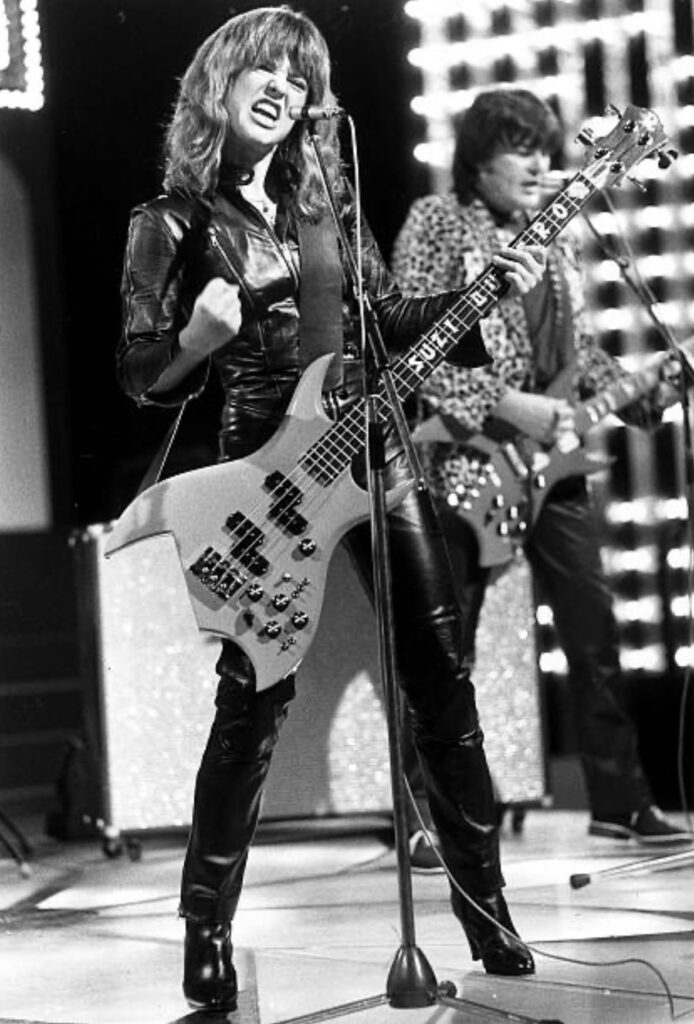
Suzi Quatro’s “Glycerine Queen” is a roaring anthem of self-empowerment and challenging societal norms.
Ah, the 1970s. What a time it was, wasn’t it? A whirlwind of change, of rebellion, of sounds that were utterly unlike anything we’d heard before. And right at the heart of that exhilarating storm, with her leather jumpsuit, bass guitar, and a snarl that could melt steel, stood Suzi Quatro. For many of us, she wasn’t just a musician; she was a seismic shift, a groundbreaking force who carved out a space for women in rock and roll that had, until then, felt largely impenetrable. Tonight, let’s cast our minds back to one of her early, electrifying declarations: the track that announced her arrival with a defiant roar, “Glycerine Queen.”
Released in 1973, “Glycerine Queen” was featured on her debut album, the self-titled “Suzi Quatro.” While it might not have scaled the dizzying heights of some of her later, more pop-oriented hits, this particular track served as a crucial cornerstone in establishing her image and musical identity. It was a clear statement of intent, a raw, unvarnished piece of glam rock that throbbed with an undeniable energy. While exact individual chart positions for album tracks can be elusive, the album itself, “Suzi Quatro,” performed admirably, particularly in the UK and Australia, laying the groundwork for her massive success. It was clear from the outset that Suzi Quatro was not just a fleeting novelty; she was a genuine rock and roll contender.
The story behind “Glycerine Queen” is deeply intertwined with Suzi Quatro‘s own journey and her relentless drive to be seen and heard on her own terms. Before her breakthrough in the UK, she had honed her craft for years in various bands in her native Detroit, most notably with her sisters in The Pleasure Seekers and Cradle. She was already a seasoned performer, a powerhouse on the bass, and a vocalist with a distinctive growl. However, it wasn’t until she was discovered by legendary producer Mickie Most, who saw her potential not just as a musician but as a unique rock and roll icon, that her solo career truly began to ignite. “Glycerine Queen,” with its swaggering attitude and confrontational lyrics, perfectly encapsulated this transition. It was her shedding of any remaining vestiges of past constraints, a full embrace of her singular persona.
At its core, “Glycerine Queen” is an anthem of self-possession and a fierce rejection of societal expectations, particularly those placed upon women. The term “Glycerine Queen” itself is evocative. Glycerine, a clear, viscous liquid, often associated with smoothness or perhaps even a certain artificiality, could be interpreted as a symbol of the superficiality or the expected “sweetness” that women were often pressured to embody. By declaring herself the “Glycerine Queen,” Suzi Quatro is not necessarily embracing this superficiality, but rather, she’s taking ownership of it, twisting its meaning, and infusing it with her own rebellious spirit. It’s a defiant reclaiming of identity. The lyrics speak to a woman who is in control, unapologetically sensual, and utterly unafraid to challenge the status quo. Lines like “I’m the queen of all that’s low” or “I’m the queen of all that’s dirty” are not confessions of depravity, but rather, a celebration of breaking free from conventional notions of femininity and embracing a raw, authentic power. It’s a shout-out to every woman who ever felt stifled by expectations, a reminder that true strength lies in embracing one’s own truth, no matter how unconventional.
For those of us who came of age in the 70s, “Glycerine Queen” wasn’t just a song; it was a feeling. It was the soundtrack to a burgeoning sense of liberation, a powerful statement delivered by a woman who looked and sounded like no one else. It gave voice to a yearning for authenticity and a rejection of pretense. You could hear the grit of Detroit in her voice, the swagger of London’s glam scene in the instrumentation, and the universal cry for individuality in every word. It’s a track that continues to resonate, a potent reminder of the enduring power of rock and roll to empower, to challenge, and to set us free. So, turn it up, close your eyes, and let the roar of the “Glycerine Queen” take you back to a time when anything felt possible, and a woman with a bass guitar could change the world.