
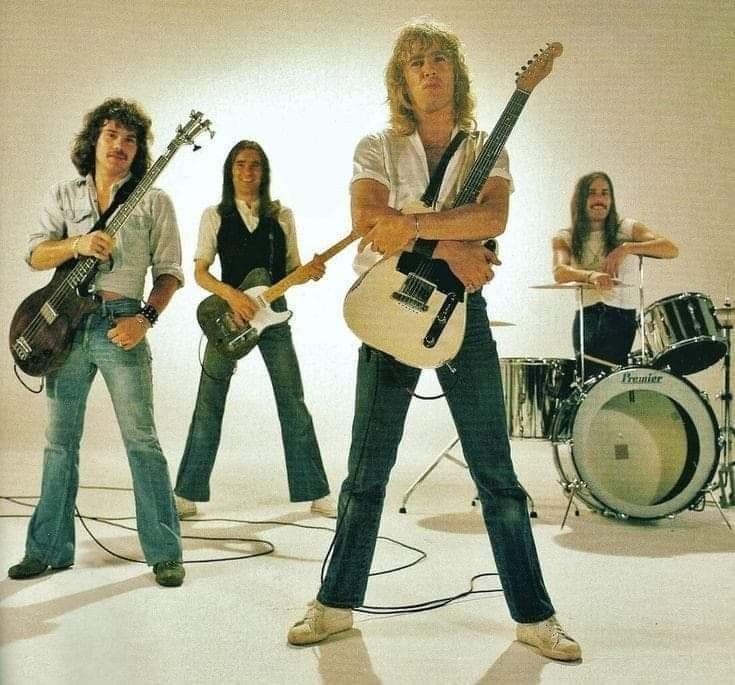
A Quirky Gem from the Quo: The Enduring Charm of “Gerdundula”
Ah, Status Quo. Just hearing that name conjures up images of denim, long hair, and that unmistakable, relentless boogie-rock shuffle that powered a thousand pubs and arenas across the decades. For those of us who came of age with their music, it’s more than just a band; it’s a soundtrack to countless memories – sticky dance floors, hazy summer nights, and the sheer, unadulterated joy of live music. While their reputation often rests on their later, more overtly commercial hits, it’s in their earlier, slightly less polished gems that you often find the true heart and soul of the Quo. And among these, nestled quietly on the B-side of a single and then later on an album, lies the curious and charming “Gerdundula.”
Now, “Gerdundula” wasn’t a massive chart-topper in its own right, and that’s precisely part of its allure. Originally released as the B-side to the single “In My Chair” in October 1970, that single itself fared reasonably well, reaching No. 21 in the UK Singles Chart and No. 38 in Germany. However, it wasn’t until a few years later that “Gerdundula” got its full moment in the sun, appearing on their critically acclaimed 1971 album, Dog of Two Head. Later, it was even re-released as a standalone single in July 1973, though it notably failed to chart on that occasion. This isn’t a tale of a meteoric rise, but rather of a song that, like a comfortable old armchair, just quietly was. It simply existed within the Quo canon, a testament to their prolific songwriting and their journey from psychedelic pop to the boogie powerhouse we all know and love.
The story behind “Gerdundula” is as understated as the song itself, and rather amusing. Penned by the formidable duo of Francis Rossi and Bob Young, the band’s long-time harmonica player and lyricist, the song was reputedly written while they were in Germany. What’s more, for its initial release, they chose to credit it under the pseudonyms John Manston and Collin James. This little quirk adds to the song’s endearing mystique, a little wink from the band to their most dedicated fans. It suggests a certain carefree attitude, a moment of spontaneous creativity that wasn’t overly concerned with formal recognition, but rather with simply capturing a musical idea.
As for its meaning, “Gerdundula” largely remains an enigma. The lyrics, if one can even call them that in the traditional sense, are simple, almost childlike incantations. There’s no grand narrative or profound message to decipher. Instead, the song is primarily an instrumental showcase, built around a deceptively simple yet incredibly catchy guitar riff and a driving, rhythmic foundation. It’s a prime example of the early Quo embracing their raw, blues-rock instincts, laying the groundwork for the stripped-down, no-frills sound that would define their most successful period. The “meaning” then, isn’t in what the words say, but in how the music feels. It’s about the groove, the infectious energy, and the sheer joy of playing. It embodies the essence of Status Quo during a pivotal time in their evolution, as they shed the last vestiges of their psychedelic past and honed in on the boogie sound that would make them legends. It’s a reminder of a time when music was less about intricate lyrical tapestries and more about the visceral, immediate impact of a well-played riff and a driving rhythm. For many of us, it evokes memories of carefree days, of simply letting the music take hold and moving with its pulse. And sometimes, isn’t that the most profound meaning of all?