
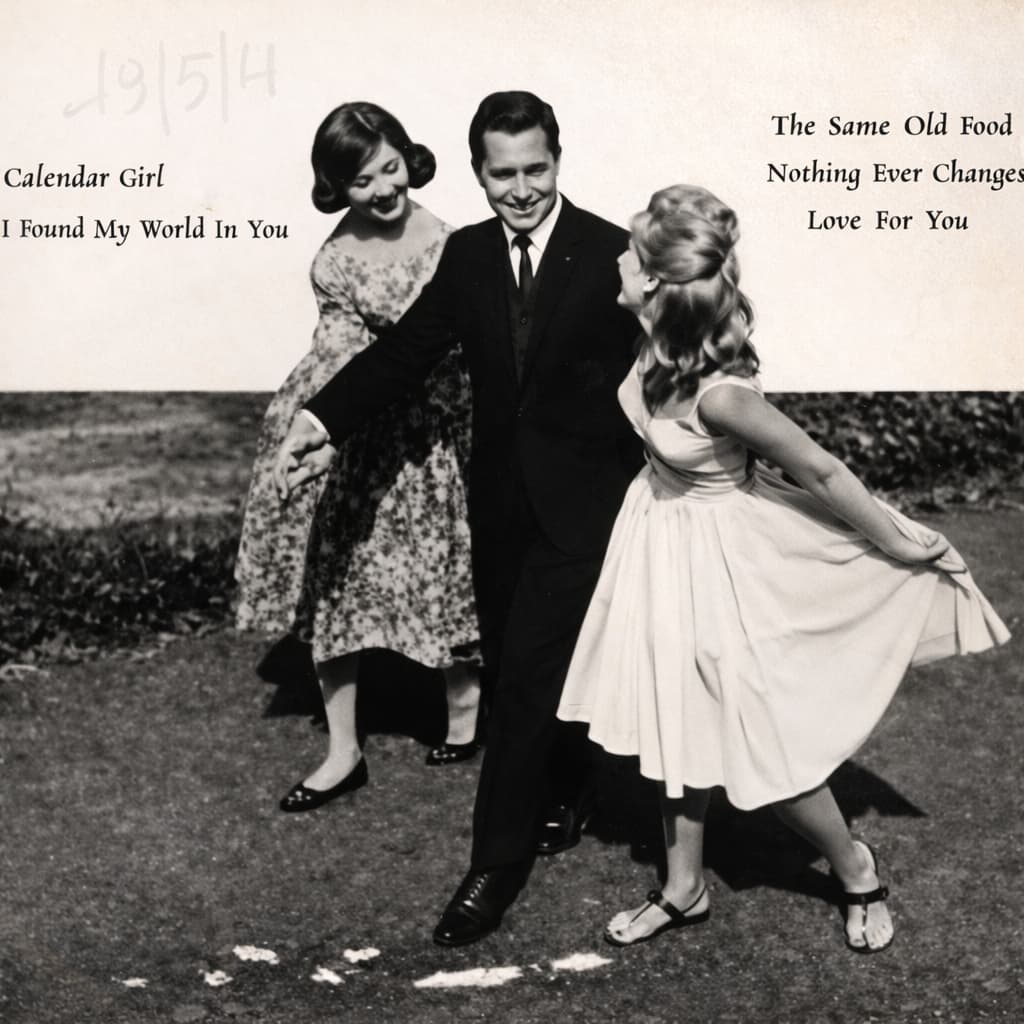
A Joyful Countdown of Young Love and the Sweet Promise of Every Month
When Neil Sedaka released “Calendar Girl” in late 1960, he was still a young man standing at the threshold of a remarkable career—but the song itself felt timeless from the very first spin. It quickly climbed to No. 4 on the Billboard Hot 100 in early 1961, becoming one of the defining hits of Sedaka’s early years. In the United Kingdom, it reached No. 8 on the UK Singles Chart, confirming that his appeal crossed the Atlantic with ease. Issued as a single and later included on his album “Neil Sedaka Sings Little Devil and His Other Hits,” the song solidified his place among the brightest pop craftsmen of the early 1960s.
What makes “Calendar Girl” endure is not complexity—it is clarity. Written by Neil Sedaka and his longtime collaborator Howard Greenfield, the song is a celebration of steady, uncomplicated devotion. Each verse moves month by month—“January, you start the year off fine…”—offering a tender promise that love is not fleeting or seasonal but constant, dependable, and joyful. In an era when pop music was often dismissed as disposable teen fare, Sedaka and Greenfield managed to craft something deceptively simple yet emotionally resonant.
Behind the cheerful melody lies a deeper truth about the time in which it was born. The early 1960s were poised between the innocence of the 1950s and the cultural upheavals that would soon reshape the world. “Calendar Girl” stands squarely in that golden moment before the storm—before the British Invasion, before folk turned political, before rock grew louder and heavier. There is a purity to its production, recorded in New York’s famed Brill Building orbit, where songwriters labored with discipline and melodic precision. You can hear the handclaps, the buoyant rhythm section, the bright piano—every note crafted with care.
Sedaka himself, classically trained at the Juilliard School’s preparatory division, brought an almost architectural sense of melody to his compositions. Yet he never allowed technical skill to overshadow warmth. In “Calendar Girl,” his voice carries a youthful sincerity—earnest, slightly nasal, undeniably charming. There is no irony here. No cynicism. Just the open-hearted certainty that love can make every month shine.
The song’s structure reinforces its message. By moving through the calendar, it suggests permanence. This is not a passing romance tied to summer nights or spring blossoms; it is a year-round commitment. Each month becomes a small chapter in a larger story, a gentle reassurance that affection can weather seasons and time. That sentiment resonated deeply with listeners in 1961—and continues to resonate decades later.
There is also something quietly sophisticated about the lyric’s restraint. Rather than grand declarations, Sedaka offers small, affectionate observations. Love is measured not in dramatic gestures but in consistency. The repetition becomes comforting, almost like flipping through an old wall calendar and remembering the milestones marked in pen—birthdays, anniversaries, simple shared moments.
As the decades rolled on, musical styles changed dramatically. Rock grew rebellious. Folk grew reflective. Soul grew urgent. Yet “Calendar Girl” remains anchored in its moment—a sparkling artifact of a gentler pop era. It evokes transistor radios on kitchen counters, vinyl spinning beneath careful hands, and the thrill of hearing a favorite song crackle through AM speakers.
In retrospect, the song also marks an important chapter in Sedaka’s own journey. He would experience career highs and lows, temporary fades from the spotlight, and a triumphant resurgence in the 1970s. But “Calendar Girl” stands as one of the pillars of his early success, alongside hits like “Oh! Carol” and “Happy Birthday Sweet Sixteen.” It represents a time when melody reigned supreme and a well-crafted pop song could feel like a small miracle.
Listening today, one cannot help but feel the gentle tug of nostalgia. Not merely for youth, but for an era when love songs dared to be unabashedly sweet. “Calendar Girl” is more than a catchy tune—it is a reminder that devotion, expressed simply and sincerely, never goes out of style. And perhaps that is why, more than sixty years later, its pages still turn with undiminished warmth.