
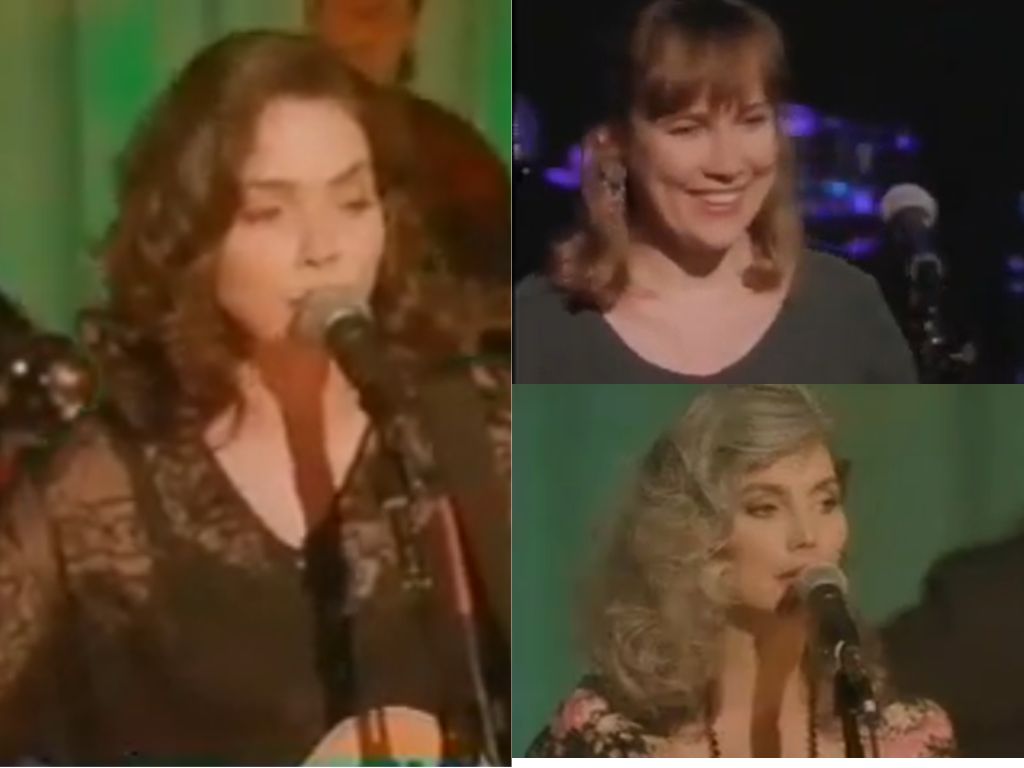
A Timeless Folk Treasure Revisited: Nanci Griffith, Emmylou Harris, and Iris DeMent Breathe New Life into “Are You Tired of Me Darling”
Few moments in folk music capture the enduring power of a traditional song quite like Nanci Griffith’s performance of “Are You Tired of Me Darling” from her acclaimed project Other Voices, Other Rooms. Preserved in a VHS recording and later shared with a wider audience, this segment features Griffith joined by Emmylou Harris and Iris DeMent in a heartfelt interpretation of a song that has survived nearly a century and a half.
Before the performance begins, Griffith reflects on the song’s remarkable emotional impact. She explains that although she never met the artist who had previously recorded it and inspired her admiration, the song immediately moved her when she first heard it. Its beauty and emotional depth, she says, reminded her why being involved in music is such a meaningful experience.
Griffith notes that “Are You Tired of Me Darling” was the oldest song included on her album of folk music. Written in 1877 by G.P. Cook and Ralph Roland, the piece is expressed from a woman’s perspective and conveys deeply personal feelings of vulnerability, devotion, and uncertainty. Griffith openly marvels at how two men living in the nineteenth century could have created such a sensitive and convincing female voice. The question became a topic of discussion among several musicians during the recording sessions, including Carolyn Hester, Arlo Guthrie, Chet Atkins, and Emmylou Harris.
According to Griffith, the conversation eventually led to a memorable response from Arlo Guthrie. Rather than offering a philosophical explanation, he jokingly suggested that it simply “took two of them” to write such a song. The lighthearted remark brought humor to a discussion centered on one of the most emotionally perceptive compositions in the folk tradition.
The recording itself highlights the collaborative spirit that defined Other Voices, Other Rooms. Griffith explains that Emmylou Harris contributed a lower harmony part, while Iris DeMent sang the higher harmony. Introducing the performance with warmth and playful humor, Griffith recalls that DeMent was assigned the difficult high part because she was the newest member of the group.
When the music begins, the conversation gives way to a performance marked by restraint, sincerity, and exquisite vocal blending. Griffith’s clear and expressive lead vocal is supported by the distinctive harmonies of Harris and DeMent, creating an atmosphere that honors both the song’s age and its emotional relevance. More than a century after its creation, “Are You Tired of Me Darling” remains a powerful reminder that genuine human feeling can transcend time, generation, and circumstance.
The performance stands as a testament to the ability of great folk music to connect the past with the present, preserving voices and stories that continue to resonate long after they were first written.