
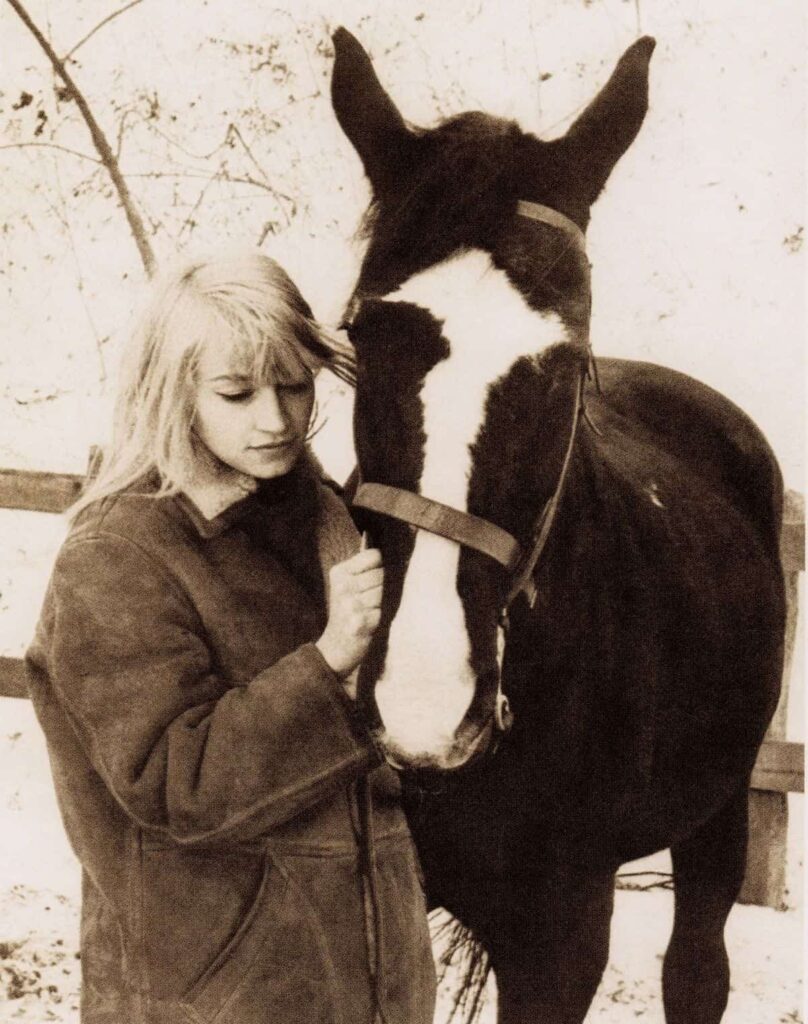
“Follow Me” — a gentle invitation into intimacy, simplicity, and the quiet longing for togetherness
In the early 1970s, when popular music was slowly moving away from the collective idealism of the 1960s folk revival into something more personal and introspective, “Follow Me” emerged as one of those quietly luminous songs that did not demand attention, but rather invited it. Recorded by Mary Travers, best known as a member of the iconic folk trio Peter, Paul and Mary, the song stands as a tender solo moment in her career—soft-spoken, reflective, and deeply human.
Released in 1972 as part of her solo work following the group’s initial disbandment, “Follow Me” was written by John Denver, a songwriter whose voice often carried the same pastoral calm and emotional sincerity that defined the folk-pop landscape of the era. Denver originally recorded the song himself in 1970, but it was Travers’ interpretation that brought it a more intimate, almost conversational warmth—less about performance, more about presence.
Commercially, “Follow Me” achieved modest but meaningful success. It reached the Billboard Hot 100 chart in the United States in 1972, peaking around the Top 50 range (approximately No. 45). While not a blockbuster hit by mainstream standards, its chart performance reflects something more subtle: the way certain songs linger in the cultural memory not through dominance, but through emotional resonance. It also appeared within the adult contemporary sphere, where its gentle arrangement and reflective lyricism found a more receptive audience.
At its core, “Follow Me” is not a song of grandeur—it is a song of invitation. Its lyrical simplicity is its greatest strength. It speaks of walking together through life, of choosing companionship over solitude, and of finding meaning not in destination, but in shared journey. There is no dramatic climax, no theatrical crescendo; instead, the song unfolds like a quiet conversation at dusk, where words are fewer but more meaningful.
What makes Mary Travers’ version especially compelling is her vocal restraint. She does not push emotion outward; she lets it breathe naturally, as if it already exists in the room and only needs to be acknowledged. That interpretive choice transforms the song from a straightforward folk composition into something more intimate—almost like a whispered reassurance. In the context of her career, it also marked a subtle shift: from collective harmonies to individual reflection, from protest-era clarity to personal emotional nuance.
The early 1970s were a transitional period for folk artists. The idealism of earlier years had not disappeared, but it had become quieter, more internalized. In that landscape, “Follow Me” feels like a bridge between two worlds: the communal voice of 1960s folk and the introspective singer-songwriter movement that would define much of the decade that followed. It carries echoes of open fields and long roads, yet it is ultimately about emotional closeness rather than political statement.
There is also something deeply universal in the song’s message. It does not ask for certainty or promise perfection. Instead, it offers something more fragile and therefore more honest: companionship in uncertainty. That is perhaps why it continues to resonate, especially for those who remember the era when music was less about spectacle and more about storytelling in its purest form.
Looking back, “Follow Me” may not stand among the most commercially dominant releases of its time, but it occupies a different kind of space—one defined by memory rather than metrics. It is a song that does not age loudly; it fades gently, like a familiar voice heard from another room, still recognizable, still comforting, still quietly asking you to come along.