
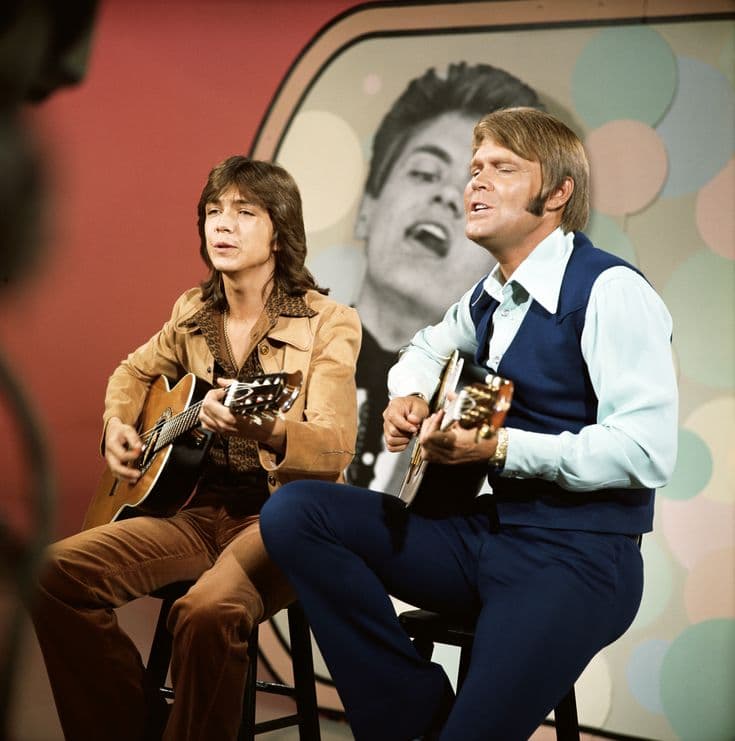
A Joyful Reunion of Rock ’n’ Roll Spirit—Two Generations Celebrating the Fire and the Hop
When Glen Campbell and David Cassidy came together to perform “Great Balls of Fire” and “At The Hop,” they were not merely revisiting two beloved rock ’n’ roll standards—they were rekindling a shared musical memory that spans generations. Though this particular duet was not released as an official charting single, the songs themselves carry remarkable chart histories and cultural weight that deserve to be remembered.
Originally recorded by Jerry Lee Lewis, “Great Balls of Fire” exploded onto the charts in 1957, reaching No. 2 on the Billboard Top 100 and becoming one of the defining anthems of early rock ’n’ roll. Its pounding piano, gospel-infused energy, and unrestrained vocal delivery symbolized a musical rebellion that was both thrilling and, at the time, controversial. Meanwhile, “At The Hop,” performed by Danny & the Juniors, climbed to No. 1 on the Billboard charts in late 1957. It captured the innocent exuberance of teenage dance culture, where gymnasiums and sock hops became sacred spaces of youthful expression.
By the time Glen Campbell—a virtuoso guitarist and one of country-pop’s most refined voices—and David Cassidy, the charming teen idol of the early 1970s, joined forces, these songs had already become timeless. Campbell, known for his work on albums like “Wichita Lineman” (1968) and “Rhinestone Cowboy” (1975), brought technical brilliance and warmth. Cassidy, whose fame soared through The Partridge Family and chart-topping hits like “Cherish” (1971), contributed a youthful nostalgia that felt both personal and universal.
Their collaboration—most notably remembered from television specials and live performances in the 1970s—was less about reinvention and more about reverence. It was a moment where two artists from slightly different eras stood side by side, honoring the roots of popular music that shaped their own careers. There is something profoundly moving in that gesture. It reminds us that music is not confined to a single moment in time; it is carried forward, lovingly, by those who understand its meaning.
What makes this pairing particularly compelling is the contrast in their artistic identities. Campbell’s smooth, controlled phrasing tempers the wild abandon of “Great Balls of Fire,” offering a more reflective interpretation without losing its spark. Cassidy, on the other hand, embraces the playful rhythm of “At The Hop,” echoing the carefree joy that first made the song a sensation. Together, they create a dialogue between intensity and innocence, between mastery and memory.
Behind these songs lies a deeper story about the evolution of popular music. The late 1950s marked a turning point when rock ’n’ roll began to challenge traditional norms, giving voice to a new generation. By revisiting these songs in the 1970s—a decade already steeped in musical experimentation—Campbell and Cassidy were, in a sense, looking back to where it all began. Their performance becomes a bridge, connecting the raw beginnings of rock with its more polished, reflective later years.
The meaning of these songs, especially when performed together, extends beyond their original themes. “Great Balls of Fire” speaks of overwhelming passion—almost uncontrollable in its intensity—while “At The Hop” celebrates communal joy and simple pleasures. When combined, they form a complete emotional picture: the fire of youth and the warmth of shared experience.
Listening to this duet today, one cannot help but feel a quiet sense of gratitude. These are not just songs; they are moments preserved in melody. And through artists like Glen Campbell and David Cassidy, those moments are given new life—gentler perhaps, but no less meaningful.
In the end, what lingers is not just the music itself, but the feeling it leaves behind—a reminder of nights filled with laughter, dance floors alive with possibility, and a time when a simple song could mean everything.