
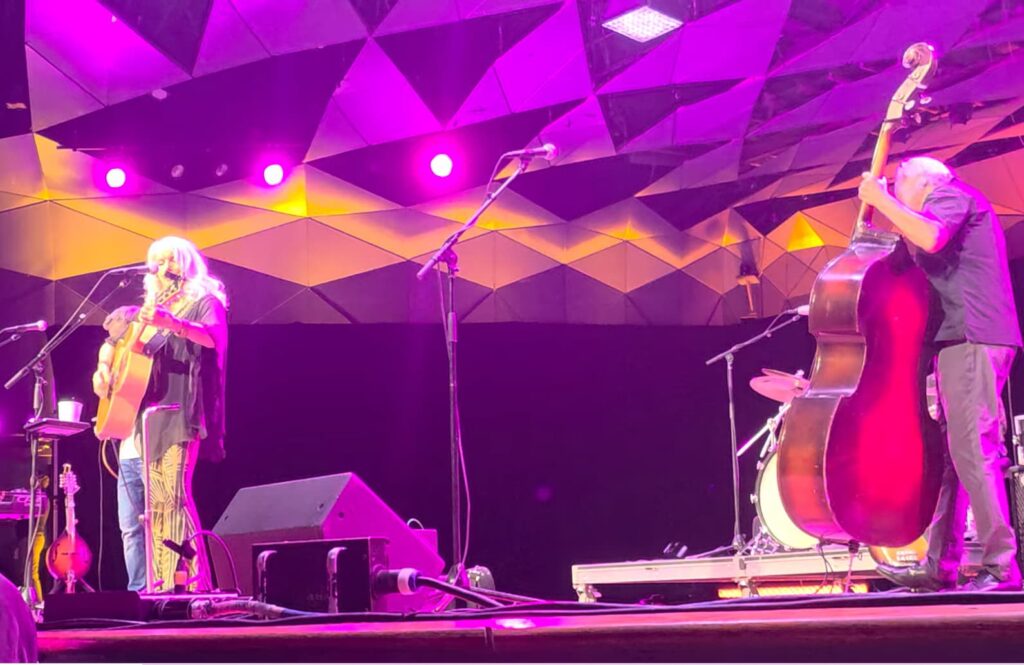
When Two Gentle Voices Met Again, Time Itself Seemed to Slow Down
Some performances are not about spectacle. They are about memory, survival, and the quiet grace of artists who have carried entire generations of songs on their shoulders. The appearance of Emmylou Harris and Graham Nash together at Tanglewood 2025 felt less like a concert moment and more like an open letter from another era — one written in harmony, weathered by time, yet still astonishingly alive.
For anyone who has followed the long and winding roads of folk-rock, country-rock, and singer-songwriter music since the late 1960s and 1970s, the sight of these two legendary voices sharing a stage carried enormous emotional weight. Tanglewood, nestled in the quiet beauty of Massachusetts, has always been a sanctuary for thoughtful music. Traditionally associated with classical performances and refined musical craftsmanship, it became the perfect setting for two artists whose careers were never built on noise or fashion, but on honesty.
By 2025, both artists represented living bridges to a musical age many listeners still hold close to their hearts. Graham Nash, first with The Hollies, then as part of Crosby, Stills & Nash and later Crosby, Stills, Nash & Young, helped define the sound of harmony-driven rock music in the late 1960s. Songs like “Teach Your Children,” “Our House,” and “Wasted on the Way” were not simply hits — they became emotional landmarks for millions of listeners navigating love, youth, idealism, and loss. Meanwhile, Emmylou Harris spent decades transforming country music into something deeply poetic and atmospheric. Emerging in the shadow of Gram Parsons, she eventually built one of the most respected careers in American roots music with albums like Pieces of the Sky (1975) and Elite Hotel (1975).
It is important to remember just how successful these artists were at their peak. “Our House” by Crosby, Stills, Nash & Young reached No. 30 on the Billboard Hot 100 in 1970, while “Teach Your Children” climbed even higher to No. 16. On the country side, Emmylou Harris scored major success throughout the 1970s and early 1980s, including No. 1 country hits such as “Together Again,” “Sweet Dreams,” and “To Know Him Is to Love Him.” Her 1975 album Elite Hotel reached No. 1 on the Billboard Top Country Albums chart and established her as one of the defining voices of country-rock’s golden era.
But statistics alone cannot explain why a performance like Tanglewood 2025 resonated so deeply. What mattered was the emotional history both artists carried into every note. These were musicians who had witnessed the rise and fall of entire musical worlds. They had outlived trends, record label empires, changing radio formats, and even many of their closest collaborators.
For Graham Nash, every harmony inevitably carries echoes of absent voices — especially David Crosby, whose passing in 2023 left an enormous silence in the history of American music. Nash has spoken openly in interviews over the years about grief, friendship, and reconciliation. Hearing him sing in 2025 was not merely nostalgic; it was profoundly human. His voice, older and softer now, carried the fragile beauty of someone who understands exactly how fleeting life can be.
And then there was Emmylou Harris — still elegant, still emotionally precise, still capable of turning even the simplest lyric into something almost sacred. Few singers in popular music have aged with such artistic dignity. Her voice no longer aims for youthful perfection; instead, it offers something rarer: emotional truth. That has always been her gift. From the beginning, she sang not to impress audiences, but to reach them quietly.
What made the pairing especially moving was how naturally their musical spirits aligned. Both artists came from traditions built on storytelling, vocal harmony, and emotional restraint. Neither needed dramatic theatrics. At Tanglewood, silence between phrases mattered just as much as the notes themselves. In an age dominated by overstimulation and instant attention, their performance reminded listeners of something almost forgotten: music can still breathe.
There is also a deeper symbolic meaning behind moments like this. Artists such as Emmylou Harris and Graham Nash belong to a generation that viewed songs as companions through life rather than disposable entertainment. Their music was played during road trips, heartbreaks, weddings, lonely nights, and uncertain mornings. Over time, the songs themselves became intertwined with personal memory. That is why audiences continue returning to these artists decades later — not simply to hear melodies, but to reconnect with earlier versions of themselves.
The beauty of Tanglewood 2025 was not that it tried to recreate the past. It did not. Instead, it acknowledged the passage of time openly and gracefully. The wrinkles in the voices, the slower tempos, the reflective atmosphere — these were not weaknesses. They were part of the story.
And perhaps that is what made the evening unforgettable.
Not because it was loud.
Not because it was historic in a commercial sense.
But because, for a little while, two voices from another century reminded everyone listening that sincerity never grows old.