
A Haunting Lullaby Wrapped in Sorrow, Mystery, and Quiet Devotion
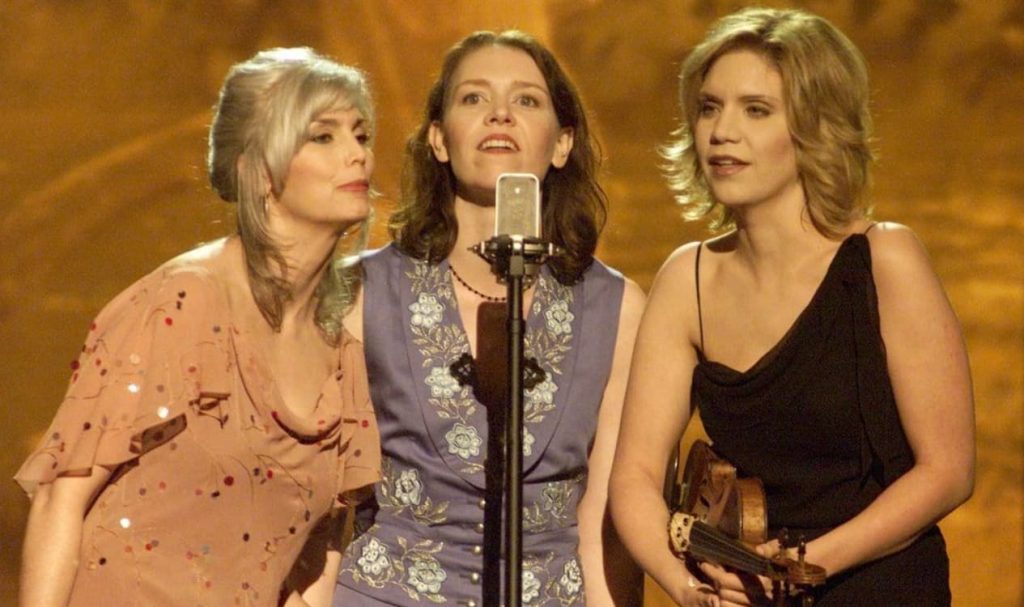
“Didn’t Leave Nobody But the Baby”, performed by Emmylou Harris, Alison Krauss, and Gillian Welch, is one of those rare songs that feels as if it has always existed—floating through time, whispered from one generation to the next. Though it never appeared on commercial singles charts, its place in music history became unmistakable the moment it appeared on the O Brother, Where Art Thou? soundtrack in 2000, a soundtrack that would go on to win Grammy Album of the Year and spark a nationwide revival of Appalachian, folk, and old-time American music.
From the very first breath, the song holds you in a soft but unshakable grasp. It is entirely a cappella, stripped of every musical comfort except the interwoven harmonies of three remarkable voices. And perhaps that is why it resonates so deeply—because it demands nothing but listening, the way one might listen to an old story told quietly by lamplight, long after the world has gone still.
The Roots of an Old Folk Ghost
“Didn’t Leave Nobody But the Baby” is built upon a traditional Southern lullaby, a fragment of American folk history that predates modern recording. Its earliest traceable versions came from field recordings of rural communities, carrying the cadence of work songs, spirituals, and lullabies sung to soothe tired children—and perhaps to soothe weary souls as well. Over the years, pieces of the song shifted and evolved, shaped by countless anonymous singers.
For the film soundtrack, Gillian Welch and producer T-Bone Burnett expanded the traditional verses, weaving them into a more cohesive narrative while preserving the stark simplicity of the original. What emerges is a lullaby that feels both ancient and eerily alive, as if it were lifted directly from the memory of the land.
A Lullaby with Shadows Beneath
At one level, the song appears tender and comforting:
“Go to sleep, you little baby…”
But listen closely, and the tenderness carries a tremble, as though hiding something unspoken. The mother is gone. The father will stay. And yet the song feels less like reassurance and more like resignation—an attempt to soothe a child in a world that has already taken too much away.
Many listeners and scholars have noted deeper undercurrents in the lyrics: hints of abandonment, themes tied to the painful realities of life in the rural American South, and even echoes of the experiences of enslaved caretakers and their borrowed children. The singer’s voice comforts the child—but also reveals a quiet sorrow of her own.
This duality—comfort wrapped in lament—is what gives the song its haunting power. It soothes, but it also unsettles. It lulls, but it also lingers.
Three Voices, Three Histories, One Spell
The performance by Emmylou Harris, Alison Krauss, and Gillian Welch is nothing short of spellbinding. Harris anchors the trio with an unusually low, earthy tone—far below the airy register she is known for. Krauss adds a delicate, crystalline grace, soft but unwavering. Welch settles between them, giving the harmony a dusky, old-world resonance.
Together, their blend feels as if it came not from a studio, but from some place older and dimmer—an attic, a riverbank, a porch at dusk.
A Song That Speaks to Memory
For many listeners, especially those who carry long lives of memory, this song strikes a deep, nostalgic chord. It recalls lullabies whispered in childhood bedrooms, stories told by elders, and the quiet, complicated emotions that linger across decades. It evokes the past not with sweetness alone, but with honesty—clear, unflinching, and human.
“Didn’t Leave Nobody But the Baby” endures because it is not simply listened to; it is felt. It is a reminder that the simplest songs can carry the heaviest histories, and that sometimes, the softest voices speak the deepest truths.