
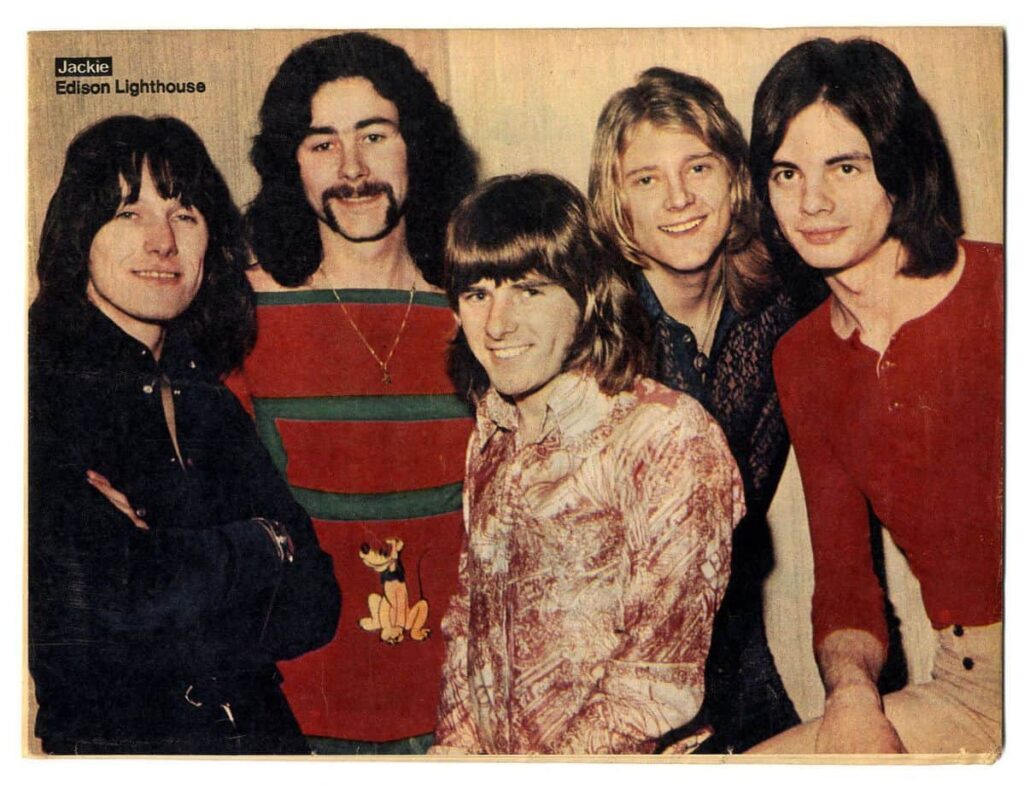
A Timeless Ode to Love and Innocence
Back in the golden age of pop, when music was still played on vinyl and you actually had to wait for your favorite song to come on the radio, there was a tune that captivated a generation with its simple, infectious charm. It was 1970, a time of bell-bottoms, vibrant colors, and a cultural shift that was both exhilarating and a little overwhelming. Amidst this whirlwind, a British band with a seemingly unassuming name, Edison Lighthouse, released a song that would forever etch itself into the annals of music history: “Love Grows (Where My Rosemary Goes)“.
The song’s journey to the top was nothing short of meteoric. Upon its release, it shot to the number one spot on the UK Singles Chart and reigned supreme for five consecutive weeks. In the United States, it enjoyed similar success, peaking at number five on the Billboard Hot 100. For a band that was essentially a one-hit wonder, this was a phenomenal achievement. The song’s success wasn’t just a flash in the pan; it was a testament to its undeniable appeal and the universal theme it celebrated.
At its core, “Love Grows (Where My Rosemary Goes)” is a simple, straightforward love song. The lyrics, penned by Tony Macaulay and Barry Mason, paint a picture of a man utterly smitten with a woman named Rosemary. The song’s main conceit is a playful, almost whimsical, declaration that love blooms wherever she goes, much like a flower following the sun. The line, “She ain’t got no money, she ain’t got no car, but she ain’t got no problem ’cause love grows where my Rosemary goes,” perfectly encapsulates the song’s carefree and optimistic spirit. It’s a reminder that true love transcends material possessions and is found in the simple presence of the person you adore.
The song’s creation, however, is a story of its own. Edison Lighthouse was never a “real” band in the traditional sense; it was a studio project, a clever creation by producer Tony Macaulay. The lead vocalist on the track was Tony Burrows, a session singer who was, at the same time, the voice behind other chart-topping hits from different “bands,” like “My Baby Loves Lovin’” by White Plains and “United We Stand” by Brotherhood of Man. It’s a fascinating peek into the music industry of that era, where the line between a genuine band and a manufactured group was often blurred.
For many who came of age in the early 70s, this song isn’t just a catchy tune; it’s a time machine. It’s the soundtrack to first dances, school discos, and long summer drives with the windows down. It evokes memories of a simpler time, a period before the digital age, where music was a shared experience that brought people together. The song’s innocence and melodic simplicity are a stark contrast to the often complex and introspective music of today. Its enduring popularity is a testament to the fact that some emotions—like the sheer joy of being in love—are timeless. Even after all these years, the opening riff and the infectious melody of “Love Grows (Where My Rosemary Goes)” can still bring a smile to your face and transport you back to a moment when the world felt a little brighter and love was the only thing that mattered.