
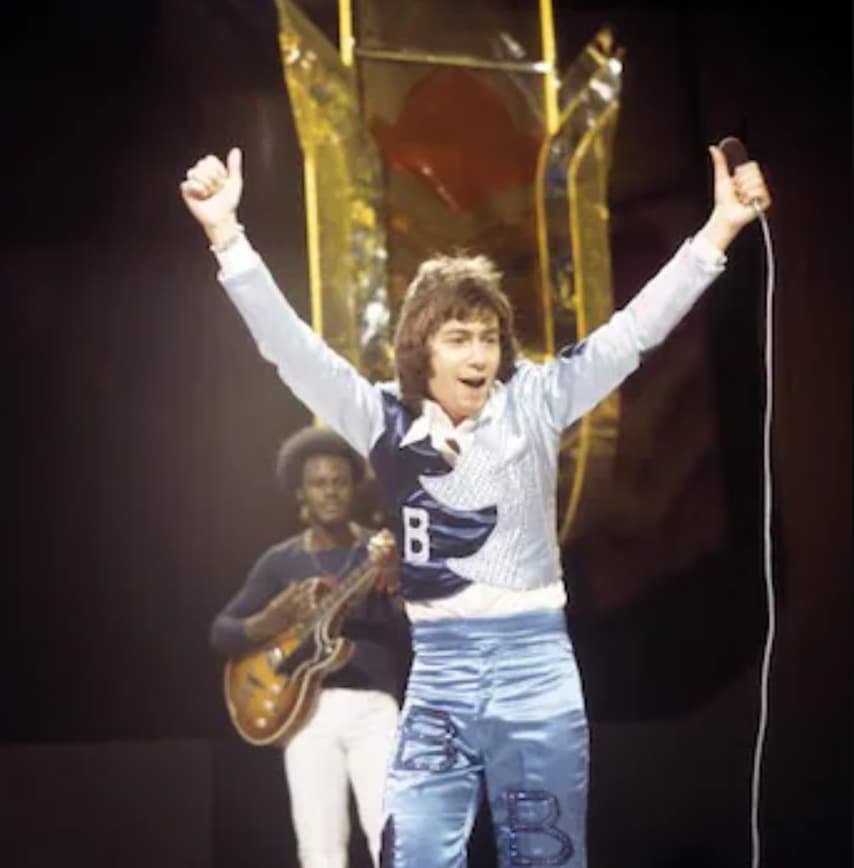
A fleeting winter dream wrapped in melody — a song that captures the quiet ache of love beneath the glow of Christmas lights
Released in 1975, “Christmas Moon” by Barry Blue never stormed the charts in the way his earlier glam-pop hits did, yet it occupies a curious, almost secretive corner of 1970s British pop. Unlike his 1973 breakthrough “Dancin’ (On a Saturday Night)”, which climbed to No. 2 on the UK Singles Chart, “Christmas Moon” did not achieve notable chart positions in either the UK or internationally. But to measure this song by chart success alone would be to misunderstand its purpose entirely. This is not a song built for the charts—it is built for memory.
By the mid-1970s, Barry Blue had already begun shifting his focus from performing to songwriting and production, later becoming a key figure behind hits for artists like Diana Ross and Bucks Fizz. In that transitional period, “Christmas Moon” feels almost like a personal postcard—intimate, reflective, and slightly removed from the glitter of glam rock that had defined his earlier career. The production is gentle, restrained, and tinged with a soft seasonal atmosphere, far removed from the stomping rhythms and flashy hooks that once made him a household name.
The song itself unfolds like a quiet winter evening. There is no bombast, no grand crescendo—only a delicate arrangement that allows the sentiment to breathe. The “Christmas moon” becomes a poetic image, symbolizing a moment suspended in time: a night when everything feels possible, yet heartbreak lingers just beneath the surface. It is not a conventional Christmas song filled with cheer or celebration. Instead, it leans into something more nuanced—the bittersweet realization that the holiday season often magnifies what is missing just as much as what is present.
Lyrically, “Christmas Moon” speaks in a language of longing and reflection. It suggests a love remembered rather than lived, a connection that perhaps once flourished under brighter lights but now exists only in recollection. There is a quiet dignity in the way Barry Blue delivers the lines—never pleading, never overreaching, but allowing the listener to fill in the emotional spaces. This restraint is precisely what gives the song its enduring power. It does not tell you how to feel; it simply opens a door and lets you walk in with your own memories.
Behind the song, there is no widely documented dramatic backstory, no scandal or grand narrative often associated with hit records of the era. And perhaps that absence is part of its charm. “Christmas Moon” feels less like a product of the music industry and more like a personal reflection set to music—a moment captured rather than manufactured. It reflects a period in Barry Blue’s life where the spotlight was beginning to shift, and with it came a more introspective artistic voice.
In the broader landscape of 1970s music, the song stands apart. While the decade was filled with bold experimentation—from the theatricality of David Bowie to the polished soul of Elton John—“Christmas Moon” chooses intimacy over spectacle. It reminds us that not every meaningful song needs to dominate the airwaves; some are meant to linger quietly, waiting to be rediscovered.
Listening to “Christmas Moon” today feels like opening an old letter—one written in careful handwriting, carrying emotions that have softened with time but never disappeared. It is a song that does not demand attention but rewards those who give it. And perhaps that is its greatest achievement: it endures not because it was everywhere, but because, for a few listeners, it became everything in a single, silent winter moment.