
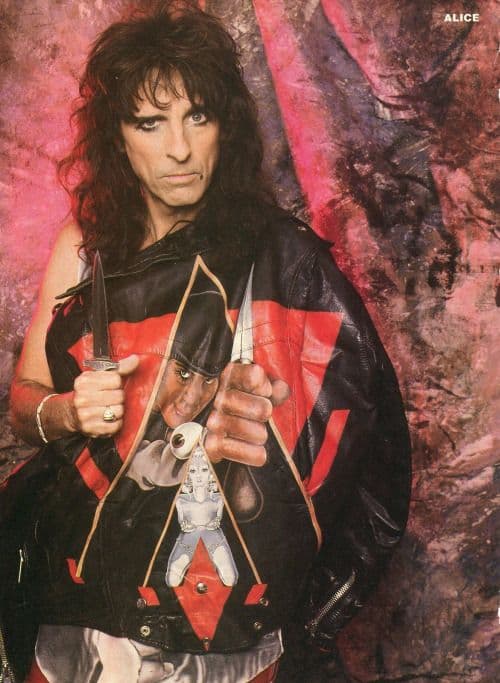
Poison — when danger became desire and hard rock learned how to seduce again
When “Poison” exploded onto the airwaves in 1989, it didn’t merely signal a comeback — it announced a rebirth. For Alice Cooper, long known as the architect of shock rock and theatrical darkness, this song marked a striking transformation: the sound of menace wrapped in melody, danger delivered with a grin, and temptation turned into a stadium-sized confession.
Right from the start, the facts matter. “Poison” was released in the summer of 1989 as the lead single from the album Trash, produced by Desmond Child, one of the era’s most influential hitmakers. The song became Alice Cooper’s biggest commercial success since the early 1970s. It climbed to No. 7 on the Billboard Hot 100 in the United States, reached No. 2 on the UK Singles Chart, and cracked the Top 10 in numerous countries around the world. For many listeners, this was their first encounter with Alice Cooper — and for others, it was a startling reminder that he had never truly gone away.
But the story behind Poison is as compelling as its chart success. By the late 1980s, Alice Cooper had already lived several musical lives. The shock-rock pioneer of the early ’70s had weathered changes in taste, personal struggles, and long stretches away from the spotlight. Trash emerged at a moment when hard rock was becoming sleeker, louder, and unapologetically glamorous. Instead of resisting the era, Cooper embraced it — without abandoning his identity.
Written by Alice Cooper, Desmond Child, and guitarist John McCurry, Poison is built on a classic rock tension: attraction versus destruction. The lyrics are simple, direct, and instantly memorable — “Your lips are venomous poison” — yet beneath that simplicity lies a familiar truth. Desire is rarely safe. Love can intoxicate, overwhelm, and undo us. Cooper doesn’t warn against temptation; he surrenders to it, fully aware of the cost.
What makes the song resonate so deeply is its perspective. This is not the voice of youthful recklessness. This is the voice of experience — someone who knows the thrill of falling too fast and the price that follows. Cooper sings not as a victim, but as a willing participant. He understands the danger, yet walks toward it anyway. There is honesty in that admission, and perhaps even wisdom.
Musically, Poison is polished but powerful. The opening bass line coils like a snake, the chorus explodes with arena-ready force, and Cooper’s voice — once snarling and theatrical — now carries a weathered confidence. He sounds comfortable in his skin, no longer needing shock for its own sake. The darkness is still there, but it’s refined, seductive, and self-aware.
For listeners who had followed Alice Cooper since his early days, Poison felt like meeting an old friend who had changed — but only grown more interesting. For those encountering him for the first time, the song opened a door to a deeper catalog, one filled with characters, cautionary tales, and sharp observations about human weakness.
And that may be the song’s lasting gift. Poison captures a moment when rock music acknowledged adulthood without losing its fire. It speaks to anyone who has ever been drawn to something they knew wasn’t good for them — and went anyway. It understands that some lessons aren’t learned through avoidance, but through experience.
Decades later, “Poison” still pulses with energy and relevance. It reminds us that reinvention is possible, that passion doesn’t fade with time, and that even danger can feel irresistible when wrapped in honesty. In the long, winding career of Alice Cooper, this song stands as proof that survival in rock and roll isn’t about staying the same — it’s about knowing exactly who you are, and daring to sing it out loud.