
A Glam Rock Anthem That Captured the Joy, Noise, and Spirit of the 1970s
Few songs explode out of the speakers with the same irresistible energy as “Tiger Feet” by Mud. Released at the very beginning of 1974, the song did not merely become a hit — it became a cultural event, a soundtrack for glitter-covered dance floors, crowded living rooms, and teenagers discovering the thrilling freedom of pop music during one of Britain’s most colorful musical eras. Even now, more than fifty years later, the opening riff still feels alive, loud, and gloriously uncomplicated in the best possible way.
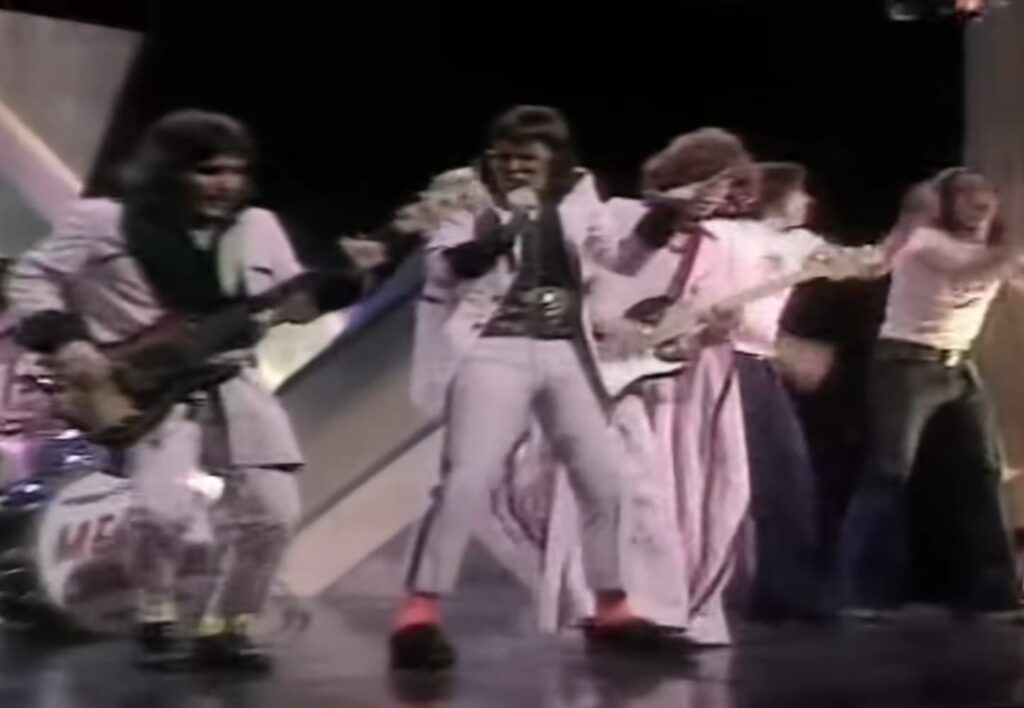
When Mud performed “Tiger Feet” live on Top of the Pops in 1974, something magical happened. The performance captured the exact heartbeat of the decade: platform boots stomping across television screens, guitars crunching with confidence, and a rhythm section so heavy and joyful that it seemed impossible to sit still while hearing it. The band looked like stars, but more importantly, they sounded like a band truly enjoying themselves. That sense of fun became contagious.
Commercially, the song was enormous. “Tiger Feet” reached No. 1 on the UK Singles Chart in January 1974, staying there for four consecutive weeks. It became the best-selling single in Britain that year, outselling many of the era’s biggest names. At the height of glam rock’s golden age — alongside artists like Suzi Quatro, Sweet, Slade, and T. Rex — Mud carved out their own identity with a sound that mixed old-fashioned rock ‘n’ roll swagger with polished pop hooks and irresistible rhythms.
The lineup of Les Gray, Rob Davis, Ray Stiles, and Dave Mount had already experienced moderate success before “Tiger Feet,” but this song changed everything. Written and produced by the legendary songwriting duo Nicky Chinn and Mike Chapman, the track was specifically designed to explode from transistor radios and television sets. Chinn and Chapman understood something many producers did not: pop music could be playful and powerful at the same time. They built “Tiger Feet” around a muscular bassline, stomping drums, handclaps, and a guitar riff that still sounds wonderfully thick and gritty today.
And that riff truly is the secret weapon.
There is something deeply satisfying about the sound of “Tiger Feet.” The bass feels enormous without becoming messy. The guitars have that crunchy glam-rock texture that somehow manages to sound both rough and polished. The drums hit hard enough to make the song feel almost rebellious, yet the melody remains cheerful and accessible. It is one of those rare records where every element fits perfectly together. Nothing feels overcomplicated. Nothing feels forced.
That may be why so many listeners continue to describe the song as emotionally uplifting. Beneath the glitter and humor, “Tiger Feet” carries a kind of unstoppable optimism. It reminds people of crowded dance halls, school discos, summer evenings, and simpler moments when music did not need to be ironic or overly serious to matter deeply. The song radiates pure movement and joy. For many listeners, hearing it again is like opening a forgotten photograph album and suddenly remembering how the world once felt.
The live Top of the Pops performance adds another layer to its legacy. In the 1970s, appearing on that program meant you had truly arrived. Families gathered around televisions together, and a performance could instantly turn musicians into household names. Watching Mud perform “Tiger Feet” during that era is not simply nostalgic because of the clothes or hairstyles — it is nostalgic because of the atmosphere. There was an innocence to pop television then, a communal excitement that feels increasingly rare today.
What makes “Tiger Feet” especially remarkable is how unpretentious it remains. The song never tries to sound intellectual or overly dramatic. It simply wants to entertain — and it succeeds brilliantly. In many ways, that honesty is exactly why it has survived. Some songs age because trends change around them, but “Tiger Feet” still works because it taps into something timeless: the simple emotional power of rhythm, melody, and shared excitement.
The late Les Gray, with his unmistakable voice and charismatic presence, played a huge role in that emotional connection. He sang with warmth rather than aggression, making the song feel welcoming rather than distant. Meanwhile, guitarist Rob Davis delivered one of glam rock’s most underrated guitar sounds — thick, crunchy, and unforgettable. Together, the band created a sound that felt larger than life without ever losing its human touch.
Listening to “Tiger Feet” today is more than revisiting a hit single. It is revisiting an era when music felt physical — when records shook the room, television performances became memories for life, and a three-minute pop song could genuinely lift someone’s spirits after a difficult day. Very few records manage to carry that kind of emotional warmth across generations.
That is why “Tiger Feet” remains far more than a glam-rock novelty. It is a celebration of energy, youth, rhythm, and togetherness. A loud, joyful reminder that sometimes the greatest songs are the ones that simply make people feel alive.