
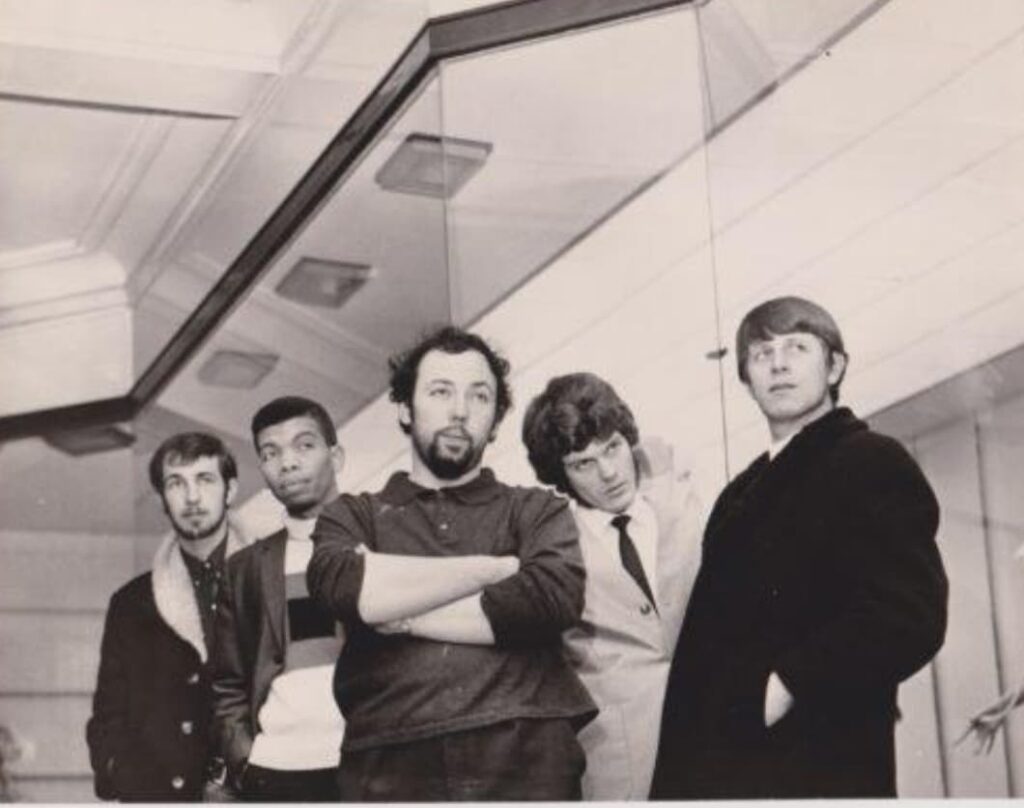
Before the fame, before the glitter of the charts, “And the Tears Came Tumbling Down” captured a young David Essex standing at the doorway of heartbreak, hope, and the uncertain dream of becoming a star.
Long before “Rock On” turned him into one of Britain’s most recognizable voices of the 1970s, David Essex was simply a young man from East London trying to find his place in a rapidly changing musical world. And somewhere in that forgotten corner of the mid-1960s lies “And the Tears Came Tumbling Down”, the very first single credited to David Essex and The Mood Indigo — a song that today feels less like a commercial release and more like an old photograph tucked inside a fading family album.
Released in 1965 on the Fontana label, the single never became a chart hit. It failed to enter the UK charts at the time of release, something that would later seem almost unbelievable considering the enormous success Essex would eventually achieve throughout the 1970s. Yet perhaps that is exactly why the song carries such emotional weight today. It belongs to a period before fame had polished his image, before television appearances and screaming crowds transformed him into a household name. This was still the sound of a young artist searching for identity.
There is something deeply touching about hearing David Essex in these early recordings. His voice had not yet developed the swagger and theatrical confidence that later defined songs like “Gonna Make You A Star” or “Hold Me Close.” Instead, on “And the Tears Came Tumbling Down,” there is vulnerability — almost innocence. The performance feels earnest, delicate, and quietly wounded, as though he were singing directly from a small club stage to a room filled with cigarette smoke and dim lights.
The song itself carries the unmistakable atmosphere of mid-1960s British pop balladry. There are traces of the dramatic orchestral style that producers loved during that era, yet underneath the arrangement is a lonely emotional core. The title alone — “And the Tears Came Tumbling Down” — already tells listeners everything they need to know. This is not a song about dramatic revenge or youthful rebellion. It is about emotional collapse after love disappears. About that silent moment after an argument when the room suddenly feels too large and too quiet.
What makes the recording especially fascinating is the story behind it. According to recollections connected to David Essex’s early years, producer and manager Derek Bowman, alongside songwriter “Bunny” Lewis, introduced the young singer to the song shortly after offering him a recording opportunity. Essex later remembered being overwhelmed when he entered a large professional studio and found himself recording alongside a full orchestra for the very first time. That memory matters because listeners can almost hear the nervous excitement in his performance. There is no cynicism here. No calculation. Only ambition mixed with fear.
And perhaps that is why the song resonates differently now than it did in 1965.
At the time, Britain was exploding with musical innovation. The Beatles, The Rolling Stones, The Kinks, and countless other groups were reshaping popular music almost monthly. In such a crowded and revolutionary era, a sentimental ballad from an unknown young singer could easily disappear into the noise. But decades later, removed from chart competition and industry pressure, the song reveals its true value. It captures a beginning.
Listening today, one can hear echoes of the artist Essex would later become. The emotional phrasing. The romantic melancholy. The instinct for storytelling. Even before stardom arrived, those qualities were already present beneath the surface.
There is also something profoundly human about artists whose first attempts fail commercially. Modern audiences often remember only the triumphs — the gold records, sold-out tours, and television appearances. Yet songs like “And the Tears Came Tumbling Down” remind us that every celebrated career begins in uncertainty. Before the applause comes silence. Before recognition comes rejection.
Ironically, the very fact that the single missed the charts has helped preserve its emotional authenticity. It remains untouched by overexposure. Unlike the larger hits that became tied to specific eras or radio nostalgia, this song still feels private, almost secretive. Discovering it today feels like uncovering a forgotten chapter in British pop history.
For longtime admirers of David Essex, the track offers something more valuable than commercial success: perspective. It allows listeners to hear the distance between the hopeful young singer of 1965 and the confident star who would later dominate the UK charts with songs like “Rock On” and “Hold Me Close.” And in that distance lies the real beauty of the recording.
Because sometimes the most moving songs are not the ones that reached Number One.
Sometimes they are the songs that quietly waited for the world to catch up with them.