
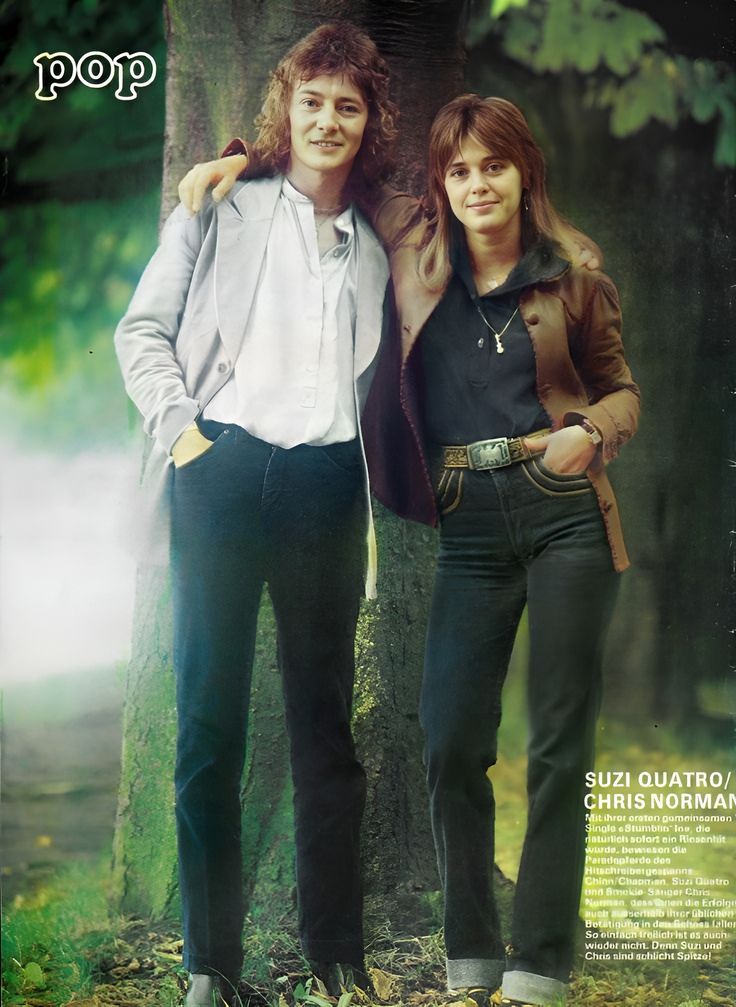
When people talk about “Stumblin’ In,” one question often comes up: why didn’t such a massive hit ever get a follow-up? The answer isn’t drama, nor failure—in fact, it’s quite the opposite. It’s because everything about it felt so right from the very beginning.
First, it’s important to understand that this wasn’t a natural artistic pairing, but rather a deliberate match crafted by producers Mike Chapman and Nicky Chinn. They recognized a compelling contrast between Suzi Quatro and Chris Norman. On one side, Quatro’s bold, edgy rock persona; on the other, Norman’s soft, emotionally rich voice. That very contrast created a love song that felt both familiar and unique. But precisely because of that, it resembled a successful experiment—one that didn’t necessarily need repeating.
At the same time, both artists belonged to different musical worlds. Suzi Quatro was deeply rooted in rebellious rock, while Chris Norman, alongside Smokie, pursued a smoother, more accessible soft rock sound. “Stumblin’ In” became a rare intersection between those two paths. Extending that collaboration might have required them to compromise their individual identities—something not easily accepted by artists at the peak of their careers.
The era itself also played a crucial role. In the 1970s, the mindset around music was very different from today. A hit song didn’t lead to sequels or expanded “universes”; instead, artists and producers quickly moved on to new projects. Success was a stepping stone, not the foundation for a continuation. So the absence of a “Stumblin’ In 2” was, in fact, completely normal for its time.
There were also practical limitations. Both artists had demanding schedules—Smokie were busy touring and releasing new hits, while Suzi Quatro continued to build her solo career. Reuniting would have required time, strategy, and motivation—factors that weren’t particularly necessary when each was already thriving in their own lane.
But perhaps the most important reason lies within the song itself. “Stumblin’ In” feels complete. It’s simple enough to be memorable, yet emotional enough to resonate deeply. A sequel wouldn’t just risk failure—it could dilute the quiet perfection of the original. Sometimes, stretching a beautiful moment too far only diminishes its meaning.
That’s why “Stumblin’ In” endures as a memory—a chance meeting that happened at exactly the right time, between exactly the right people. And sometimes, in music as in life, the things that happen only once… are the ones we remember forever.