
Four Green Fields – A Lament for a Divided Land and a Quiet Hope That Endures Beneath It
A deeply symbolic folk ballad of Ireland, “Four Green Fields” speaks in metaphor rather than politics, turning history into memory and memory into song.
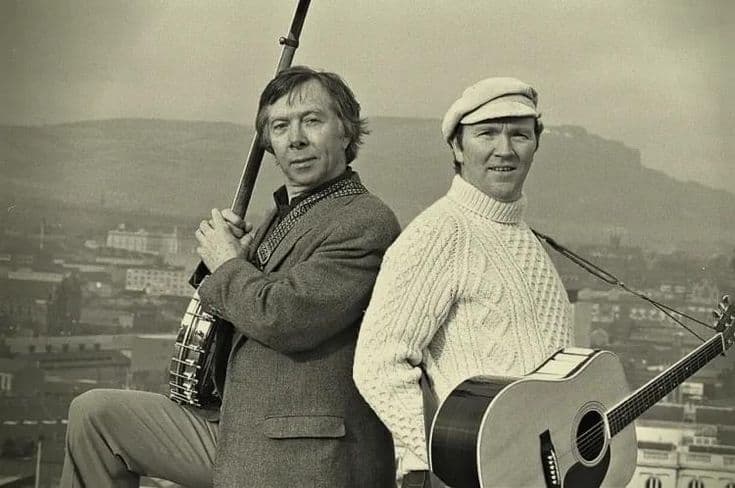
There are songs that do not ask for attention in the way modern music often does. They do not climb charts or compete for fleeting fame. Instead, they settle quietly into the cultural bloodstream, carried forward by voices that understand that some stories are too old, too tender, and too painful to be told in any other way. “Four Green Fields”, written by Irish folk songwriter Tommy Makem, is one of those rare works. Most widely associated with the performances of Makem & Clancy, it stands today not as a commercial hit, but as a lasting piece of musical storytelling rooted in Ireland’s emotional landscape.
It is important to note, with historical accuracy, that “Four Green Fields” did not chart on mainstream pop charts upon release, nor was it ever intended to compete within the commercial music industry. Instead, it emerged within the folk revival movement of the 1960s and 1970s, where songs were judged not by sales or rankings, but by how deeply they resonated in shared performance—at gatherings, on small stages, in living rooms, and among communities who recognized their own histories within its verses.
At its core, the song is an allegory for Ireland itself. The “four green fields” represent the four provinces of the island—Leinster, Munster, Connacht, and Ulster. But rather than presenting geography, the song frames them as something more intimate: a mother speaking of her children, one of whom remains taken or separated. Through this simple but powerful metaphor, Tommy Makem transforms political division into human emotion. The listener is not asked to debate history, but to feel its absence.
The story behind the song is inseparable from the broader Irish experience of partition and longing. Written during a period when cultural identity was often expressed through music rather than political discourse, “Four Green Fields” carries a restrained sorrow. It does not accuse loudly. Instead, it mourns softly, as if speaking to someone who already understands what has been lost. That restraint is precisely what gives the song its weight. It allows silence between the lines, and in that silence, listeners often find their own reflections.
When performed by Makem & Clancy, the song gains an even deeper texture. Their harmonies are unadorned, almost stark, yet rich with emotional clarity. There is no excess instrumentation to distract from the words. The storytelling is allowed to breathe. In those performances, one can sense the quiet discipline of traditional Irish folk music—where every note exists to serve memory rather than spectacle.
Lyrically, the song unfolds like an old oral tale. A mother figure tends her fields, speaking of each one with care. One field, however, remains distant—taken away across the sea. The imagery is not merely symbolic; it is pastoral, grounded in soil, wind, and land. This grounding makes the emotional message even more universal. Even listeners unfamiliar with Irish history can recognize the ache of separation, the dignity of endurance, and the fragile hope that one day wholeness might return.
Over time, “Four Green Fields” has become more than a folk song. It has become a quiet companion to reflection. It is sung not in celebration of triumph, but in acknowledgment of continuity—of how stories survive even when circumstances change. Its endurance within the folk tradition speaks to something deeper than popularity: it speaks to cultural memory itself.
There is a certain kind of music that does not age in the usual sense. Instead, it deepens. With each passing decade, “Four Green Fields” feels less like a composition and more like an inheritance—passed from voice to voice, generation to generation, carrying with it the weight of what was endured and the fragile hope of what might still be reconciled.