
A Quiet Song of First Love and Eternal Memory
A tender folk reflection on the moment love is first truly seen, “The First Time Ever I Saw Your Face” lingers like a soft echo from a more patient era of music and emotion.
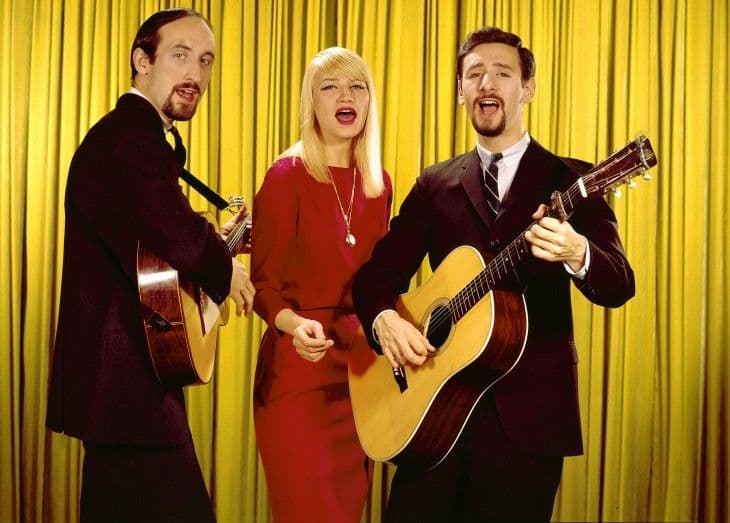
In the landscape of early 1960s folk revival, few songs carried the intimate stillness and emotional restraint of “The First Time Ever I Saw Your Face”, as performed by Peter, Paul & Mary. Their rendition did not arrive as a chart-dominating single, nor did it need to. Instead, it appeared on their 1963 album “Moving”, a record that itself reflected the trio’s deepening maturity beyond protest anthems into quieter, more introspective storytelling. Unlike their more commercially prominent hits such as “Blowin’ in the Wind,” this particular track was never issued as a major standalone single in the United States and therefore did not enter the Billboard Hot 100 upon its release in the way radio-driven singles typically did at the time.
Yet its absence from the charts at the moment of release tells only part of the story. The song itself was written by Ewan MacColl in 1957 for Peggy Seeger, and its origins already carried the weight of personal devotion rather than public performance. It was never conceived as a pop commodity, but rather as a private expression of love so intense that language itself seems to falter in its presence. When Peter, Paul & Mary recorded it, they preserved that fragile intimacy with remarkable discipline. Their harmonies—always carefully balanced, never overpowering—treat the lyric not as a performance, but as something almost overheard, like a confession spoken in low light.
What makes their version so enduring is not volume or arrangement, but restraint. In the early 1960s folk scene, where political urgency often defined artistic identity, this song moves in the opposite direction: inward, toward silence and personal memory. The trio’s interpretation gently resists drama. Instead of building toward a climactic release, it lingers in suspended feeling, as if afraid that speaking too loudly might break the emotional spell it casts.
The meaning of “The First Time Ever I Saw Your Face” is deceptively simple. It is about the overwhelming clarity of first love—the kind that reshapes perception itself. The narrator does not merely see another person; they are transformed by the act of seeing. Time slows, the world narrows, and everything once ordinary becomes newly luminous. In the hands of Peter, Paul & Mary, this experience is rendered with a quiet dignity. Their voices do not rush toward conclusion; instead, they allow each phrase to settle, like dust illuminated in a beam of late afternoon light.
While the song would later achieve global fame through Roberta Flack’s 1972 interpretation—which reached No. 1 on the Billboard Hot 100 for six weeks—the earlier folk version holds a different kind of historical weight. It represents a period when the song was still close to its original form: unadorned, contemplative, and rooted in the folk tradition of storytelling rather than spectacle. Flack’s version would reframe it as a slow-burning pop-soul masterpiece, but the earlier recording preserves the song’s original intimacy, almost like a handwritten letter before it is ever read aloud to the world.
There is also something quietly moving about how Peter, Paul & Mary approach the lyric “I saw your face in the morning sun.” In their delivery, it does not feel like metaphor—it feels like memory. Not a memory of an event, but of a feeling so precise that it continues to exist long after the moment has passed. This is where the song transcends its structure and becomes something closer to lived experience.
Today, listening to their version is like opening an old photograph album that has been handled carefully over decades. The edges are softened, the colors slightly faded, yet the emotional truth remains untouched. It is a reminder that not all songs are meant to dominate charts or define eras. Some exist simply to preserve a feeling that words alone could never fully contain.