
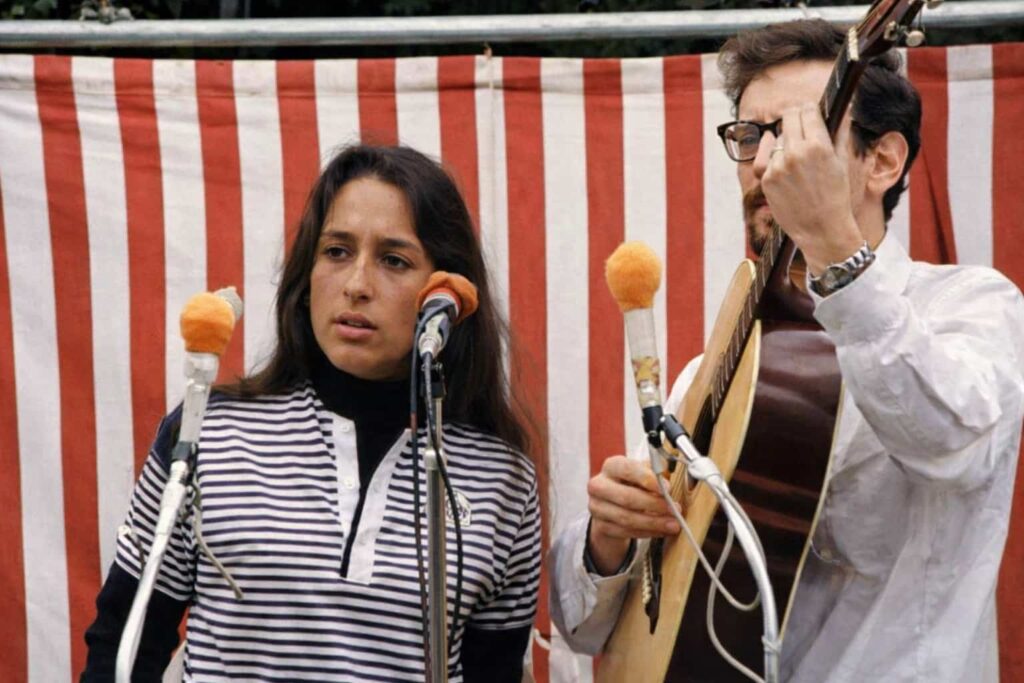
A fragile rehearsal moment that reveals the quiet humanity behind a timeless folk voice
There are recordings that achieve greatness through polish, and then there are those rare fragments that linger because of their imperfection—because they allow us to step behind the curtain and witness something profoundly human. “Go Tell Aunt Rhody (False Start)” by Joan Baez and Peter Yarrow belongs to the latter category. Though not released as a formal single and therefore absent from traditional chart rankings, this recording holds a quiet but enduring place in the emotional landscape of folk music enthusiasts.
The piece itself draws from the traditional American folk song “Go Tell Aunt Rhody,” a melody dating back to the 18th century and often associated with themes of loss and gentle mourning. When interpreted by Joan Baez, whose voice has always carried a crystalline clarity tinged with melancholy, the song takes on an almost sacred stillness. In this particular “false start” version, however, what we hear is something even more intimate: a moment interrupted, restarted, humanized.
The context of this recording traces back to the folk revival era of the late 1950s and early 1960s—a time when artists like Baez, Bob Dylan, and groups such as Peter, Paul and Mary were rediscovering and reshaping traditional songs for a modern audience. Peter Yarrow, best known as a member of that trio, often collaborated within this tight-knit community of musicians. The “false start” suggests a rehearsal or studio session rather than a polished release—perhaps a moment captured unintentionally, yet preserved because of its sincerity.
There is no grand production here, no sweeping arrangement designed to climb the charts. Instead, we hear the subtle hesitations, the gentle restart, and the quiet communication between artists who understood each other deeply. It is in these fleeting seconds that the recording gains its meaning. It reminds us that even the most revered voices in music were, at their core, searching—feeling their way through a song, just as listeners feel their way through life.
Lyrically, “Go Tell Aunt Rhody” speaks of delivering sad news, traditionally about the death of a beloved goose. While the imagery may seem simple, even quaint, it carries a deeper resonance about the inevitability of loss and the tenderness required to share it. In Baez’s interpretation, the song becomes less about the literal narrative and more about the emotional weight behind it—the quiet sorrow that accompanies every farewell, no matter how small.
The “false start” element adds an unexpected layer of meaning. It mirrors life itself: the missteps, the pauses, the need to begin again. In a world that often celebrates perfection, this recording gently insists that there is beauty in vulnerability. The slight break in continuity does not diminish the song—it enriches it, making it more relatable, more human.
For those who have followed Joan Baez throughout her career—from her early Vanguard recordings to her role as a voice of conscience during turbulent times—this piece feels like a whispered aside, a private moment shared across decades. And for admirers of Peter Yarrow, it serves as a reminder of the collaborative spirit that defined an era when music was as much about connection as it was about performance.
In the end, “Go Tell Aunt Rhody (False Start)” is not a chart-topping hit, nor was it meant to be. Its significance lies elsewhere—in the spaces between notes, in the breath before the restart, in the quiet understanding between two artists. It is a small, delicate fragment of musical history, yet it carries the weight of something much larger: the enduring truth that even in imperfection, there is profound beauty waiting to be heard.