
A Song of Peace That Echoed Through a Restless Era, Carrying Hope Beyond the Turbulence of Its Time
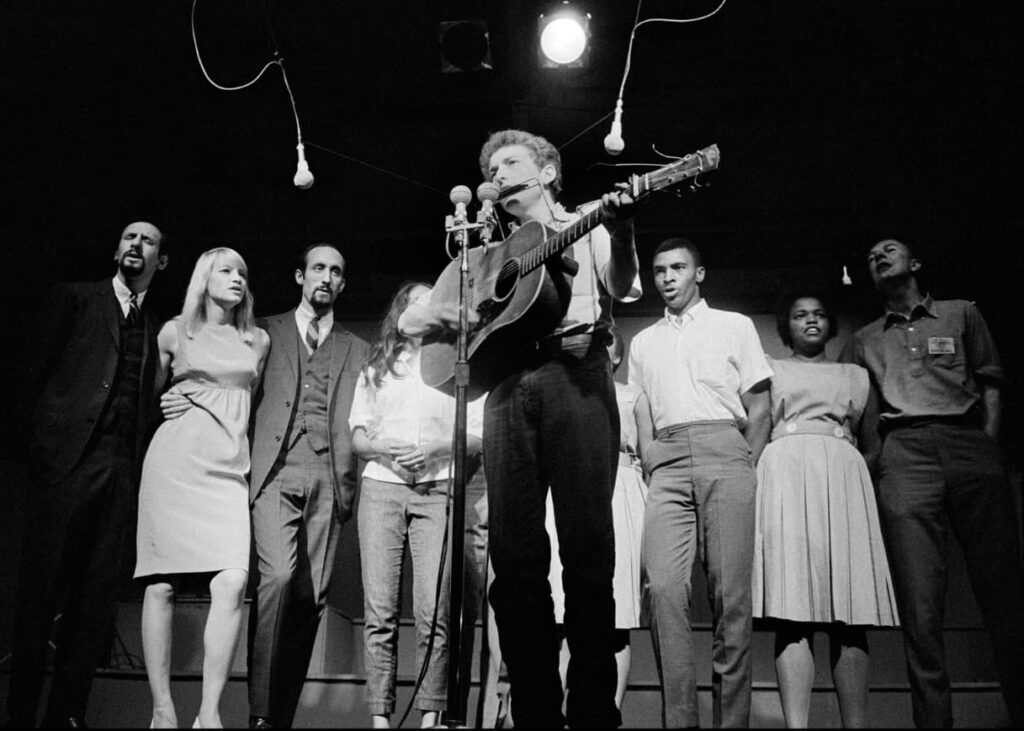
Few songs in the vast landscape of American folk music carry the quiet gravity and enduring spirit of “Down By the Riverside”. Though its roots stretch back to African American spiritual traditions of the 19th century, its revival in 1964—performed by a remarkable collective including Pete Seeger, Odetta, Joan Baez, and Peter, Paul and Mary—gave it renewed meaning in a world grappling with conflict and conscience. This was not a chart-topping single in the conventional sense; rather, it lived within the cultural bloodstream of the time, frequently performed at civil rights gatherings, peace rallies, and folk festivals. Its influence was not measured by Billboard rankings, but by the number of voices it gathered and the hearts it steadied.
The 1964 rendition is often associated with the broader folk revival movement, a period when traditional songs were rediscovered and reshaped to reflect contemporary struggles. Artists like Seeger and Baez were not merely performers—they were custodians of memory and conscience. In their hands, “Down By the Riverside” became more than a spiritual; it became a quiet protest, a gentle but firm refusal of violence. The repeated line, “I ain’t gonna study war no more,” resonated deeply in a decade overshadowed by the escalation of the Vietnam War and the ongoing fight for civil rights in America.
The story behind the song is as layered as its harmonies. Originally sung by enslaved African Americans, it carried coded messages of hope, liberation, and spiritual refuge. The “riverside” was not just a physical place—it symbolized peace, renewal, and a crossing into freedom. When these folk artists revived it in the 1960s, they were not simply preserving history; they were drawing a direct line between past suffering and present resistance. The song’s simplicity—its almost childlike melody and repetitive structure—allowed it to be sung by anyone, anywhere. It was a communal experience, not a performance meant for applause.
Listening to Pete Seeger’s banjo or Joan Baez’s clear, unwavering voice, one cannot help but feel a sense of stillness, as though time itself pauses to listen. Odetta, often called “the voice of the civil rights movement,” brought a depth and solemnity that grounded the song in its historical roots. Meanwhile, Peter, Paul and Mary added a polished harmony that made the message accessible to a wider audience, bridging the gap between traditional folk and popular music.
There is a quiet dignity in this song that speaks across generations. It does not shout, it does not accuse—it simply invites reflection. In an age where music often seeks to dazzle, “Down By the Riverside” reminds us of the power of restraint. It asks us to consider what it truly means to lay down our burdens, to step away from conflict, and to choose peace—not as an abstract ideal, but as a daily practice.
For those who remember the 1960s, this song may bring back images of candlelit vigils, open fields filled with voices in unison, and a belief—fragile yet persistent—that change was possible. For others, it offers a window into a time when music was inseparable from movement, when a simple melody could carry the weight of a generation’s hopes.
In the end, “Down By the Riverside” (1964) is not bound to its year of revival. It continues to flow, much like the river it sings of—steady, reflective, and enduring. And perhaps that is its greatest gift: a reminder that even in the most uncertain times, the human spirit can still choose harmony over discord, and peace over noise.