
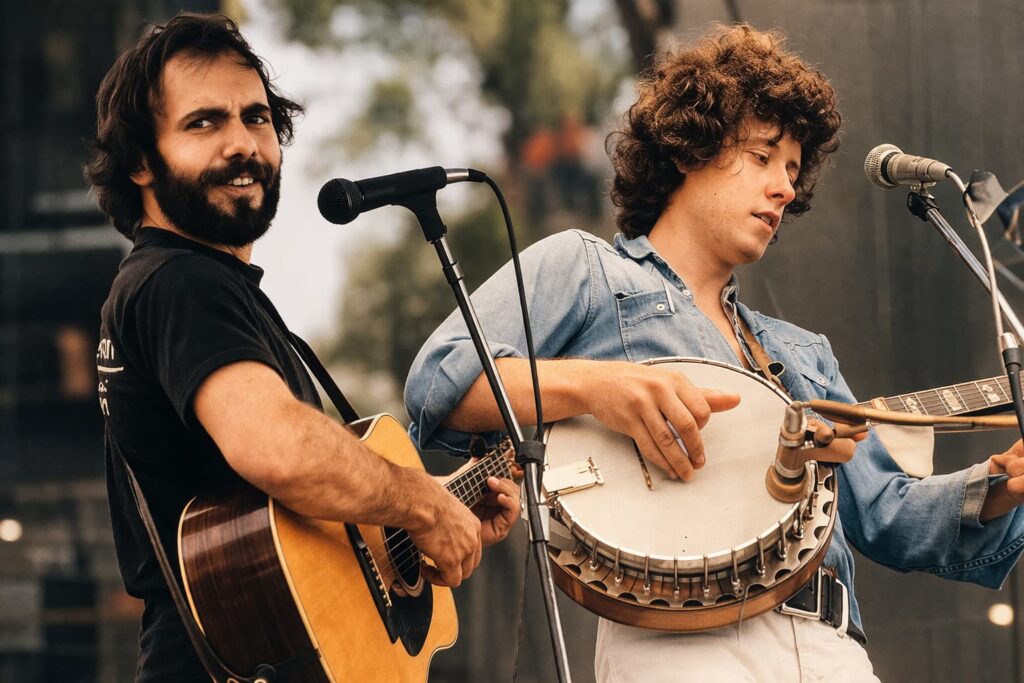
A rare gathering of storytellers—three voices, one stage, and a night where American folk memory felt alive and unbroken
There are evenings in music history that seem to exist outside of time—moments when the right artists meet, not for spectacle, but for something far more enduring: shared spirit. One such moment arrived when Arlo Guthrie, Steve Goodman, and Hoyt Axton appeared together on the celebrated television program Soundstage. Broadcast in the 1970s—a decade when folk music still carried the echoes of protest, storytelling, and hard-earned wisdom—this performance was not about chart positions or commercial triumphs, but about something deeper: authenticity.
Unlike conventional singles released for radio play, this collaboration was not tied to a specific chart debut. However, each of these artists brought with them a legacy of songs that had already found their place in the American consciousness. Arlo Guthrie, for instance, had long been associated with his iconic “Alice’s Restaurant Massacree” (1967), a sprawling anti-establishment narrative that became a Thanksgiving tradition for many listeners. Steve Goodman, though never a dominant chart figure, achieved lasting recognition with “City of New Orleans,” a song that would later reach No. 1 on the U.S. country charts through Willie Nelson in 1984. Meanwhile, Hoyt Axton enjoyed chart success with songs like “Joy to the World,” famously recorded by Three Dog Night, which topped the Billboard Hot 100 in 1971.
What made their shared appearance on Soundstage so remarkable was not competition, but camaraderie. These were men who understood the craft of songwriting as a form of lived experience. They did not merely perform songs—they inhabited them. Watching them together, one senses a quiet respect, an unspoken acknowledgment that each had walked a similar road, shaped by smoky venues, long highways, and audiences who listened not just with their ears, but with their hearts.
The story behind this gathering is, in many ways, the story of American folk music itself. By the mid-1970s, the genre had evolved from the protest-heavy early ’60s into something more reflective, more personal. The urgency of political upheaval had softened into introspection. On that stage, Guthrie, Goodman, and Axton represented different threads of that evolution—Guthrie with his inherited legacy from his father Woody Guthrie, Goodman with his poignant, almost literary songwriting, and Axton with his blend of folk, country, and a touch of rugged individualism.
There is a warmth in their performance that is difficult to replicate today. It lies in the spaces between verses, in the knowing glances, in the gentle humor that often accompanies folk storytelling. These were not polished pop stars chasing perfection; they were storytellers comfortable with imperfection, aware that truth often resides there. For listeners, especially those who remember the era, such moments evoke a powerful sense of recognition—a reminder of a time when music felt less manufactured and more lived-in.
The meaning behind this performance extends beyond any single song. It is about continuity—about how stories are passed down, reshaped, and sung again. Each artist carried his own narrative, yet on that stage, those narratives intertwined. Themes of travel, longing, humor, and resilience surfaced again and again, echoing the broader American experience. There is also, perhaps, a quiet poignancy in hindsight. Knowing the paths their lives would take—particularly the untimely passing of Steve Goodman in 1984—adds a layer of reflection to what might otherwise seem like just another televised session.
In the end, what remains is not a chart statistic, but a feeling. The Soundstage performance by Arlo Guthrie, Steve Goodman, and Hoyt Axton stands as a testament to a kind of musical honesty that resists fading. It reminds us that the most enduring songs are not always the ones that climb the highest, but the ones that stay—lingering in memory, resurfacing in quiet moments, and continuing to speak long after the final note has faded.