
A quiet meditation on memory, distance, and the fragile traces we leave behind in love and life
There is something profoundly reflective—almost literary in its emotional cadence—about “Footnotes On The Map”, a song that feels less like a conventional recording and more like a page torn from a well-worn diary. Released in 2022 as part of the album For All Our Days That Tear the Heart, the collaboration between Jessie Buckley and Bernard Butler arrived quietly, without the bombast of modern chart-chasing releases. Unsurprisingly, it did not storm mainstream charts such as the UK Singles Chart or the Billboard Hot 100, but that absence of commercial noise is precisely what grants it such enduring intimacy.
The album itself reached a respectable position on the UK Albums Chart, peaking within the Top 40, a notable achievement for a project so rooted in subtlety and emotional nuance rather than radio-friendly immediacy. Yet, numbers tell only a fraction of the story. The true success of this work lies in its ability to linger—quietly, persistently—in the listener’s inner world.
The origins of “Footnotes On The Map” are deeply intertwined with the creative partnership between Buckley and Butler. Unlike many modern studio pairings assembled by industry design, this collaboration grew organically out of mutual artistic respect. Butler, known for his work with Suede, brought with him a refined sense of melody and restraint, while Buckley—already acclaimed for her emotionally raw performances in both film and music—offered a voice that feels lived-in, almost weathered by experience. The recording process was intentionally intimate, reportedly built around minimal takes, live instrumentation, and a deliberate avoidance of overproduction. One can hear this clearly: the silences between notes matter just as much as the notes themselves.
Lyrically, the song unfolds like a series of recollections—fragmented, incomplete, yet deeply evocative. The title itself, “Footnotes On The Map,” suggests something secondary, easily overlooked, yet essential for understanding the full journey. It speaks to the small, often forgotten moments that define relationships: the places visited, the words left unsaid, the quiet departures that never quite receive closure. There is no dramatic climax here, no sweeping declaration—only a gentle, persistent ache.
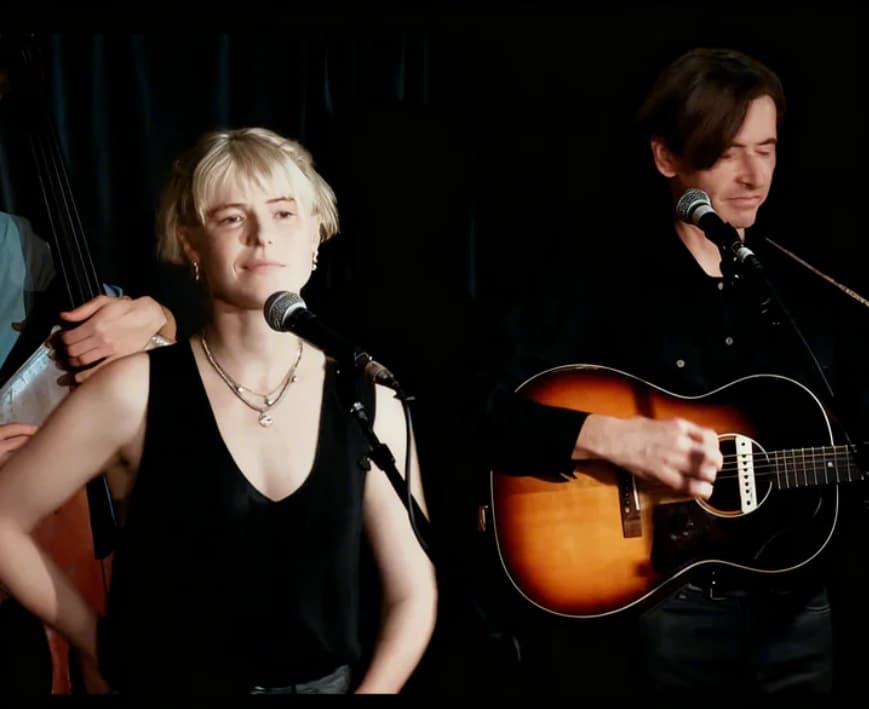
Buckley’s vocal delivery is central to this effect. She does not “perform” the song in the traditional sense; instead, she inhabits it. There is a tremor in her phrasing, a careful hesitation, as if each line carries the weight of memory. Butler’s arrangement complements this beautifully—acoustic textures, restrained guitar lines, and subtle orchestration that never intrudes, only supports. Together, they create a soundscape that feels suspended in time.
The meaning of the song, while open to interpretation, leans heavily toward themes of distance and emotional residue. It reflects on how people leave traces in one another’s lives—traces that may seem insignificant in the moment but grow in importance as time passes. It is not a song about dramatic endings, but about the quiet realization that something meaningful has slipped into the past, leaving only echoes behind.
There is also, perhaps, an undercurrent of acceptance. Not resignation, but a gentle acknowledgment that not all stories are meant to be resolved. Some remain as “footnotes”—small annotations in the broader map of one’s life. This perspective gives the song a certain maturity, a refusal to simplify complex emotions into neat conclusions.
In live settings, particularly during intimate performances in venues across the UK, the song has taken on an even more poignant character. Audiences often respond not with immediate applause, but with a kind of reflective silence—a rare and telling reaction. It is the kind of piece that asks to be felt rather than merely heard.
What makes “Footnotes On The Map” truly worth returning to is its honesty. In an era where music often seeks to amplify, dramatize, or exaggerate emotion, this song does the opposite. It whispers. It lingers. It trusts the listener to meet it halfway.
And perhaps that is why it endures—not as a chart-topping hit, but as a quiet companion for moments of reflection, when the past feels close enough to touch, and the smallest memories carry the greatest weight.