
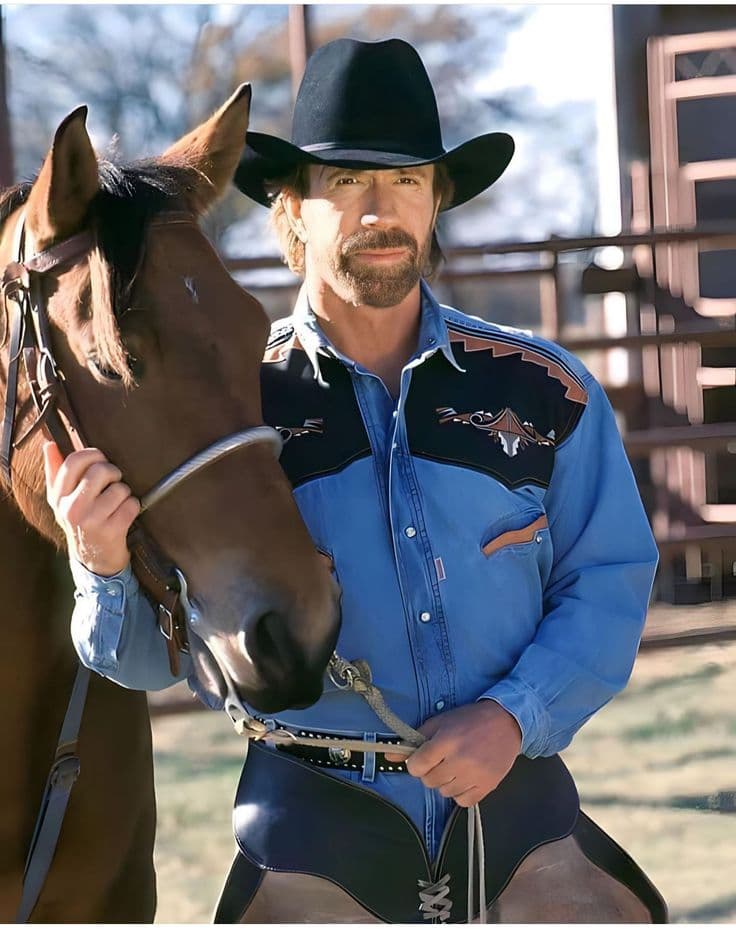
A rugged anthem of justice and quiet strength, echoing the spirit of the American frontier and a lone lawman’s unwavering code
There are themes that simply introduce a television show—and then there are themes that define it. The “Walker, Texas Ranger Theme”, closely associated with Chuck Norris and the long-running series Walker, Texas Ranger, belongs firmly to the latter category. First heard in 1993 when the show premiered on CBS, the theme—titled “Eyes of a Ranger”—was more than just an opening number; it was a mission statement, a distillation of values that resonated deeply with audiences who appreciated stories of honor, justice, and moral clarity.
Performed by Chuck Norris himself, alongside co-writer and producer Tirk Wilder, the song did not chart on mainstream outlets like the Billboard Hot 100—a reflection not of its quality, but of its context. Television themes in the 1990s rarely competed in commercial charts. Yet, its cultural footprint was undeniable. Week after week, it reached millions of households across America and beyond, embedding itself in the memory of viewers who came to associate its steady rhythm and earnest delivery with the image of Cordell Walker standing tall against wrongdoing.
Musically, “Eyes of a Ranger” is rooted in country and western traditions, with a straightforward arrangement that favors clarity over embellishment. There is a certain restraint in its composition—acoustic guitar lines, measured percussion, and a vocal delivery that feels more spoken than sung. This simplicity is its strength. Much like the character it represents, the song avoids unnecessary flourish. It speaks plainly, honestly, and with conviction.
Lyrically, the song paints a portrait of vigilance and moral duty. Lines that speak of watching over the land and standing firm against injustice evoke the archetype of the lone ranger—a figure deeply embedded in American folklore. But beyond that, there is a quiet melancholy in its tone, as if acknowledging the burden that comes with such responsibility. The “eyes of a ranger” are not only watchful; they are weary, experienced, and shaped by years of seeing both the best and worst of humanity.
The story behind the theme adds another layer of authenticity. Chuck Norris, already an established action star by the early 1990s, was not content to merely act the role. By lending his own voice to the theme, he blurred the line between performer and character. This was not a polished studio singer delivering a perfect vocal take; it was a man embodying the ethos of the role, imperfections and all. That raw sincerity is precisely what gives the song its enduring charm.
One cannot overlook the cultural environment in which the theme emerged. The early to mid-1990s were a time when television still held a certain communal power. Families gathered in living rooms, and weekly shows became shared rituals. The opening notes of “Eyes of a Ranger” signaled not just the beginning of an episode, but the continuation of a familiar, comforting narrative—one where right ultimately triumphed over wrong.
Over the years, the theme has taken on a life of its own, often revisited with a sense of nostalgia. For many, it serves as a time capsule, transporting listeners back to an era when storytelling felt more straightforward, and heroes were defined by their principles rather than their flaws. It reminds us of a period when music did not need to be complex to be meaningful; sometimes, all it required was honesty.
In the end, the “Walker, Texas Ranger Theme” stands as a testament to the power of simplicity and sincerity in music. It may not have climbed the charts or won prestigious awards, but it achieved something far more enduring—it became part of the emotional fabric of its audience. And in that quiet, steadfast way, it continues to resonate, much like the ranger whose eyes never stopped watching over the land.