
The Echo of Longing and Grace in “Angel from Montgomery”
A song that carries the weary heart of everyday life and a yearning for transcendence, sung through the ages with a voice that feels like it’s been living somewhere in our memory for decades.
When we talk about “Angel from Montgomery,” the version performed by Jessie Buckley — among many others — we are stepping into a lineage of one of the most resonant songs in American songwriting. Though Buckley herself recorded it for the Wild Rose soundtrack in 2019, the roots of the song stretch back to its original writer, John Prine, and his deeply evocative portrait of longing, weariness, and hope.
At its core, “Angel from Montgomery” is a song that never topped the pop charts in a conventional sense — it wasn’t a commercial blockbuster with a high debut position on Billboard’s Hot 100 — but it charted deeply in the consciousness of listeners and critics alike. Over the years, it has been recognized not for numeric chart dominance but for its enduring emotional impact: in 2021 it was ranked No. 350 on Rolling Stone’s “Top 500 Greatest Songs of All Time,” a testament to its timeless resonance and influence long after its original release.
Written and first recorded by John Prine for his self-titled debut album in 1971, “Angel from Montgomery” came into being not as a calculated hit, but as a reflection of life’s quiet struggles. Prine was prompted by a friend — after the success of his song “Hello in There” — to write “another song about old people,” but instead he took a different direction: writing from the perspective of a middle-aged woman who feels older than she is, standing over her dishwater with soap in her hands, yearning for something beyond her immediate, confining world.
There’s a humble genius in the structure of the lyrics — words that feel like they could have been spoken around a kitchen table rather than penned for a song. The narrator speaks of an “old man” who’s “another child that’s grown old,” of dreams like lightning that should have burned her house down years ago, and of a life that has slipped by like “a broken-down dam.” These lines are not dramatic in the theatrical sense, but deeply, painfully human. They carry a heaviness that only time and repetition can give — as though the song itself has lived a lifetime, just like the woman at its center.
The chorus — “Make me an angel that flies from Montgomery / Make me a poster of an old rodeo / Just give me one thing that I can hold on to…” — holds all of the song’s yearning in one fragile plea. It’s not merely a call for rescue; it’s a longing for meaning, for beauty, and for affirmation that life, even when it feels repetitive and worn, still matters. Montgomery, Alabama, the song’s eponymous city, resonates almost like a mythic place — both real and imagined — a symbol of escape and possibility that never quite arrives, yet somehow stays with us.
Over the decades, “Angel from Montgomery” has taken on new life through the voices of others: Bonnie Raitt’s 1974 cover for her album Streetlights brought the song into the wider public consciousness, infusing it with her soulful blues-inflected sound and turning it into one of her signature performances. That version — more than the original in some circles — became the definitive voice of the song’s emotional core for many listeners, especially in live settings where its simplicity and sincerity cut through the noise of everyday life.
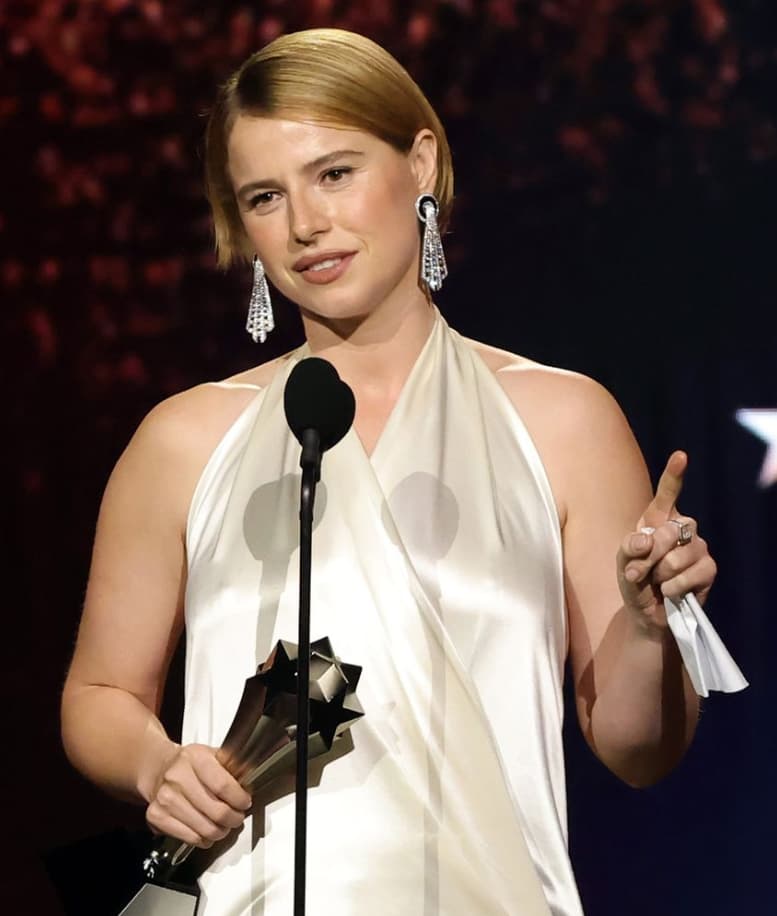
When Jessie Buckley sings it, she steps onto a long and storied stage. Her version, recorded for the Wild Rose soundtrack, honors the lineage of the song while bringing her own interpretive depth — a timbre and vulnerability that echo the original longing but now filtered through decades of listening, remembering, and living. There is a kind of grace in that: the way a song written by a young man about a fictional middle-aged woman in 1971 can still feel like it’s speaking to the depths of our own years, to lives lived in kitchens and back porches and long roads between home and nowhere.
For listeners now old enough to have watched the world outside their windows change so many times, “Angel from Montgomery” remains more than a song. It’s a mirror, a companion, a recollection of unfulfilled dreams and hard-won wisdom. It reminds us that music, at its best, does not merely entertain — it remembers us. And when the final chord fades, we find ourselves holding onto the echoes of our own stories in the quiet spaces it leaves behind.