
“Tear the Fascists Down” – A Fierce Folk Cry Against Tyranny That Echoed Far Beyond Its Time
Among the many protest songs written during the turbulent years of the early 1940s, few carry the raw moral clarity and urgency of “Tear the Fascists Down.” Written and recorded by Woody Guthrie, one of America’s most influential folk troubadours, the song stands as a blunt and unflinching declaration against authoritarianism during World War II. Though it was never a conventional chart single—folk recordings of that era rarely entered the commercial pop rankings—it became a powerful cultural statement within the American folk tradition and later among the revival audiences of the 1950s and 1960s.
The song was recorded in 1944 during Guthrie’s sessions for Moe Asch, the founder of Folkways Records, a label devoted to documenting authentic American music. These sessions produced dozens of recordings that would later form the backbone of Guthrie’s legacy. While “Tear the Fascists Down” did not appear on mainstream hit charts such as Billboard’s Best Sellers, its influence was immense among musicians, activists, and listeners who saw music as a vehicle for truth. In many ways, the song functioned less as entertainment and more as a rallying cry.
To understand the meaning of “Tear the Fascists Down,” one must first understand the man who wrote it. Woody Guthrie was not merely a singer; he was a wandering chronicler of American life. Born in 1912 in Okemah, Oklahoma, he had traveled across the country during the Great Depression, witnessing poverty, displacement, and the struggles of ordinary working people. By the time the United States entered World War II, Guthrie had already established himself as a voice for those who felt unheard.
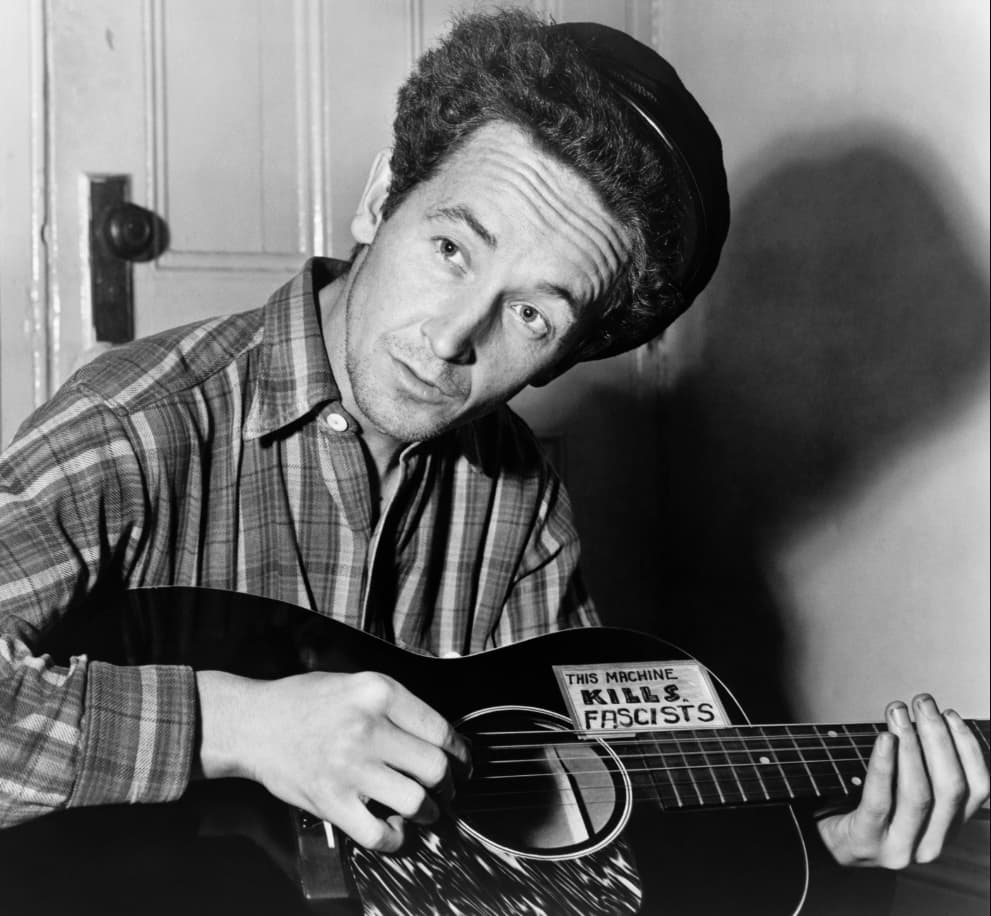
His guitar famously carried the hand-painted slogan “This Machine Kills Fascists.” It was not a threat in the literal sense, but a declaration that songs—truthful songs—could challenge oppressive ideas. “Tear the Fascists Down” was one of the clearest expressions of that belief.
Musically, the song is built on a simple folk structure. Guthrie often borrowed traditional melodies, and in this case the tune is closely related to older American folk and gospel patterns, allowing listeners to focus on the message. There is no elaborate arrangement, no studio polish—just a voice, a guitar, and a moral conviction that feels almost startling in its directness.
The lyrics name the enemies of democracy without hesitation: Adolf Hitler, Benito Mussolini, and the ideology they represented. But the song is not merely about specific leaders. Guthrie was warning about something broader—the danger of hatred, racism, and authoritarian power anywhere it appears. Lines like “We’re gonna tear the fascists down” repeat like a determined chant, giving the song the feeling of a march or collective declaration.
What makes the song particularly powerful is its sense of ordinary people standing together. Guthrie believed deeply that history was not only shaped by generals and presidents, but by workers, farmers, soldiers, and families who refused to surrender their freedoms. In that sense, “Tear the Fascists Down” belongs to the same moral universe as Guthrie’s better-known anthem “This Land Is Your Land.”
The recording sessions themselves have become part of folk legend. During the 1944 Folkways sessions, Guthrie recorded dozens of songs in a matter of days, many of them first takes. There was little money and even less concern for perfection. What mattered was capturing the spirit of the moment. Listening to “Tear the Fascists Down” today, one can almost feel the urgency of wartime America—radio bulletins, soldiers leaving for distant battlefields, and the collective determination to defeat tyranny.
In later decades, the song gained renewed attention during the American folk revival. Artists influenced by Guthrie, including Bob Dylan, Pete Seeger, and Bruce Springsteen, often spoke about how Guthrie’s songs shaped their understanding of what folk music could be. Though “Tear the Fascists Down” was not always among the most frequently performed of Guthrie’s catalog, it remained one of his most uncompromising statements.
There is also something timeless about the song’s spirit. Unlike many protest songs tied to a specific moment, Guthrie’s words feel universal. They remind listeners that democracy requires vigilance, courage, and a willingness to stand against injustice—no matter the era.
Today, “Tear the Fascists Down” is remembered not as a chart-topping hit but as a piece of musical history that captured the conscience of a generation. It reflects the voice of Woody Guthrie at his most direct: a man with a battered guitar, a simple melody, and a belief that songs could help push the world toward something better.
And perhaps that is why the song still resonates decades later. Beneath its straightforward folk chords lies a quiet but unshakable conviction—that ordinary voices, raised together in song, can confront even the darkest forces of history.